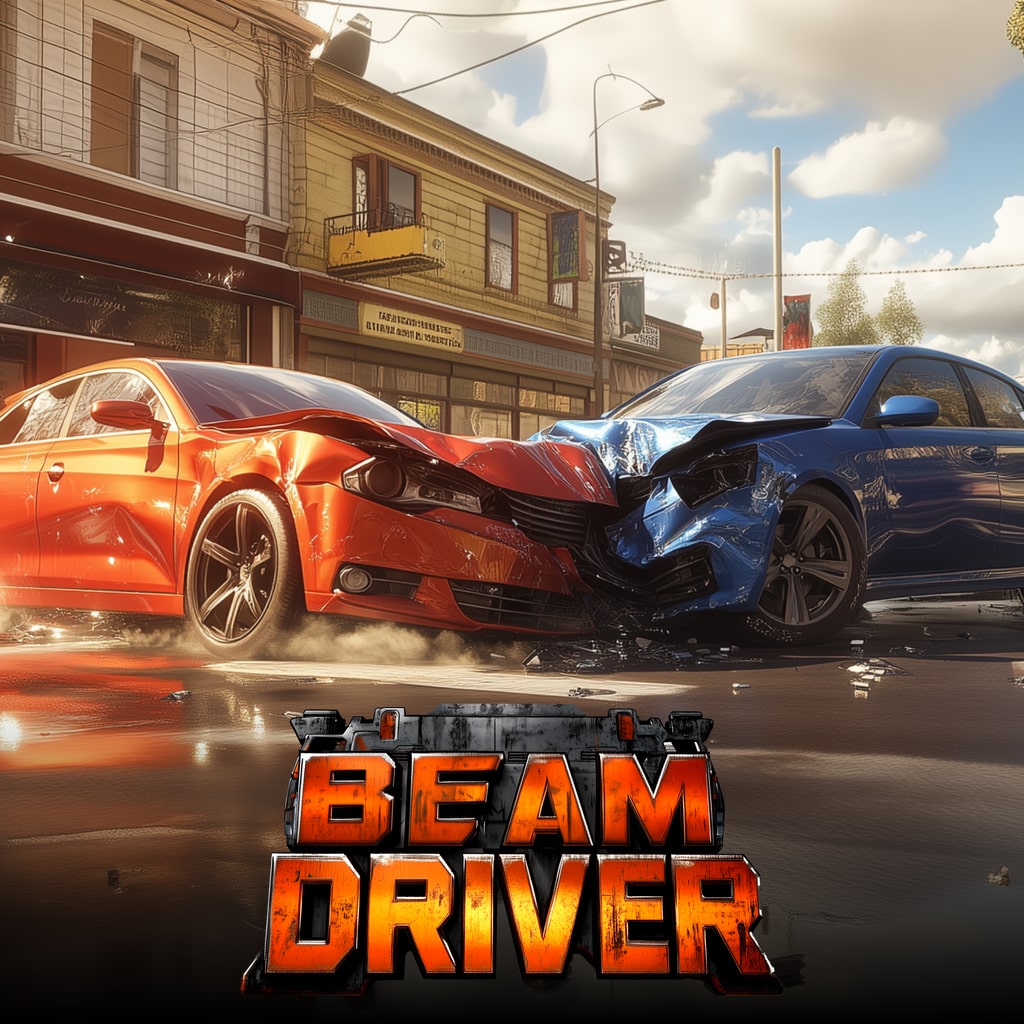
At first glance, Beam Driver (also known as Beam Driver: Impossible Car Stunts 3D) looks like something far more ambitious than it actually is. The name alone invites confusion, often mistaken for the PC simulation heavyweight BeamNG.drive. But let’s make this clear upfront: this is not a console port of that soft-body engineering sandbox.
Developed by Play Games LTD and released on PlayStation 4 on July 28, 2025, Beam Driver is an arcade-style stunt game built around mega ramps, explosive crashes, and short-burst adrenaline challenges. It is unapologetically budget-priced. It is unapologetically arcade-focused. And it leans much harder into spectacle than simulation.
The question is whether that spectacle is enough.
Not BeamNG — and That Matters
The comparison is unavoidable. The “Beam” branding and marketing references to physics naturally draw attention toward BeamNG.drive.
But Beam Driver is not a meticulous crash simulator.
It is not a sandbox engineering experiment.
It is a pick-up-and-play stunt arcade experience.
And approaching it with the right expectations makes all the difference.
This game is about launching a sports car off a kilometer-long ramp, flipping three times mid-air, slamming into a destructible tower, and watching debris scatter while the timer ticks down.
It is chaos over calculation.
The Core Loop: Go Big or Go Home
The primary gameplay loop centers around impossible mega ramps and stunt-focused tracks suspended in the sky.
You accelerate.
You launch.
You flip.
You crash.
You repeat.
There’s a surprising amount of variety within that simple structure. Some tracks emphasize clean landings and precision timing. Others push you toward reckless destruction, rewarding style points for mid-air spins and daring maneuvers.
The controls are responsive enough to feel satisfying without becoming overly technical. Steering in mid-air has an exaggerated arcade feel, giving players enough control to salvage risky jumps.
It’s not realistic.
But it’s entertaining.
Vehicle Variety: Weight Matters
Beam Driver offers a modest but welcome selection of vehicles:
- Lightweight sports cars
- Heavy SUVs
- Large cargo trucks
Each vehicle handles noticeably differently. Sports cars accelerate quickly and rotate easily mid-air, making them ideal for trick-heavy stages. Trucks feel heavy and harder to control, but their mass makes destruction challenges more satisfying.
The physics engine, while nowhere near true soft-body simulation, does give vehicles a sense of weight. Collisions feel impactful. Momentum matters. Landing poorly will punish you.
It strikes a balance between arcade accessibility and light physics authenticity.
Timed Destruction Mode: Smash and Score
One of the more enjoyable modes is Timed Destruction.
Here, the objective is simple: demolish as much of the environment as possible within a time limit.
You barrel through stacked crates, destructible towers, and obstacle courses designed to crumble under impact.
It’s cathartic.
There’s something undeniably satisfying about smashing through structures at high speed and watching the physics react.
This mode feels closer to the game’s true identity than the more technical stunt stages.
Cargo Delivery Mode: A Surprising Curveball
For players wanting a slower, more methodical experience, Cargo Delivery mode shifts focus to precision.
You must transport cargo across treacherous terrain without dropping your load.
This mode demands restraint. Hard acceleration or sloppy turns can send cargo flying.
It’s an interesting addition that breaks up the chaos of ramp launching. However, it feels somewhat underdeveloped compared to the stunt-focused content. The physics aren’t nuanced enough to create deep challenge — it’s more about patience than mastery.
Still, it adds variety.
Track Design: Spectacle First
Tracks are built for spectacle.
Sky-high platforms.
Impossible vertical ramps.
Twisting airborne pathways.
Loops suspended over empty voids.
They don’t aim for realism. They aim for visual drama.
While the environments lack detailed textures or environmental storytelling, they serve their purpose: creating jaw-dropping launch angles and high-speed set pieces.
That said, visual repetition does set in. Many tracks share similar skybox backdrops and structural aesthetics.
For a budget title, it’s acceptable.
But it won’t win awards for artistic depth.
Performance and Technical Stability
Originally launched as a PS4 title, Beam Driver runs reliably on base hardware and benefits from PS4 Pro enhancements.
On PlayStation 5 via backward compatibility, frame rates remain stable even during heavy collision moments.
Load times are improved on newer hardware, making quick restarts more seamless.
The game doesn’t push hardware boundaries, but it maintains stability during high-speed crashes — which is arguably the most important factor.
Where It Falls Short
The biggest limitation is depth.
Once the novelty of mega ramps and explosive crashes fades, progression can feel repetitive.
There’s limited customization.
No significant upgrade trees.
No deeper campaign narrative.
The physics, while fun, don’t evolve meaningfully over time.
AI opponents are minimal or absent in many modes, meaning most challenges feel isolated rather than competitive.
It’s a sandbox-lite experience without the long-term complexity of true simulation titles.
The Budget Factor
Beam Driver’s reputation on the PlayStation Store as a low-cost stunt simulator is accurate.
It is priced accordingly.
And that pricing shapes expectations.
This is not a premium racing sim.
It is not a polished AAA stunt epic.
It is a straightforward, arcade-friendly crash-and-flip playground.
Approached with those expectations, it delivers reasonable value.
Who Is It For?
- Players who enjoy impossible stunt ramps
- Fans of short-session arcade challenges
- Trophy hunters seeking accessible completion goals
- Anyone curious about physics-based crash games without simulation depth
If you’re expecting BeamNG-level realism, you will be disappointed.
If you want explosive, exaggerated stunt fun at a low price point, Beam Driver offers exactly that.
Final Verdict
Beam Driver is a simple, chaotic stunt sandbox that knows its lane.
It delivers exaggerated physics, mega ramp spectacle, and satisfying destruction in short, accessible bursts.
It lacks long-term depth and visual variety, and its simulation aspirations never extend beyond surface-level physics. But as a budget arcade stunt experience, it’s competent and occasionally exhilarating.
It won’t redefine the genre.
But it doesn’t need to.
Sometimes launching a truck off an impossible ramp is enough.