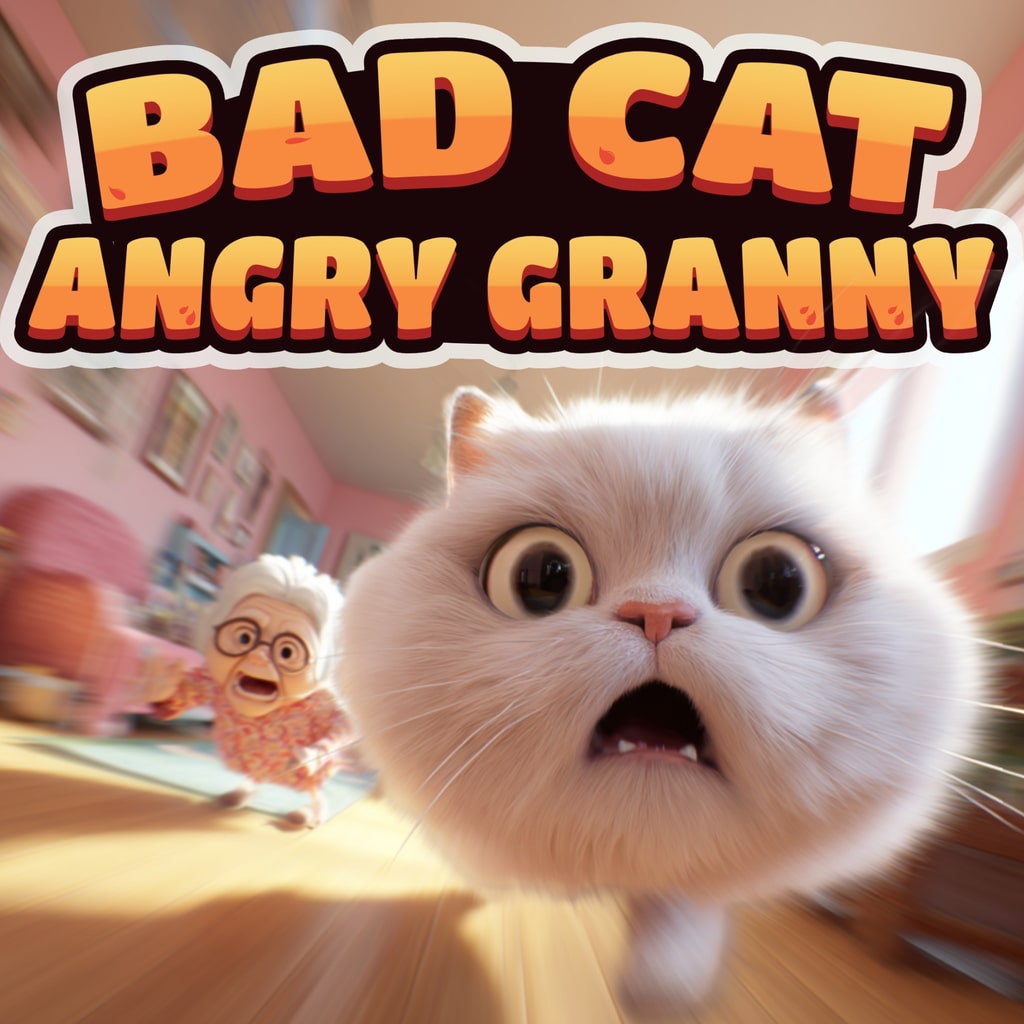
Bad Cat Angry Granny is a game that thrives on disorder. Built around a mischievous cat and an increasingly irate grandmother, it leans fully into slapstick humour, exaggerated reactions, and deliberately disruptive gameplay. It is a title that makes no attempt to disguise its mobile roots or casual ambitions, instead focusing on fast gratification, simple controls, and visual comedy. While this approach makes Bad Cat Angry Granny immediately accessible and often amusing, it also exposes the limits of its design once the novelty begins to fade.
A Premise Designed for Instant Recognition
The setup in Bad Cat Angry Granny is refreshingly straightforward. You play as a badly behaved cat whose sole purpose is to wreak havoc within a confined domestic environment, provoking increasingly angry responses from Granny. There is no narrative arc to speak of, nor does the game pretend otherwise. The entire experience is structured around cause and effect: break something, annoy Granny, escape the consequences, repeat.
This simplicity is one of the game’s strengths. Players understand the objective within seconds, and the exaggerated reactions of Granny serve as immediate feedback for player actions. The humour is broad, physical, and intentionally repetitive, clearly targeting a casual audience that values quick laughs over depth.
Core Gameplay Loop
At its core, Bad Cat Angry Granny is a light sandbox-style game built around exploration, object interaction, and evasion. Players roam small environments, knocking over furniture, smashing objects, and triggering traps, all while avoiding being caught. Granny patrols the space, responding dynamically to noise and destruction, escalating her pursuit as chaos increases.
Controls are deliberately simple. Movement is responsive, interactions are contextual, and there is little mechanical friction. This ensures the game remains approachable, even for players with minimal gaming experience. The cat’s agility — jumping, sprinting, and hiding — provides just enough mobility to keep chases entertaining without becoming mechanically demanding.
However, the gameplay loop is extremely rigid. While the environment contains a variety of objects to interact with, the underlying objective never changes. There are no meaningful alternate goals, strategic layers, or evolving systems. The challenge comes solely from avoiding capture while maximising destruction, and once players understand Granny’s behaviour patterns, tension diminishes significantly.
Enemy Behaviour and Challenge
Granny herself functions as the game’s primary obstacle. Her AI is reactive rather than complex, responding to sound cues and visual proximity. Early encounters are genuinely amusing, as her exaggerated anger animations and vocal reactions reinforce the game’s cartoon tone.
Over time, however, her behaviour becomes predictable. Players quickly learn how close they can get, how long they can remain in one area, and how easily Granny can be distracted. This predictability undermines long-term challenge, shifting the experience from playful evasion to routine exploitation.
The game attempts to offset this through escalating difficulty, usually by increasing Granny’s speed or reducing safe spaces. While this adds momentary tension, it does little to fundamentally alter how the game is played. Difficulty increases feel quantitative rather than qualitative, extending playtime without introducing new mechanics.
Visual Style and Presentation
Bad Cat Angry Granny’s visual design leans heavily into caricature. Characters are exaggerated, animations are expressive, and environments are designed for clarity rather than realism. The cat’s movements are intentionally bouncy and playful, while Granny’s animations emphasise frustration and overreaction.
This cartoon aesthetic suits the game well. It communicates tone instantly and ensures that the humour lands visually, even without dialogue. Environmental detail is modest but sufficient, with clear object silhouettes that make interactive elements easy to identify.
That said, visual variety is limited. Environments reuse assets heavily, and while new rooms or layouts appear over time, they rarely feel distinct. Extended play sessions reveal repetition quickly, reinforcing the sense that the game is designed for short bursts rather than prolonged engagement.
Audio Design and Humour
Audio plays a central role in Bad Cat Angry Granny’s identity. Granny’s vocal reactions — grunts, shouts, and exasperated noises — are deliberately exaggerated, serving as punchlines in their own right. Sound effects for breaking objects, knocking items over, and sprinting across rooms are crisp and responsive, reinforcing player actions.
Music, where present, is light and unobtrusive, designed to support the chaotic tone without demanding attention. However, the repetition of audio cues becomes noticeable over time. The same reactions and effects recur frequently, diminishing their comedic impact with repetition.
Progression and Replayability
Progression in Bad Cat Angry Granny is limited and largely cosmetic. Players unlock new environments, minor visual changes, or small variations in challenges, but these additions rarely alter the core experience. There are no deep upgrade systems, alternate playstyles, or branching paths to meaningfully extend longevity.
Replayability relies almost entirely on player tolerance for repetition and enjoyment of slapstick humour. For some, the simple pleasure of causing chaos and evading capture will be enough to justify repeated sessions. For others, the lack of evolving mechanics will lead to fatigue relatively quickly.
Importantly, the game does not overstay its welcome if approached as intended. Short play sessions suit its structure perfectly, while extended sessions expose its limitations.
Technical Performance and Accessibility
Technically, Bad Cat Angry Granny is stable and functional. Performance is smooth, load times are minimal, and controls are reliable. This consistency is critical for a game built around timing and movement, and it largely delivers on that front.
Accessibility is another strong point. The game’s systems are intuitive, instructions are minimal but sufficient, and failure carries little penalty. This makes it well-suited to a wide audience, including younger players and casual gamers.
Final Verdict
Bad Cat Angry Granny is a game that understands its audience and scope. It delivers simple, chaotic fun built around slapstick humour and accessible mechanics. In short bursts, it is genuinely entertaining, offering light-hearted mischief and visual comedy without demanding much from the player.
However, its limited depth, predictable systems, and lack of meaningful progression prevent it from achieving lasting appeal. Once the novelty wears off, repetition becomes its defining trait. As a casual distraction, it succeeds; as a fully realised game experience, it remains modest.
A playful and amusing time-waster that delivers short-term laughs, but whose shallow mechanics and repetition limit its long-term impact.