There is something wonderfully old-fashioned about stepping into a dungeon with absolutely no idea what is waiting around the next corner. Modern RPGs often make exploration feel comfortable, with generous maps, quest markers and endless guidance telling you exactly where to go next. Dungeon Of Dragon Knight REMAKE harks back to a time when getting lost was part of the adventure, when a suspicious-looking wall might hide a secret and a pressure plate could be just as frightening as the monster standing in front of you. It is a deliberate throwback to classic first-person dungeon crawlers, but thankfully it does more than simply recreate an old formula and hope nostalgia does the rest.
Developed by HexGameStudio, Dungeon Of Dragon Knight REMAKE takes the foundations of the original 2019 release and gives them a more polished presentation and a more approachable control scheme for modern players. The result is a compact fantasy adventure that understands why this particular style of RPG remains so appealing. You create a four-person party, descend into an ancient labyrinth and begin to unravel a mystery involving a stolen artefact, a forgotten Dragon Knight and a darkness that has been waiting beneath the dungeon for far too long. It is not trying to reinvent the genre, and honestly, it does not need to.
Back Into The Dungeon
The opening moments establish exactly what kind of adventure this is. You are lured into an ancient dungeon by a mysterious witch, promised an artifact and warned of something far darker waiting below. Before long, your party moves through corridors, one square at a time, checking walls, opening doors and wondering whether the next step will reveal treasure or something considerably less pleasant.
That sense of uncertainty is one of the remake’s biggest strengths. Dungeon Of Dragon Knight REMAKE does not constantly bombard you with objectives or distractions. Instead, it gives you a dungeon and expects you to pay attention. Ancient carvings, scattered letters, switches and strange environmental details all become pieces of a much larger puzzle, and there is genuine satisfaction in working out what the game wants you to notice.
The story itself is fairly traditional fantasy fare, but that suits the experience. There is a Dragon Knight, an ancient artifact, mysterious magic and a growing darkness beneath the stones. None of it is going to completely reinvent fantasy storytelling, yet the narrative works because it gives your exploration purpose without overwhelming the dungeon crawling itself. The real story is arguably told through the environment, and there is something appealing about discovering fragments of the past rather than having everything explained to you immediately.
A Party Of Four
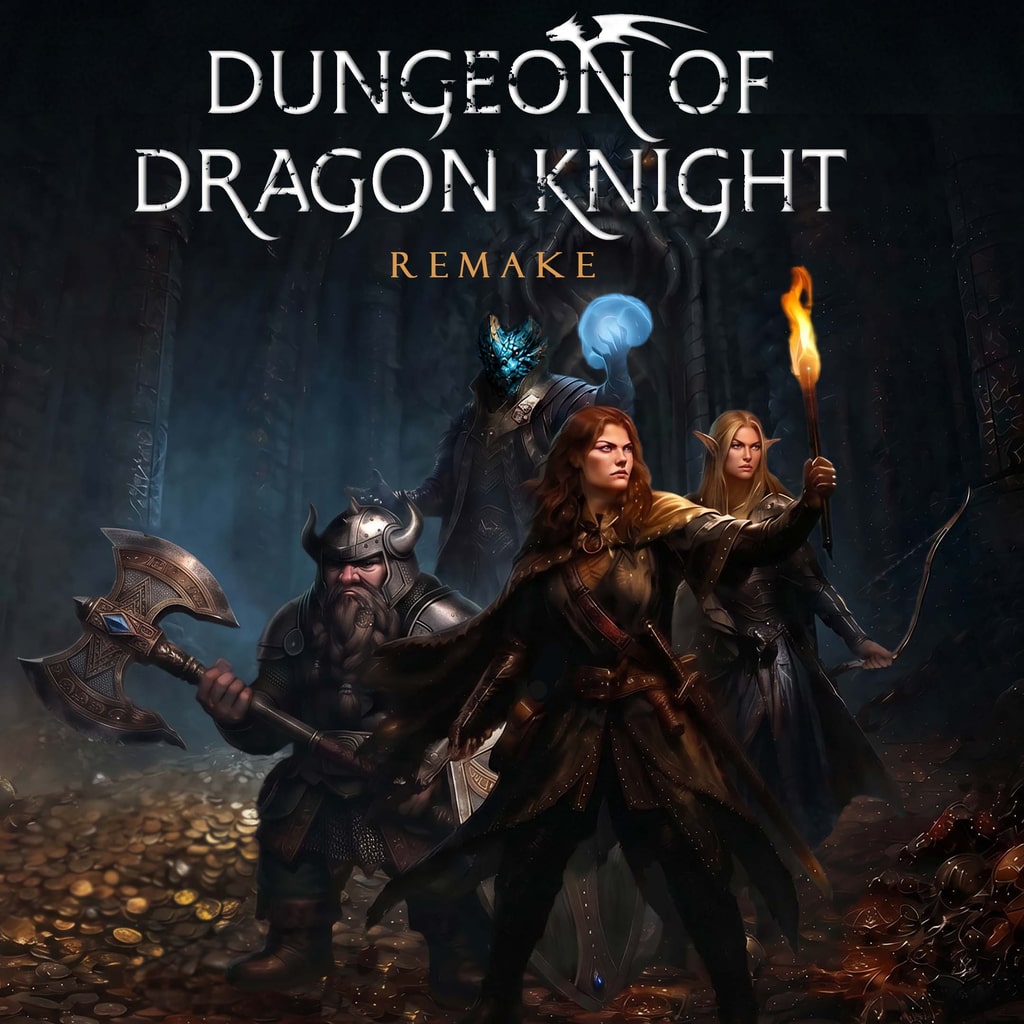
Before you can properly appreciate the dungeon, you need a party capable of surviving it. Dungeon Of Dragon Knight REMAKE lets you build a four-character team from different races and classes, with each character offering their own strengths and weaknesses. That gives the adventure a satisfying layer of traditional RPG strategy, as the composition of your group can meaningfully shape how you approach combat and exploration.
The familiar fantasy archetypes are all here in one form or another, allowing you to build a party focused on physical damage, defence, magic, or a combination of abilities. There is nothing especially revolutionary about the system, but there is something comforting about seeing these classic mechanics used in a game that is clearly in love with the old-school dungeon crawler. Building a balanced party becomes particularly important as the dungeon grows more dangerous and enemies begin hitting harder.
Progression has also been streamlined for the remake, helping prevent the experience from becoming bogged down in unnecessary systems. Rather than throwing endless layers of equipment management and merchant mechanics at you, the remake places greater emphasis on exploration, combat and discovery. That is a sensible decision because the dungeon itself is the star of the show, and anything that distracts too heavily from it risks weakening the atmosphere.
Step By Step Into Darkness
Grid-based movement is likely to be the biggest adjustment for anyone raised on modern first-person RPGs. Movement is deliberately methodical, with each step taking you to a new position on the dungeon grid. At first, it can feel restrictive, particularly if you are accustomed to freely running around enormous 3D environments, but after a while that restriction becomes part of the appeal.
There is a rhythm to exploration that works surprisingly well. Move forward, check the surroundings, inspect the walls, look for anything unusual, and then decide whether it is safe to continue. Because the dungeon is designed around this system, even a simple corridor can create tension. A dark opening ahead is not just another piece of scenery. It is a question, and the game expects you to answer it.
The puzzles strengthen this sense of engagement considerably. Dungeon Of Dragon Knight REMAKE understands that the best dungeon design is not always about throwing increasingly complicated riddles at the player. Sometimes it is simply about making you observe your surroundings. A switch hidden behind an unexpected object or a secret wall can completely change your understanding of an area, while a seemingly insignificant clue found several rooms earlier may suddenly become important.
Real Time Combat
Combat unfolds in real time, giving the traditional dungeon-crawling structure a welcome injection of urgency. When an enemy appears, there is no lengthy transition to a separate battle screen. The threat is simply there, and you need to respond. Physical attacks, spells and party abilities all have their place, and the effectiveness of your group depends heavily on how well you have prepared them.
The combat is not the deepest real-time system you will ever encounter, but it fits the game well. There is a satisfying immediacy to stepping into range, attacking and reacting to incoming damage. Magic becomes increasingly important as stronger enemies appear, while party composition and character development can make a noticeable difference in difficult encounters.
There are moments when the combat can feel a little basic, particularly when compared with modern action RPGs. This is not a game built around flashy combos or spectacular battlefield manoeuvres. Instead, it is about understanding your party, managing your resources and knowing when you are strong enough to push deeper into the dungeon. That slower pace is intentional, and players who approach it expecting Skyrim-style action are likely to find it somewhat underwhelming.
The Dungeon Is The Puzzle
What makes Dungeon Of Dragon Knight REMAKE most enjoyable is how its puzzles and exploration constantly overlap. You are not simply walking through a dungeon between combat encounters. The dungeon itself is something you have to understand. Every room can contain a clue, a trap, a secret, or a route to somewhere you could not previously reach.
This design encourages you to develop your own mental map of the environment. Even with modern conveniences, there is still a lovely feeling of gradually learning the structure of the dungeon. You begin to remember where certain doors are, which corridors you have already explored, and which suspicious-looking sections might be worth revisiting.
That old-school philosophy also means the game occasionally expects patience. Some solutions are not immediately obvious, and there can be moments when you find yourself wandering around, trying to work out what you missed. For some players, that will be frustrating. For others, it will be exactly the reason they are playing in the first place.
A Remake That Understands Its Audience
Visually, Dungeon Of Dragon Knight REMAKE sits somewhere between a modern indie RPG and a deliberate retro revival. It does not attempt to compete with the enormous budgets of today’s biggest fantasy adventures, but it provides enough atmospheric detail to make the dungeon feel like a real place. Lighting plays an important role in creating mood, particularly when exploring darker areas where visibility becomes part of the challenge.
The remake’s improvements to controls are perhaps even more important than its visual changes. Grid-based dungeon crawlers can feel awkward on modern controllers if their interfaces are not designed carefully, so the effort to make the game more comfortable with a gamepad is welcome. It makes the experience feel less like an old PC game being ported to a console and more like a genuine attempt to modernise a classic style.
The audio design also plays its part in maintaining the atmosphere. There is a subdued quality to the presentation that suits the forgotten nature of the dungeon. Rather than trying to make every encounter feel like an epic fantasy spectacle, the game often lets silence and ambience create the tension. It is another example of how restraint can work in the game’s favour.
A Love Letter To A Different Era
There is a danger that retro-inspired games become little more than collections of references. Dungeon Of Dragon Knight REMAKE avoids that trap because its mechanics are not merely pretending to be old-fashioned. They are built around the principles that made classic dungeon crawlers enjoyable in the first place.
It asks you to explore rather than simply follow instructions. It encourages you to experiment rather than constantly rewarding the obvious solution. Most importantly, it trusts the player enough to let them get lost for a while. That confidence is refreshing, especially in an era when many games are terrified that players might spend five minutes without knowing exactly what to do.
It is not flawless, of course. Combat could benefit from greater depth, and players who have little affection for grid-based movement may struggle to settle into its rhythm. The story is also more functional than groundbreaking, with familiar fantasy ideas doing much of the heavy lifting. Yet those shortcomings never completely undermine what the game is trying to accomplish.
Final Verdict
Dungeon Of Dragon Knight REMAKE is a charming reminder that dungeon crawling need not be complicated to be compelling. Its blend of grid-based exploration, real-time combat, party management and environmental puzzles creates an experience that feels comfortably rooted in the classics while making enough concessions to modern players. It is at its best when you are alone in the dungeon, staring at a suspicious wall and wondering whether something is hidden behind it.
The remake also deserves credit for understanding that atmosphere can be more important than spectacle. There are no enormous open worlds here and no endless stream of cinematic distractions. Instead, there is a dungeon, a party and a mystery waiting to be unravelled. That simplicity gives the adventure a personality of its own.
For fans of old-school first-person dungeon crawlers, this is an easy recommendation. Newcomers may need a little patience to appreciate its deliberate pace and occasionally stubborn puzzles, but those willing to meet it on its own terms will find a surprisingly rewarding adventure beneath the surface. Dungeon Of Dragon Knight REMAKE does not attempt to drag classic dungeon crawling into the future. Instead, it carefully reminds us why we enjoyed getting lost in these places in the first place.