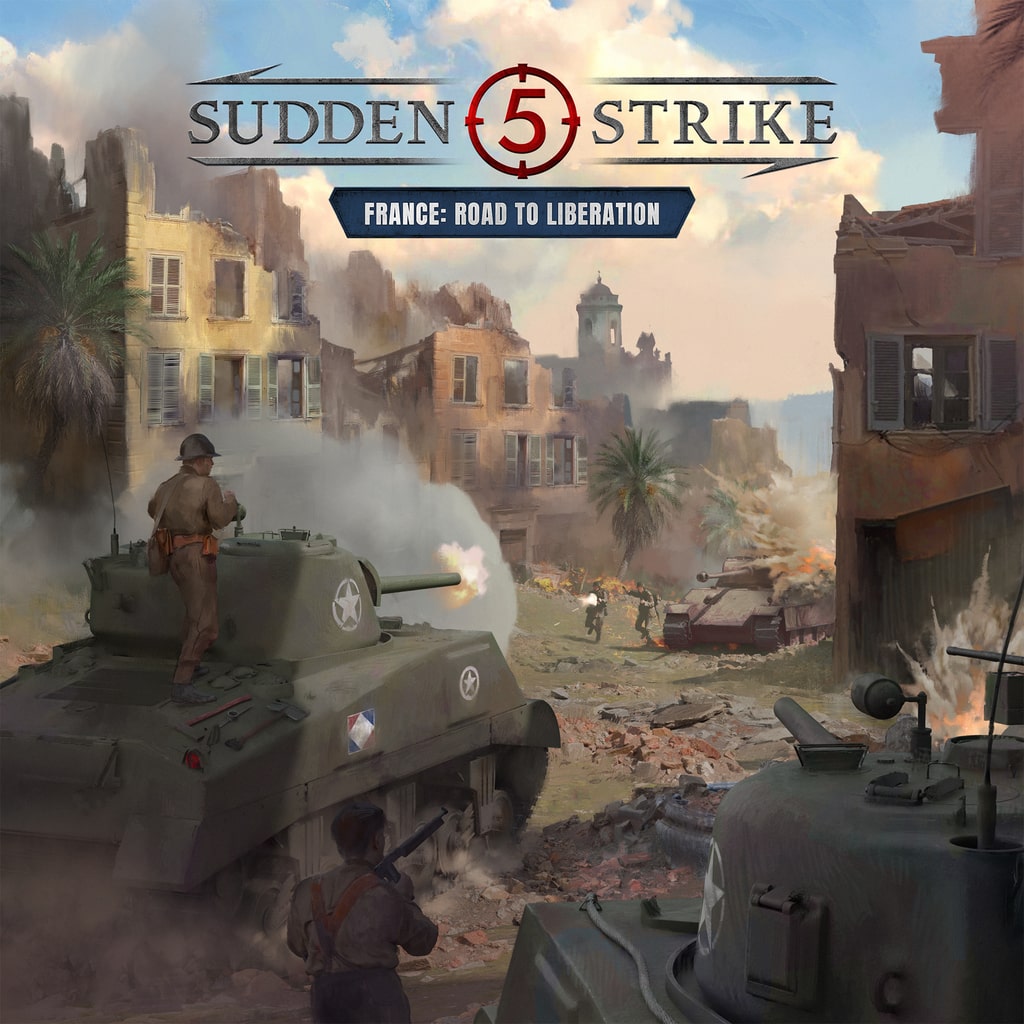
History often remembers sweeping victories, triumphant marches into liberated cities and the iconic photographs that define an era. What is sometimes forgotten are the countless tactical decisions that shaped those moments. Every bridge defended, every hillside contested and every delayed retreat could alter the course of an entire campaign. Sudden Strike 5: France: Road to Liberation shines a spotlight on one of those pivotal operations, revisiting the Allied invasion of Southern France during Operation Dragoon and reminding players that warfare is rarely black and white. It is an expansion that values careful planning over spectacle, rewarding patience, adaptability and a cool head under pressure.
Rather than simply adding more missions to an already established strategy game, Road to Liberation feels like a focused historical campaign that explores both sides of a desperate conflict. Kite Games continues to demonstrate its understanding of tactical warfare, delivering battles that demand thoughtful leadership rather than lightning-fast reflexes.
Two Perspectives on One Historic Campaign
The expansion is built around six new missions that split evenly between the Allied advance and the German withdrawal through Southern France. This dual perspective immediately gives the campaign more depth than a straightforward retelling of Operation Dragoon. Rather than presenting a single unquestionable narrative, it shows how both sides faced enormous strategic challenges despite vastly different objectives.
The Allied missions naturally focus on momentum. Landing at Camel Beach, securing Toulon, and eventually capturing Hill 300 all revolve around maintaining pressure while balancing aggression with the careful preservation of valuable units. Charging headlong into fortified positions is rarely successful. Success comes through reconnaissance, coordinated assaults, and exploiting weaknesses before the enemy has time to regroup.
The Axis campaign offers an entirely different rhythm. Rather than chasing victory through conquest, players are tasked with delaying an inevitable retreat. Every defensive line becomes precious, every sacrifice calculated. There is a genuine sense of desperation as dwindling resources are stretched across increasingly vulnerable positions. This creates surprisingly tense scenarios where survival often feels like the true victory condition.
Strategy Before Speed
Like the base game, Road to Liberation refuses to reward impatience. This is not a real-time strategy game where overwhelming production eventually solves every problem. Instead, each soldier, tank and artillery piece carries genuine value. Losing experienced units to careless positioning can have consequences that ripple throughout an entire mission.
Terrain remains one of the game’s greatest strengths. Hills provide valuable sightlines, forests conceal advancing infantry, and urban environments become deadly labyrinths where every street corner may hide an ambush. Learning to read the battlefield is every bit as important as understanding your available units.
Combined-arms tactics continue to form the backbone of every successful operation. Infantry alone cannot withstand entrenched armour, while tanks charging unsupported into narrow streets quickly become easy targets. Artillery softens hardened positions before infantry advances under covering fire, with reconnaissance constantly feeding valuable intelligence back to commanders. Every successful engagement feels like the result of careful planning rather than brute force.
New Commander, Fresh Possibilities
The introduction of French commander Jean de Lattre de Tassigny adds meaningful variety without significantly altering the game’s balance. His mobility-focused abilities encourage aggressive repositioning and flexible battlefield control rather than static defensive play. For experienced players, this creates opportunities to experiment with faster-paced tactical manoeuvres that contrast well with some of the slower, methodical operations elsewhere in the campaign.
The accompanying doctrine cards further reinforce this approach. Maquis Mobilization offers interesting options for deploying resistance forces at key moments, while Crew Vehicle Training enhances the efficiency of armoured units through improved battlefield performance. Neither mechanic feels overpowered, yet both provide fresh strategic tools that reward thoughtful application.
Perhaps most importantly, these additions integrate naturally into existing systems. They expand tactical possibilities without overwhelming returning players with unnecessary complexity.
New Units Expand Tactical Depth
The additional units introduced throughout the expansion may appear modest on paper, but each serves a worthwhile purpose. The USS Edison provides powerful naval fire support during coastal operations, creating dramatic moments when carefully timed bombardments can completely reshape the battlefield.
The German SdKfz. 302 Goliath proves equally fascinating for entirely different reasons. This remotely controlled demolition vehicle requires patience and careful positioning, but when used effectively it can devastate fortified positions or eliminate heavily defended obstacles with remarkable efficiency. It perfectly captures the experimental ingenuity that characterised many specialised wartime vehicles.
French infantry and new amphibious vehicles also enhance historical authenticity while adding tactical flexibility across several missions. Rather than introducing novelty for its own sake, every addition feels appropriately grounded within the historical setting.
Historical Authenticity Done Right
One of Sudden Strike’s greatest strengths has always been its respect for military history, and Road to Liberation continues that tradition admirably. The battlefields feel authentic without becoming sterile recreations. Locations are detailed enough to evoke their historical inspiration while remaining enjoyable strategic playgrounds.
The campaign avoids romanticising warfare. Objectives often revolve around difficult compromises rather than glorious victories. Holding a defensive position just long enough for retreating forces to escape creates emotional tension rarely found in more action-oriented strategy games. Likewise, liberating occupied territory carries genuine weight because players have witnessed the effort required to achieve those advances.
This grounded approach extends to pacing as well. Battles unfold naturally, allowing players time to assess situations, reposition forces and adapt to changing circumstances rather than constantly reacting to scripted chaos.
Presentation That Serves the Battlefield
Visually, Road to Liberation maintains the strong presentation established by the main game. Battlefields are richly detailed, with convincing environmental destruction and attractive terrain that remains easy to read even during large engagements. Explosions feel impactful without obscuring key battlefield information, preserving gameplay clarity throughout extended encounters.
Sound design deserves equal recognition. The distant rumble of artillery, the crack of rifle fire and the thunder of advancing armour combine to create an immersive battlefield atmosphere. Music remains understated for much of the campaign, allowing the sounds of combat to take centre stage while quietly reinforcing moments of mounting tension.
Performance remains consistently solid, even during larger confrontations when numerous units occupy the battlefield. That stability is particularly important in a tactics game where precision often determines success or failure.
Not Without Challenges
Road to Liberation is an excellent expansion, though it naturally assumes players already understand Sudden Strike 5’s core mechanics. Newcomers who jump straight into this campaign may initially find its demanding mission design overwhelming. The game expects players to think like battlefield commanders, not action heroes.
Some missions also lean towards lengthy engagements that require considerable patience. For strategy enthusiasts, this deliberate pacing will likely be welcomed, but players seeking quicker bursts of action may occasionally find operations stretching longer than expected.
The campaign is relatively concise at six missions, though their complexity ensures each offers substantial playtime. Quality comfortably outweighs quantity here, even if some players may wish there were additional historical scenarios to explore.
Final Verdict
Sudden Strike 5: France: Road to Liberation succeeds because it recognises that compelling military strategy rests on meaningful decisions rather than overwhelming scale. Every mission asks players to weigh risks, preserve valuable assets and adapt to evolving battlefield conditions with intelligence rather than haste.
The dual-perspective campaign provides welcome narrative balance, while new commanders, doctrine cards and historical units enrich an already robust tactical foundation. Most importantly, the expansion captures the uncertainty of warfare with remarkable accuracy. Victory rarely comes easily, and even successful operations often carry visible costs.
For existing Sudden Strike 5 players, Road to Liberation feels like a natural continuation of what the base game does well. It expands the historical scope without compromising tactical depth, delivering six carefully crafted missions that remain engaging from the opening landings to the final desperate withdrawal. It may not radically reinvent the formula, but it confidently reinforces why Sudden Strike continues to stand among the finest names in historical real-time tactics.