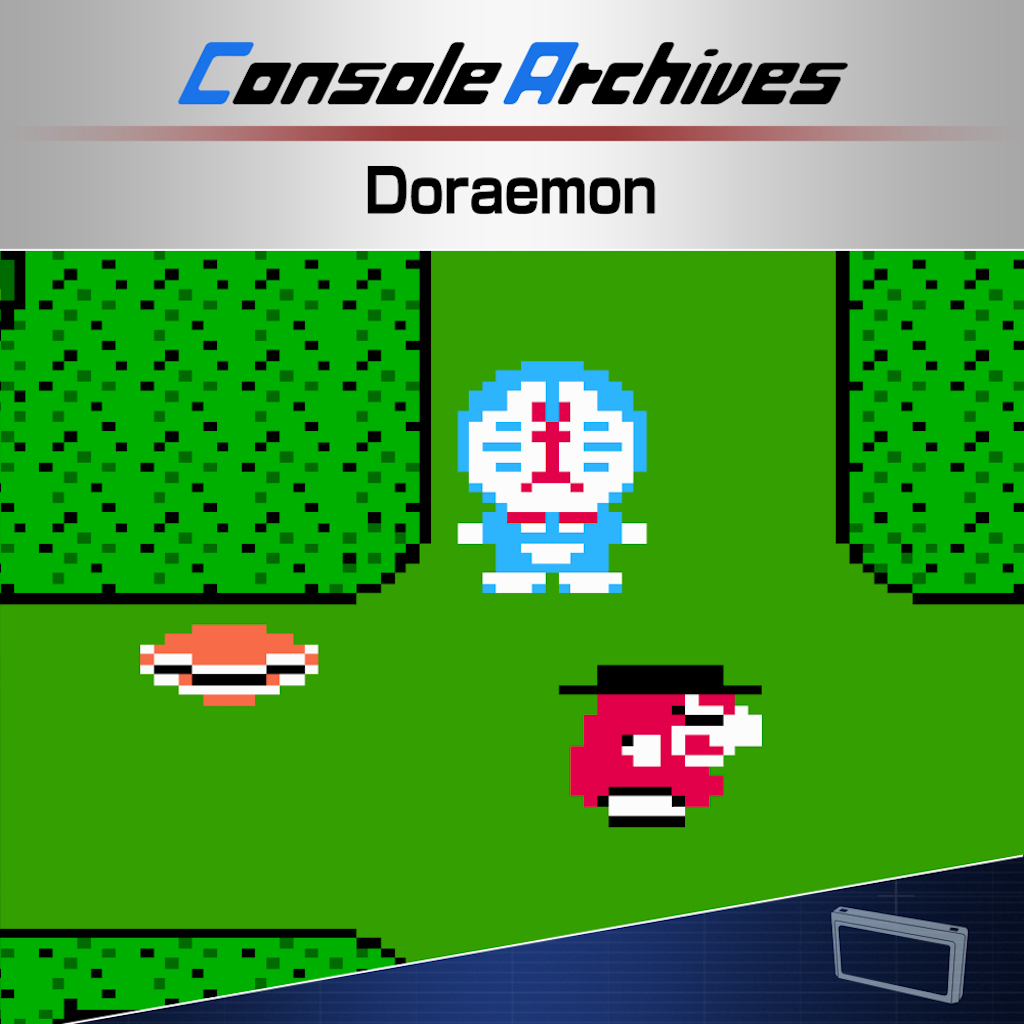
There is something wonderfully special about seeing forgotten classics finally receive the recognition they deserve. For decades, Doraemon on the Famicom remained one of those curious pieces of gaming history that many players outside Japan had only heard whispers about. Released in 1986 by Hudson Soft, it earned a reputation for doing things differently, blending several gameplay styles into a surprisingly ambitious adventure. Thanks to the Console Archives series, that adventure is finally available to a much wider audience, complete with modern conveniences that make revisiting retro games far less intimidating.
Approaching Console Archives: Doraemon today is an interesting experience. This is not a remake or remaster that attempts to modernise every aspect of the original. Instead, it preserves the game almost exactly as players would have experienced it nearly forty years ago, while adding features that respect modern expectations. Save states, button remapping and rewind functions make the experience considerably more approachable without compromising its historical authenticity.
The result is both a celebration of one of gaming’s most beloved characters and a reminder of how experimental developers were in the early days of console gaming. While some rough edges inevitably remain, an infectious charm runs through every stage, making it surprisingly easy to overlook many of its limitations.
Gameplay
One of Doraemon’s greatest strengths is that it refuses to stay in one lane for very long. Rather than presenting a straightforward platformer from beginning to end, the adventure is divided into three distinct gameplay styles. Even by today’s standards, that feels like a bold design decision, and in 1986 it was genuinely ahead of its time.
The opening chapter takes place in space and adopts a top-down action-adventure structure. Players guide Doraemon through sprawling areas, collecting items, battling enemies and gradually uncovering the route forward. Exploration is encouraged, and while progression occasionally feels cryptic by modern standards, there is genuine satisfaction in slowly piecing everything together. The map design rewards curiosity, making each discovery feel earned rather than simply handed to you.
The second world shifts gears dramatically, becoming a side-scrolling shooter. Suddenly, the slower exploration gives way to constant movement, airborne enemies and projectile-filled battles. It almost feels like stepping into an entirely different game, yet somehow the transition works because each section maintains the light-hearted spirit of the Doraemon universe.
Finally, the underwater chapter introduces a maze-driven adventure built around careful navigation and observation. It is arguably the slowest portion of the game, but it also delivers some of its most thoughtful moments as players search for hidden paths while avoiding increasingly dangerous enemies. Each world brings enough mechanical variety that the adventure never settles into repetition.
Combat remains simple throughout. Enemies are relatively straightforward to defeat once their patterns are familiar, though bosses require slightly more patience and positioning. Difficulty can occasionally spike unexpectedly, particularly for newcomers unfamiliar with classic 8-bit design philosophies, but modern save features mitigate much of the frustration.
Doraemon’s famous Secret Gadgets play a major role throughout the journey. Fans of the manga and anime will instantly recognise many of these iconic inventions, while newcomers will simply appreciate them as inventive gameplay tools. Rather than existing purely for fan service, the gadgets genuinely contribute to exploration and progression, helping the game establish its own identity beyond simply starring a popular character.
A Time Capsule Worth Preserving
Playing Console Archives: Doraemon feels remarkably close to opening a gaming museum exhibit you are actually allowed to touch. Every sprite, every sound effect and every design decision reflects an era when developers were still discovering what home consoles could accomplish.
Visually, the game remains charming despite obvious technical limitations. Character sprites are expressive enough to convey personality with only a handful of pixels, while each world has its own distinct identity. The space environments, haunted landscapes and underwater ruins all possess surprisingly memorable visual themes, considering the modest hardware they originally ran on.
Animation is understandably basic compared to modern releases, but there is an undeniable warmth to the presentation. It never tries to impress through technical spectacle. Instead, it relies on colourful environments and instantly recognisable character designs to carry the experience, and that timeless simplicity still works remarkably well today.
The soundtrack also deserves recognition. Like many memorable Famicom titles, the music makes excellent use of limited hardware. Individual tracks quickly lodge themselves in your memory, providing energetic accompaniment without becoming repetitive during longer play sessions. The sound effects are equally nostalgic, transporting veteran players straight back to the mid-1980s while offering newcomers an authentic glimpse into gaming’s formative years.
Modern Features Make All the Difference
Had Console Archives: Doraemon been released without any quality-of-life improvements, recommending it would have been far more difficult. Thankfully, the emulation package supplied here dramatically improves accessibility while respecting the integrity of the original game.
Save states alone transform the experience. Older games often expected players to repeat large sections after every mistake, something modern audiences understandably have far less patience for. Being able to save virtually anywhere removes unnecessary frustration and allows players to appreciate the game’s design rather than simply enduring its harsher limitations.
The rewind feature proves equally valuable during particularly demanding sections. Instead of replaying entire stages after a mistimed jump or a careless mistake, players can simply rewind a few seconds and continue. Purists may choose to ignore these options entirely, but having them available makes the game significantly more welcoming.
Customisable controls and screen display options further enhance the package. Whether players prefer crisp modern visuals or simulated CRT filters that recreate the appearance of vintage televisions, the presentation can be adjusted to suit personal taste. These additions demonstrate genuine care for preservation rather than simple emulation.
Nostalgia Meets Modern Expectations
The biggest question surrounding any retro re-release is whether the game still holds up decades later. In Doraemon’s case, the answer is mostly yes, though with important caveats.
Players raised on contemporary design will likely notice moments when progression feels obscure. The game rarely explains itself in detail, often expecting experimentation and persistence rather than explicit tutorials. Objectives occasionally become unclear, and certain solutions require the sort of trial and error that was commonplace in the 1980s but feels less satisfying today.
The controls also show their age at times. Character movement lacks the precision modern players have grown accustomed to, particularly during platforming and action-heavy sequences. These shortcomings never completely derail the experience, but they do remind you exactly when this adventure was originally created.
Yet these imperfections are part of its historical identity. Console Archives: Doraemon is not trying to disguise its age. Instead, it proudly presents an influential piece of gaming history with just enough modern support to make it enjoyable rather than exhausting.
Final Verdict
Console Archives: Doraemon is far more than a nostalgic curiosity. It is a fascinating snapshot of an era when developers happily experimented with genre-blending long before it became fashionable. By combining exploration, shooting and puzzle-driven navigation into a single cohesive adventure, Hudson Soft created something that still feels refreshingly unpredictable nearly four decades later.
The excellent Console Archives presentation ensures those strengths shine brighter than ever. Modern conveniences remove much of the frustration associated with classic gaming while preserving the original experience almost entirely intact. Longtime Doraemon fans will finally have the opportunity to enjoy an important chapter in the character’s gaming history, while retro enthusiasts gain access to a fascinating title that has remained frustratingly inaccessible for years.
It will not convert every modern player into a retro enthusiast, and some dated design choices remain impossible to ignore. Even so, this thoughtful preservation effort reminds us why revisiting gaming’s past continues to matter. Some classics earn their reputation through nostalgia alone. Doraemon earns it by still offering an adventure that surprises you at every turn.