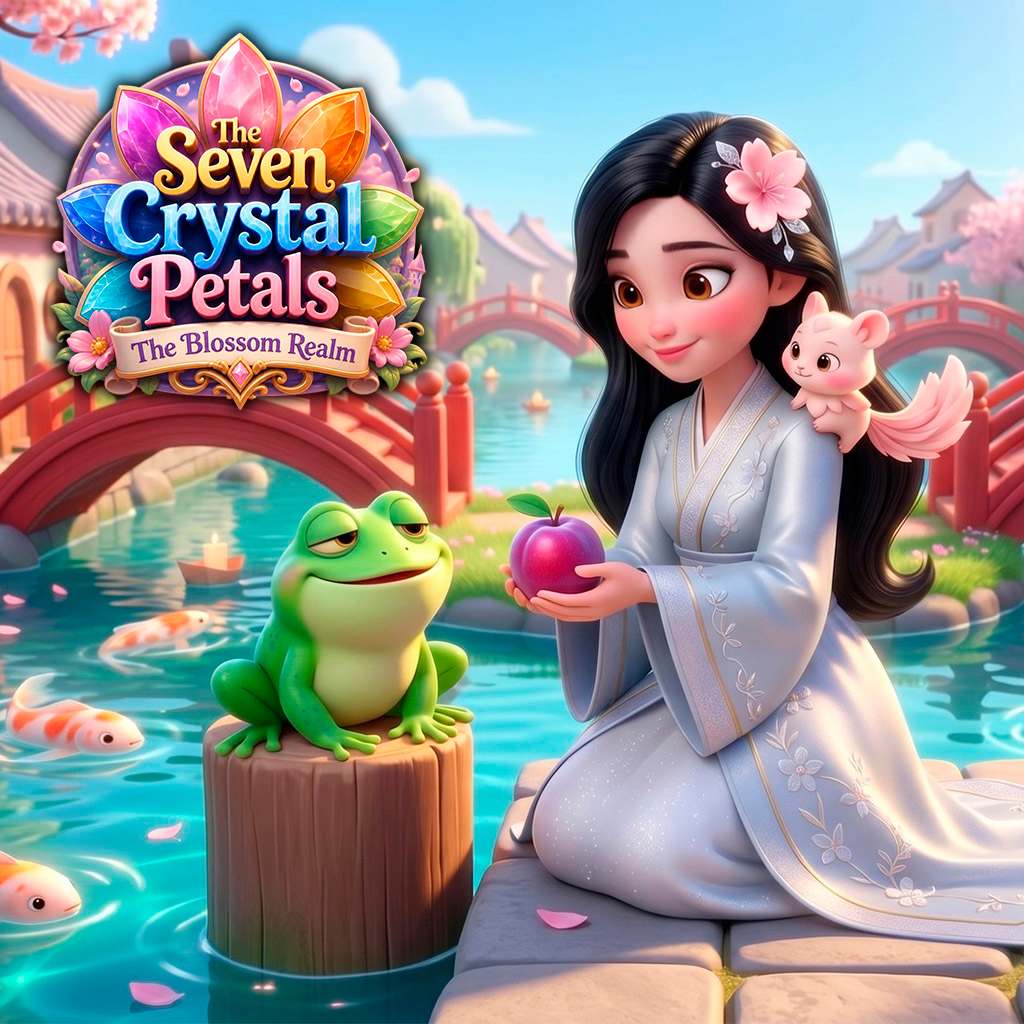
Not every game needs monsters to slay, kingdoms to conquer, or impossible odds to overcome. Sometimes the greatest adventure begins with something as simple as stepping outside your comfort zone. The Seven Crystal Petals: The Blossom Realm understands this from its very first moments, telling a story in which kindness matters more than combat and empathy carries far more weight than any magical sword ever could.
At first glance, it resembles a digital bedtime story brought to life. Colourful artwork, a cheerful fantasy setting, and an unmistakably wholesome tone make it immediately inviting. Yet beneath its gentle exterior lies a story about self-belief, responsibility, and the realisation that courage isn’t always loud. Princess Yumi isn’t a fearless warrior destined to save the world by strength alone. Instead, she’s an uncertain young ruler who gradually learns that leadership begins with compassion.
That approach won’t appeal to everyone. Players expecting traditional adventure mechanics or interactive gameplay may find themselves wishing for more to do. However, for those prepared to treat The Seven Crystal Petals as an illustrated storybook rather than a conventional game, there is plenty of warmth to enjoy.
Gameplay
Calling The Seven Crystal Petals a game in the traditional sense feels slightly misleading. It sits much closer to an interactive storybook or visual novel than to a typical adventure title. The experience centres on reading, progressing through dialogue, and watching Princess Yumi’s journey unfold across more than ten chapters.
Interaction remains deliberately light throughout. Players advance conversations, admire the accompanying illustrations, and occasionally influence the narrative’s pacing, but this is very much a story first and foremost. Rather than testing reflexes or puzzle-solving abilities, it encourages players to settle in and become immersed in the world.
There’s something refreshing about that simplicity. Modern games often feel determined to keep players constantly occupied with collectibles, skill trees, crafting systems, or side objectives. The Seven Crystal Petals strips all of that away. Instead, it trusts its writing and characters to maintain interest without relying on mechanical distractions.
That confidence mostly pays off. The relaxed pacing allows individual moments to breathe, giving conversations room to develop rather than rushing from one event to another. Younger players, in particular, will appreciate how approachable everything feels, while parents searching for family-friendly experiences will likely welcome the complete absence of violence or stressful situations.
The lack of gameplay depth inevitably limits replay value. Once the story has been experienced, there is little incentive to revisit it beyond simply enjoying the narrative again. Players seeking meaningful choices or multiple branching outcomes may also find the journey more linear than expected.
Story and Characters
Princess Yumi makes for an easy protagonist to root for. Rather than presenting an impossibly capable heroine from the outset, the story embraces her insecurities. She begins uncertain of herself, reluctant to venture beyond the familiar safety of home, so her gradual growth feels both believable and rewarding.
The central premise is charmingly straightforward. After the sacred crystal petal of the Blossom Realm is carried away on the spring breeze, Yumi embarks on a journey to recover it. Along the way, she encounters a variety of creatures facing their own problems, discovering that helping others often teaches us as much about ourselves.
The supporting cast follows a similar philosophy. Instead of dramatic villains threatening the entire kingdom, most encounters revolve around smaller, more personal struggles. Whether assisting woodland creatures, comforting anxious companions, or lending a helping hand to those in need, the narrative continually reinforces its themes of kindness and understanding without becoming overly sentimental.
Its writing succeeds because it rarely feels preachy. The lessons emerge naturally from the situations Yumi experiences rather than from lengthy speeches explaining the moral of every chapter. Children will easily understand the messages, while older readers can still appreciate the sincerity behind them.
Some seasoned visual novel fans may wish for greater complexity. The plot remains intentionally gentle from beginning to end, avoiding darker subject matter or unexpected twists. That’s entirely appropriate for its target audience, although it does mean experienced readers may predict many developments long before they arrive.
Presentation
Visually, The Seven Crystal Petals embraces a colourful fairy-tale aesthetic that perfectly suits its tone. Every location bursts with soft colours and inviting scenery, from peaceful forests filled with curious creatures to imaginative landscapes that resemble pages lifted from an illustrated children’s book.
The artwork consistently enhances the experience. Character portraits are expressive without becoming exaggerated, helping convey emotion even in quieter scenes. Meanwhile, the backgrounds create a world that feels magical without relying on excessive visual effects or technical spectacle.
There’s an innocence to the presentation that’s hard not to admire. Rather than chasing realism, the developers fully commit to a whimsical storybook style that gives the Blossom Realm its own distinct identity. It’s easy to imagine younger players becoming completely absorbed in its colourful fantasy world.
The interface deserves praise as well. Menus remain straightforward, navigation is intuitive, and the reading experience feels comfortable whether you’re playing in handheld mode or on a television. Nothing gets in the way of the storytelling, which is exactly how it should be.
Audio
The soundtrack quietly complements the game’s peaceful atmosphere throughout the adventure. Gentle melodies accompany exploration and conversation without ever becoming intrusive, reinforcing the relaxed mood that defines the entire experience.
Sound effects are used sparingly but effectively. Ambient touches bring each environment to life, while subtle musical shifts reflect changes in emotion as Yumi’s journey progresses. Although the audio never reaches the memorable heights of some larger visual novels, it consistently supports the narrative without drawing unnecessary attention to itself.
Voice acting is absent, placing greater emphasis on the written dialogue. Fortunately, the writing is approachable enough that this never becomes an issue. Players are free to imagine each character’s personality in their own way, reinforcing the feeling of reading an illustrated storybook.
A Story That Knows Exactly What It Wants to Be
Perhaps the greatest strength of The Seven Crystal Petals is that it never loses sight of its audience. It doesn’t try to compete with sprawling role-playing games or choice-driven narrative epics. Instead, it offers something increasingly rare: a genuinely wholesome experience centred on optimism rather than conflict.
There is undeniable value in games that simply make you feel comfortable. After countless adventures centred on violence, betrayal, and world-ending catastrophes, Princess Yumi’s quiet journey feels almost refreshing. Sometimes helping someone solve a small problem can be every bit as satisfying as defeating an ancient evil.
That said, its simplicity will naturally divide opinion. Players expecting meaningful gameplay systems or deeper narrative complexity may struggle to justify the asking price based purely on the interactive story. The experience remains charming throughout, but it rarely ventures beyond the boundaries set in its opening chapter.
Final Verdict
The Seven Crystal Petals: The Blossom Realm succeeds by recognising the quiet power of kindness. Through Princess Yumi’s heartfelt journey, it offers a gentle coming-of-age story set within a beautifully illustrated fantasy world that prioritises empathy over action and compassion over conflict.
Its limited interactivity and straightforward storytelling keep it from reaching the heights of the very best visual novels, but that’s never really its ambition. Instead, it offers a comforting, family-friendly experience that feels like settling down with a beautifully illustrated children’s book on a rainy afternoon. It won’t challenge your reflexes or strategic thinking, but it might remind you that sometimes the smallest acts of kindness leave the biggest impressions.