There are countless RPGs that promise meaningful choices, yet many of them ultimately lead to the same destination no matter which road you take. The Life and Suffering of Sir Brante is different. It commits wholeheartedly to the idea that every decision matters, not simply because it changes the ending, but because it changes the person making those decisions. This is less a traditional role-playing game and more a chronicle of an entire life, asking you to shape a man from the moment he is born until the day his story finally reaches its conclusion.
Set within the oppressive Arknian Empire, the game places you in the worn boots of Sir Brante, a child born into a world where destiny has already been decided. Society is rigidly divided into social classes known as Lots, with nobles ruling, the clergy enforcing divine law, and commoners expected to endure hardship without question. From the very beginning, your life is dictated by traditions that have existed for generations, and every attempt to challenge them carries consequences that can echo for decades. It is a bleak setting, but one that immediately captures your imagination through exceptional world-building and remarkably consistent storytelling.
What makes the experience so compelling is that it never relies on spectacle to hold your attention. Instead, it invests fully in its characters, political intrigue and moral complexity. It trusts the strength of its writing, and more often than not, that trust is rewarded.
Every Decision Shapes Your Future
The central mechanic revolves around making choices, but reducing the game to a simple choose-your-own-adventure would do it a great disservice. Every conversation, relationship and life event feeds into an intricate web of statistics, personality traits and long-term consequences. Decisions made in childhood continue to influence opportunities decades later, creating a genuine sense that your actions have lasting significance.
As Sir Brante grows older, his personality evolves under your guidance. You may foster determination and resilience, nurture compassion and empathy, or forge someone driven by ambition, regardless of the cost. These traits are far more than flavour text. They directly affect dialogue options, unlock entirely new storylines, and determine how others perceive your character throughout his life.
Perhaps the greatest strength of the system is how naturally it avoids obvious right-or-wrong answers. Helping one person may alienate another. Pursuing justice might put your own family in danger. Remaining loyal to tradition may offer stability, but it could also mean accepting terrible injustices. Every major decision forces you to weigh competing priorities, and the game rarely offers comforting reassurance that you made the correct choice.
A World Built on Injustice
The Arknian Empire is easily one of the game’s greatest achievements. It is a society in which inequality is not merely accepted but considered sacred, with divine law reinforcing every aspect of everyday life. People rarely question the system because they have been raised to believe it is both natural and unavoidable. That quiet acceptance makes the setting feel disturbingly believable.
As someone born without privilege, Sir Brante constantly encounters barriers unrelated to intelligence or ability. Doors remain firmly closed because of his birth, while opportunities are freely handed to those born into nobility. The frustration this creates becomes a powerful motivator, encouraging players to challenge traditions even when doing so risks everything they have built.
Rather than presenting exaggerated villains, the game populates its world with believable people shaped by generations of custom. Even characters responsible for terrible acts often believe they are preserving order or protecting society. That moral complexity keeps every interaction engaging, because motivations remain understandable even when actions become difficult to forgive.
Reading That Never Feels Passive
Despite its RPG label, The Life and Suffering of Sir Brante contains very little traditional gameplay. Combat is absent, exploration is limited, and much of your time is spent reading beautifully written dialogue and narration. That might sound intimidating to some players, but the strength of the writing ensures the experience rarely loses momentum.
The developers understand that interaction does not always require physical action. Every decision feels active because it carries genuine weight. Watching relationships evolve over decades becomes just as engaging as winning battles in more traditional role-playing games. You become invested in family disputes, political rivalries and personal ambitions because they stem directly from choices you have made.
The pace is deliberate, allowing emotional moments to breathe without tipping into melodrama. Conversations often reveal hidden layers beneath seemingly ordinary characters, rewarding players who pay close attention. It feels like reading an outstanding fantasy novel in which you also happen to control the fate of its central character.
More Than a Storybook
Beneath the narrative lies a surprisingly intricate role-playing system. Statistics governing determination, endurance, sensitivity and countless other qualities constantly shape what your character can achieve. Family relationships evolve independently, factions remember your actions, and the wider political landscape shifts with your choices.
Managing these systems becomes increasingly rewarding as the story progresses. Certain careers require specific attributes, while major events can completely reshape your available options. It encourages thoughtful planning without ever feeling overwhelming, allowing role-playing decisions to emerge naturally rather than being dictated by numbers alone.
The balance between storytelling and mechanics is impressive. Statistics reinforce the narrative rather than distract from it. Every increase in determination or decline in family trust feels like a believable consequence of your actions rather than an arbitrary numerical adjustment. That cohesion strengthens immersion throughout the experience.
Presentation That Matches the Tone
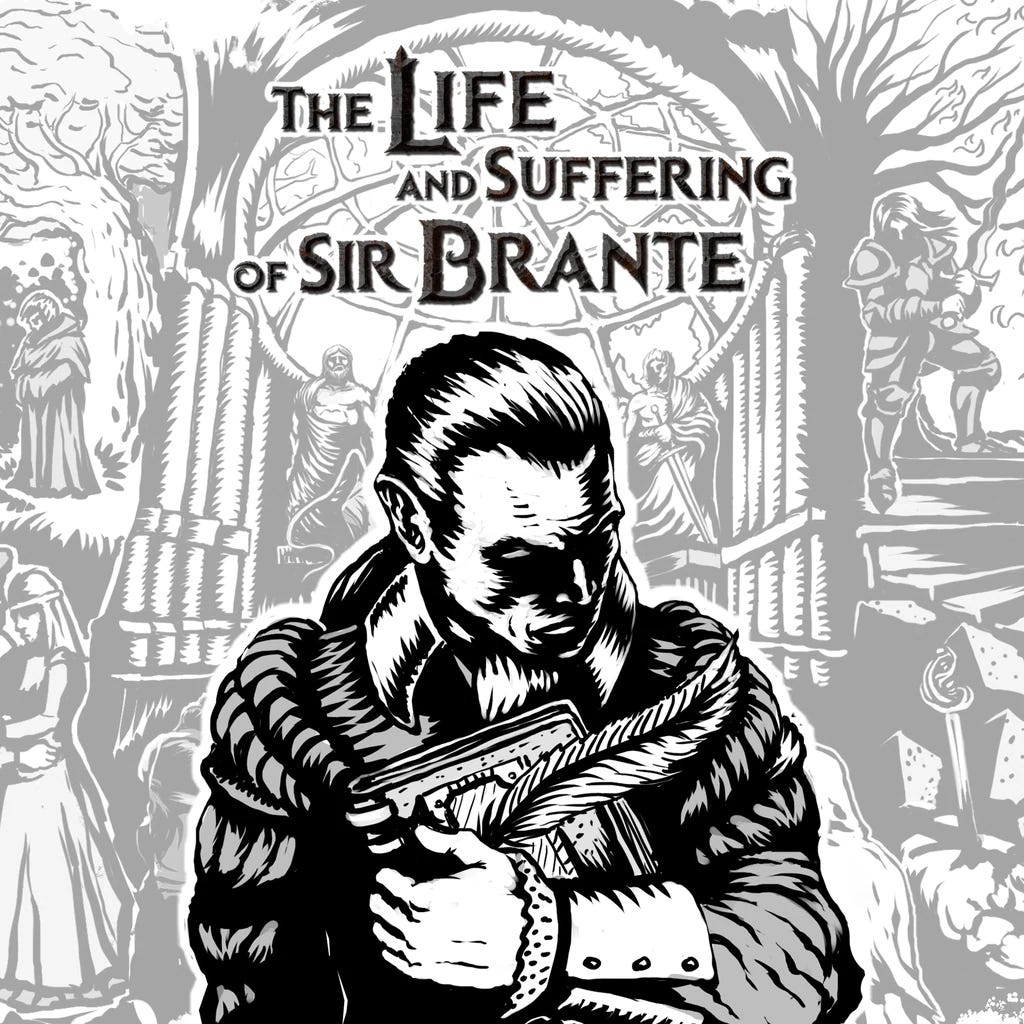
Visually, The Life and Suffering of Sir Brante embraces simplicity rather than chasing technical spectacle. Its illustrated portraits resemble pages from an ancient chronicle, with muted colours and detailed artwork that perfectly capture the Empire’s bleak atmosphere. Every image reinforces the setting’s oppressive nature, allowing your imagination to fill the spaces between scenes.
The interface is clean, making lengthy reading sessions surprisingly comfortable on console. Menus are logically organised, statistics are easy to track, and navigation remains intuitive even as the story’s complexity increases. It may not be visually extravagant, but everything serves the experience efficiently.
The soundtrack adopts a similarly restrained philosophy. Gentle orchestral arrangements, sombre melodies, and carefully placed moments of silence enhance the emotional impact without ever overwhelming the narrative. Rather than demanding attention, the music quietly supports every conversation and difficult decision, allowing the writing to remain firmly at centre stage.
Every Life Tells a Different Story
Replayability is where Sir Brante truly excels. Completing a single playthrough feels satisfying, yet it also reveals how many possibilities remain unexplored. Entire professions, political allegiances and personal relationships may never appear, depending on the choices you make on your first journey.
One version of Sir Brante may rise through the legal system to become a respected judge, seeking to reform society from within. Another may devote himself to the Inquisition, enforcing laws he once questioned. Others may reject the Empire entirely, risking everything to lead a revolution against centuries of oppression. Each route feels substantial enough to warrant another full playthrough.
Even familiar scenes take on fresh meaning when viewed through a different version of the protagonist. Conversations shift, motivations evolve and characters reveal new dimensions based on your previous actions. Few narrative games reward experimentation with quite this depth, making every return visit genuinely worthwhile.
Not Without Its Flaws
While the game excels at storytelling, it is not universally accessible. Players expecting frequent action or cinematic set pieces may struggle with its slower pace and text-heavy presentation. This is very much an experience built around reading, reflection and careful decision-making rather than fast-paced gameplay.
There are also moments when the political discussions become dense, particularly in the middle chapters. Although the writing remains consistently intelligent, some sections could have benefited from slightly tighter pacing. The extensive stat system may initially feel intimidating, especially for newcomers unfamiliar with narrative-focused RPGs, though patience is rewarded as the mechanics gradually become second nature.
Fortunately, these shortcomings do little to detract from the overall quality of the experience. The writing remains compelling enough to carry slower sections, and the depth of the role-playing systems continues to reward careful investment throughout the campaign.
Final Verdict
The Life and Suffering of Sir Brante is one of the finest examples of interactive storytelling available today. It refuses to offer simple answers or easy victories, instead asking players to navigate a harsh world where morality is complex and every achievement demands sacrifice. The result is an emotionally rich narrative that lingers long after the credits roll.
Its greatest strength is its complete commitment to player agency. Every relationship, personality trait and political decision contributes to a life that feels uniquely yours. Rather than chasing cinematic spectacle, the game builds its reputation through exceptional writing, intelligent design and a world that feels convincingly lived-in from beginning to end.
This is not a role-playing game for everyone, and it never tries to be. Those seeking constant action may find its measured pace hard to embrace, but players willing to immerse themselves in its remarkable narrative will find one of the most rewarding dark fantasy experiences in recent years. Sir Brante’s story may begin in suffering, but the journey that unfolds is unforgettable, making this an easy recommendation for anyone who values meaningful storytelling above all else.