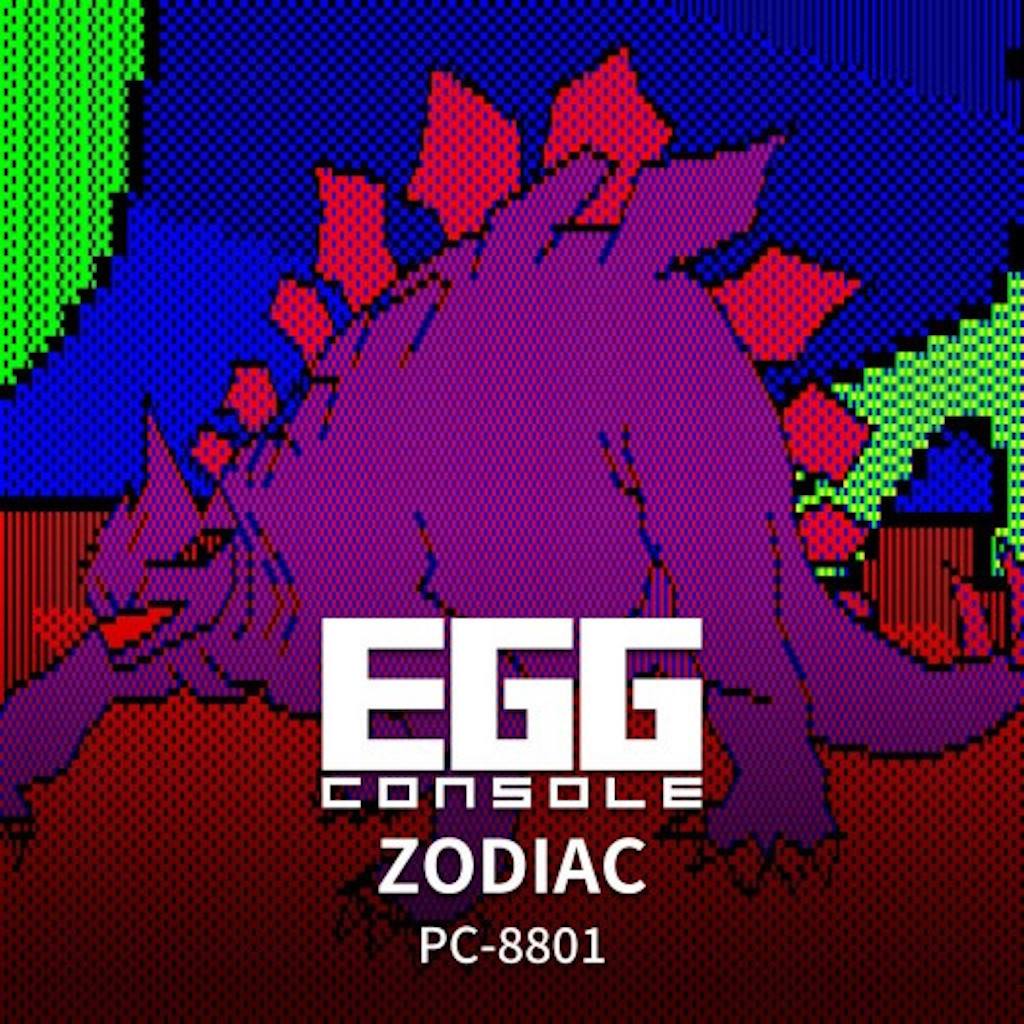
The EGGCONSOLE series has quietly become one of the most significant preservation projects on modern consoles. While many retro collections focus on arcade classics or well-known console releases, D4 Enterprise continues to shine a light on an older, often overlooked era of gaming history. These are games that helped shape entire genres in Japan long before role-playing games and visual novels became global phenomena. EGGCONSOLE ZODIAC PC-8801 is another fascinating addition to that growing archive.
Originally released by Riverhill Soft in 1985 for the NEC PC-8801, ZODIAC is a science-fiction adventure that blends text-based investigation with exploration and puzzle-solving. It arrives on the Nintendo Switch not as a remaster or modern reinterpretation, but as a faithful preservation of the original experience. That means players get a genuine piece of gaming history, complete with all the creativity, charm, and frustrations that come with software designed more than forty years ago. For modern audiences, that authenticity can be both a blessing and a challenge.
Science Fiction With Heart
The story begins with a mystery. Five years have passed since the disappearance of Dr. Dumas, a brilliant scientist whose whereabouts remain unknown. His son, known simply as Boy, has never stopped searching for answers. Accompanied by his robotic companion, Amaroid Mary, he follows the only clue he has left: a mysterious Blue Crystal that suddenly reacts, pointing towards a distant region of space known as the Dester Slum.
What follows is a classic science-fiction adventure filled with strange worlds, unexplored locations, and hidden secrets. While the narrative may seem simple by modern standards, there is an undeniable charm to its presentation. The relationship between Boy and Mary provides much of the emotional core, and there is a surprisingly warm sense of optimism beneath the adventure, despite the dangers that lie ahead.
The game’s promotional material describes the experience as a space romance, and while that aspect may feel understated today, it reflects the storytelling ambitions of Japanese computer games in the mid-1980s. Developers were beginning to experiment with more character-focused narratives, and ZODIAC offers an interesting snapshot of that evolution.
Typing Your Way Through the Unknown
The heart of ZODIAC lies in its command-based adventure design. This is a game from an era before intuitive point-and-click interfaces became standard. Instead, progress is achieved by entering commands, usually simple verb-and-noun combinations. Players must investigate environments, examine objects, use items, and interact with characters through careful experimentation.
This style of gameplay demands patience. There are no glowing objective markers, no highlighted clues, and certainly no quest logs. Every discovery feels earned because the game rarely hands over solutions. Instead, it asks players to think logically and test ideas through direct interaction with the world.
At its best, this creates a genuine sense of adventure. Solving a puzzle often feels like uncovering a secret rather than simply ticking off another objective. There is a satisfying reward in finally finding the correct command after carefully considering the available information.
At the same time, the design philosophy is undeniably archaic. Modern players accustomed to streamlined interfaces may find themselves wrestling with the game’s logic more than with its actual puzzles. Progress occasionally depends on very specific actions, and the lack of contemporary guidance systems means it is possible to spend significant time stuck without clear direction.
Preserved Rather Than Modernised
One of the most impressive aspects of the EGGCONSOLE release is its commitment to preservation. D4 Enterprise has resisted the temptation to heavily alter or modernise the original software. Instead, they present ZODIAC exactly as it existed on the PC-8801, while surrounding it with a collection of modern conveniences.
Save states are perhaps the most valuable addition. In a game where experimentation is essential and mistakes can be costly, the ability to save progress at any moment dramatically reduces frustration. Variable game speed options are also welcome, helping players move through slower sections more comfortably.
The included gallery also deserves special mention. While some players may overlook it, the collection of historical materials offers fascinating context for the game’s original release. Box art, manuals, and promotional assets help transform the package into something that feels more like an interactive museum exhibit than a simple digital re-release. It is clear that the goal here is not merely to sell an old game, but to preserve an important piece of gaming history.
A Language Barrier That Remains
The biggest obstacle facing modern audiences is one that preservation alone cannot fully resolve. The game itself remains largely in Japanese. Although menus outside the main software and instructional materials have been translated into English, the original game content remains untranslated. For players who understand Japanese, this will hardly be an issue. For everyone else, it creates a substantial barrier to entry.
The included English documentation does an admirable job of explaining how the game works and guiding navigation. However, there is only so much supplementary material can accomplish when the adventure itself relies heavily on reading and interpreting text. Players willing to approach the game as a historical curiosity may find ways around this limitation, but those expecting a fully localised experience should be aware of what they are purchasing.
This is not necessarily a flaw of the release itself. Preservation sometimes means accepting the limitations of the original work. Still, it remains the single biggest factor affecting accessibility.
A Window Into Another Era
Visually, ZODIAC immediately transports players back to the early days of Japanese home computing. The PC-8801’s distinctive colour palette, chunky pixel art, and simple screen layouts feel worlds apart from modern gaming standards. Yet there is a certain beauty in that simplicity.
The artwork leaves much to the imagination, allowing players to mentally fill in details the hardware could never fully depict. Science-fiction locations possess a dreamlike quality, while character portraits and environmental illustrations carry the unmistakable charm of mid-1980s Japanese design.
The audio presentation follows a similar path. The PC-8801’s sound capabilities were limited compared with later hardware, but the music and effects still contribute significantly to the atmosphere. There is a nostalgic warmth to the synthesised melodies that perfectly complements the game’s sense of discovery and adventure.
Final Verdict
EGGCONSOLE ZODIAC PC-8801 is not an easy recommendation for everyone. Its age is impossible to ignore, its pacing is unapologetically old-fashioned, and the language barrier poses a genuine challenge for many players. Those seeking immediate gratification or modern conveniences beyond the preservation features may struggle to connect with it.
Yet judging ZODIAC solely by contemporary standards would miss the point entirely. This release succeeds by preserving a fascinating chapter of gaming history with remarkable care and respect. It allows players to experience the design philosophies, storytelling ambitions, and technical limitations that helped shape the future of Japanese adventure games.
For retro enthusiasts, digital historians, and anyone curious about the roots of interactive storytelling, EGGCONSOLE ZODIAC PC-8801 offers a compelling glimpse into the past. It may require patience, curiosity, and a willingness to meet it on its own terms, but those who do will discover a fascinating relic from a pioneering era of game development.