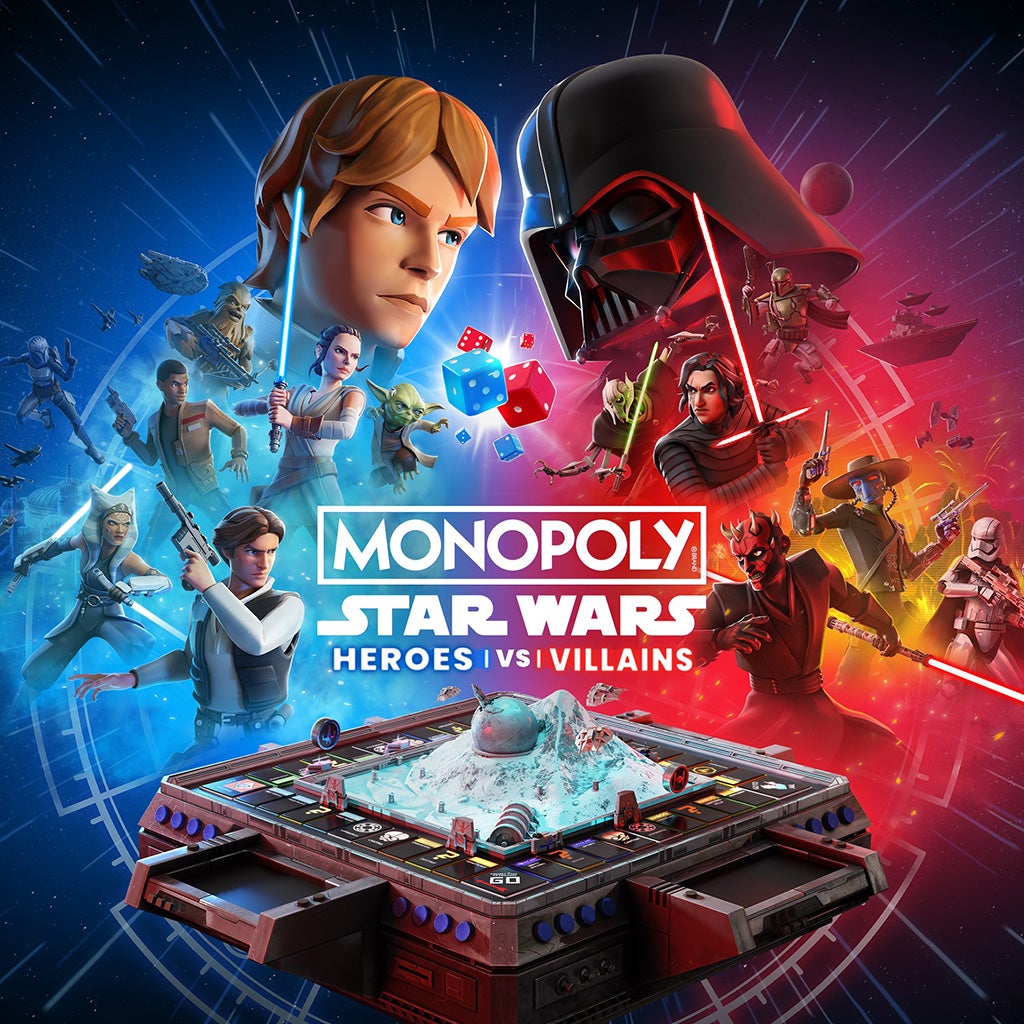
There is something slightly surreal about watching a century-old board game thrown into the Star Wars universe and rebuilt as a competitive team battler. Monopoly: Star Wars Heroes vs Villains, released on June 11, 2026 by Behaviour Interactive and Ubisoft, does not feel like a simple themed reskin. Instead, it feels like someone dismantled the slow, predictable rhythm of classic Monopoly and rebuilt it around character abilities, team coordination, and sudden bursts of controlled chaos. The result is a game that still remembers its roots, yet refuses to sit quietly within them.
At its core, the experience is no longer about quietly circling a board and grinding opponents into bankruptcy over time. Instead, matches unfold as structured team confrontations, with 2v2 and 3v3 setups defining the entire flow of play. Every decision feels more immediate, partly because the board is now a shared space in a much more aggressive sense. Properties are still central, but they behave less like passive investments and more like contested territory on a shifting battlefield. From the opening roll, the game signals that this is Monopoly rebuilt for spectacle rather than patience.
Heroes, Villains, and Control of the Board
The most significant structural change is the introduction of character-driven abilities. Instead of simple tokens, players choose from a wide roster of Star Wars heroes and villains, including Luke Skywalker, Princess Leia, Darth Vader, and Darth Maul. Each brings a distinct ability set that can alter ownership, protect assets, or disrupt an enemy’s momentum at crucial moments. This transforms every turn into a tactical decision rather than a passive roll of the dice.
Team composition quickly becomes the real game beneath the board. Coordinating abilities across a duo or trio adds a layer of strategy that traditional Monopoly never attempted. Timing a defensive skill to block a property steal or using an offensive trigger to destabilise an opponent’s position can swing entire matches. The satisfaction comes not just from winning, but from executing a chain of coordinated actions that leaves the opposing team scrambling to recover. It is here that the game finds its most engaging identity, even if it sometimes leans heavily on unpredictability.
Dice Battles and Galactic Chaos
Classic Monopoly’s pacing has been completely reworked. Passing GO is no longer a safe financial reset; instead, it triggers Dynamic GO Events that can alter the rules of the board in real time. These moments introduce sudden advantages, penalties, or environmental shifts that force players to adapt constantly. Combined with Dice Battles that resolve contested spaces through direct confrontation, the game rarely allows momentum to settle for long.
This constant volatility is both the game’s greatest strength and its most divisive trait. On the one hand, it ensures that no match becomes predictable or stagnant. On the other, it means that carefully built advantages can disappear in a single turn if the wrong event or dice outcome occurs. The design clearly prioritises excitement over stability, and while that keeps energy levels high, it can make long-term strategy feel fragile. Victory often feels earned, but never entirely secure until the final roll.
Presentation and Star Wars Integration
Where the game succeeds most consistently is in its presentation of the Star Wars universe. The board is no longer an abstract economic grid but a collection of recognisable planets and locations across the saga. Each space has enough visual identity to make control feel meaningful, and character animations lend personality to every interaction. Watching Darth Vader actively contest territory or Leia disrupt enemy plans gives the match a sense of narrative weight that elevates it beyond its mechanical roots.
Audio and visual effects reinforce this transformation. Ability activations land with cinematic impact, and match events are framed with enough flair to make even routine turns feel part of a larger conflict. While it never reaches the depth of a dedicated strategy game, it succeeds in making Monopoly feel louder, faster, and more theatrical than it has any right to be.
Balance, Frustration, and Design Limits
Despite its ambition, the game is not without friction. The lack of a traditional ruleset toggle is a noticeable limitation. Players cannot strip away abilities or revert to a slower, more familiar Monopoly experience, which may alienate purists expecting a hybrid rather than a full reinvention. The game is unapologetic about its direction, and that confidence will not suit everyone.
Volatility also remains a persistent issue. Because character abilities and event systems can override careful planning, matches sometimes hinge on sudden swings rather than consistent strategy. This can be thrilling in short bursts, especially in casual or party settings, but it may frustrate players who prefer predictable competitive systems. The game fully embraces chaos, and there is no option to soften that edge.
Final Verdict
Monopoly: Star Wars Heroes vs Villains is not interested in preserving tradition. It rebuilds a familiar board game into something faster, louder, and far more unpredictable, anchored in team play and character abilities that constantly reshape the flow of competition. While its reliance on randomness and lack of a classic mode may divide players, its commitment to reinvention is undeniable.
This is Monopoly reimagined as a Star Wars skirmish, where every roll carries narrative weight and every match feels like a shifting battle for control of the galaxy. It will not replace the original, nor does it try to. Instead, it carves out its own space as a chaotic, energetic reinterpretation that thrives on unpredictability and spectacle, even when the dice refuse to behave.