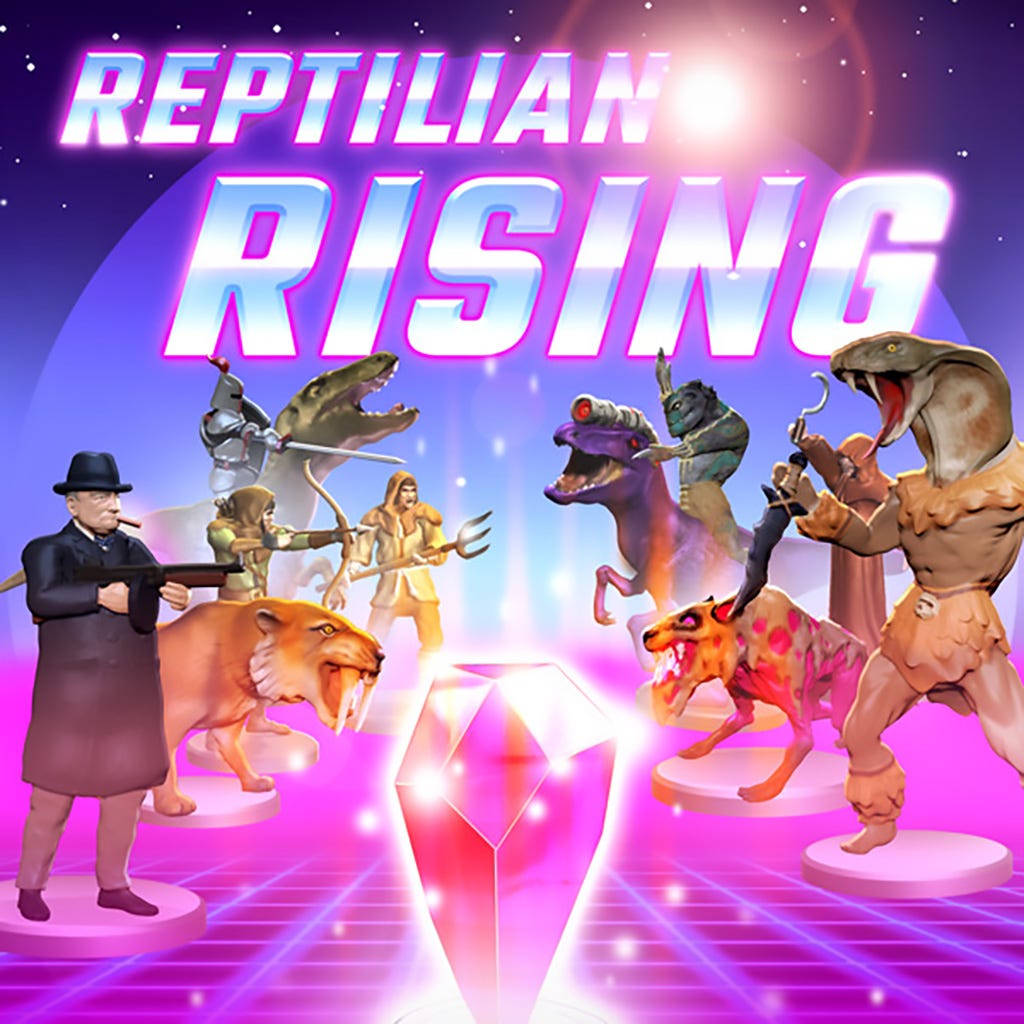
Reptilian Rising is a turn-based tactical RPG released in April 2026, developed by Robot Circus alongside Gregarious Games and Hyper Luminal Games, and published by Numskull Games. It builds its identity around a gloriously unhinged premise: history’s most recognisable figures are recruited to fight a war against time-travelling reptiles bent on rewriting existence itself.
Cleopatra, Robin Hood, Einstein and others are pulled into a squad-based strategy framework that blends retro tabletop aesthetics with modern tactical systems. Across prehistoric wastelands, fractured timelines and dystopian futures, players assemble teams to battle absurd enemies such as cyborg dinosaurs, warped humanoid soldiers and the ever-looming Dictatorsaur.
Gameplay
At its core, Reptilian Rising is a grid-based, turn-based tactics game, but that description barely captures how elastic its systems become once everything starts interacting.
The standout mechanic is the “time-energy” system, which lets players bend battle conditions in ways that feel borderline reckless at first glance. You can clone units to multiply pressure points, open time gates for rapid repositioning, or chain abilities across turns to create multi-layered strategies that unfold like a carefully planned accident.
Combat is reactive in a way that sets it apart from more traditional tactical RPGs. Enemy turns are not passive interruptions but active parts of the puzzle. Positioning mistakes can spiral quickly, but equally, smart sequencing can dismantle encounters in a satisfying, almost theatrical fashion.
The learning curve is there, but it never feels hostile. Instead, it encourages experimentation, often rewarding the kind of improvisation that would normally be punished in stricter strategy systems.
Presentation and Style
The game’s ‘80s tabletop inspiration is not merely cosmetic. It shapes everything from how battles are framed to how menus are presented. The UI has a tactile, almost physical quality, as if you are moving pieces across an actual board rather than navigating a digital space.
That identity carries through its tone as well. The writing leans into absurdity without tipping into parody fatigue. Historical figures are not treated as sacred reinterpretations but as playful archetypes, more concerned with personality and team synergy than with accuracy.
Visually, it is consistent if not extravagant. Environments do repeat over time, but the strong art direction helps each era feel distinct enough to maintain clarity during longer play sessions. It is not chasing cinematic spectacle, and it is better for it.
Critical Analysis
What makes Reptilian Rising stand out is not just its premise but its discipline in sticking to it. It would have been easy for a concept this chaotic to collapse under its own humour, yet the systems are surprisingly robust.
The time-manipulation mechanics are not gimmicks. They fundamentally reshape how you approach positioning and pacing, creating encounters that feel less like scripted puzzles and more like living systems that react to your decisions.
That said, repetition is the one real structural weakness. Mission objectives can begin to echo each other after extended play, and while branching paths and optional goals help soften that effect, they do not eliminate it entirely.
The roster of twenty-plus heroes is a genuine highlight. Runs feel meaningfully different depending on composition, and the game rewards curiosity in how you combine abilities. Some synergies feel almost broken, but in a way that enhances the sense of experimentation rather than undermining balance.
There is also a clear understanding that tone is part of design. The humour is not separate from the mechanics; it is embedded in them. When Einstein is holding a defensive line against a mechanical raptor invasion, the joke and the strategy are the same thing.
Final Verdict
Reptilian Rising is not trying to be the most polished tactical RPG on the market, and it does not need to be. It succeeds by being unmistakably itself: messy in places, clever in others, yet consistently engaging from start to finish.
It will not win over players who already struggle with turn-based strategy, but for those who enjoy systems-driven experimentation wrapped in absurdist humour, it offers something genuinely distinctive. There is confidence here, even in its rougher edges, and that confidence carries the experience further than polish alone could. It is a game that understands its own ridiculousness and leans into it without hesitation. Somehow, that makes it work.