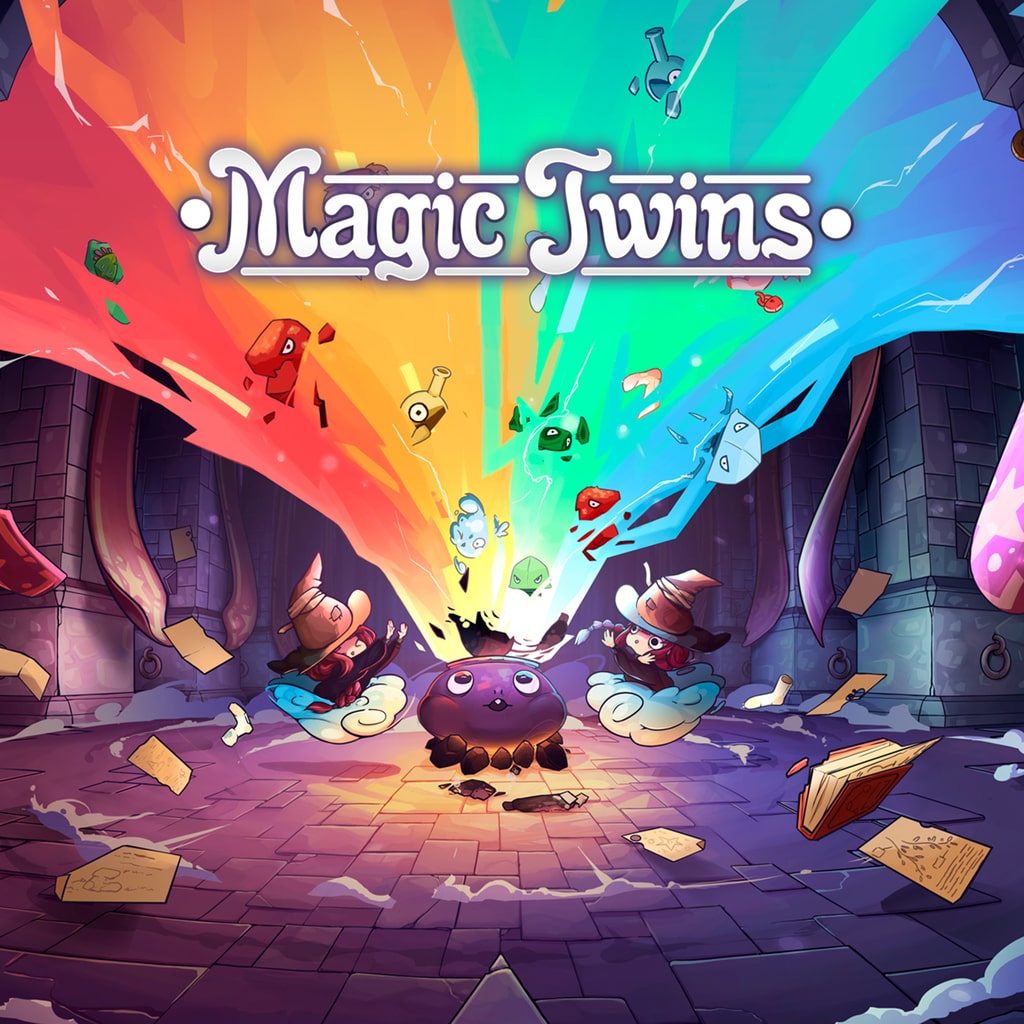
At first glance, Magic Twins looks like it belongs in the cosy corner of the arcade genre. Soft colours, whimsical witches, and a cheerful fantasy premise all suggest something light, approachable, even relaxing. That illusion lasts about five minutes.
Developed by Flying Beast Labs and published by Artax Games, this cooperative puzzle-action hybrid throws players into a magical crisis known as the Colormageddon. You control twin witches, Abra and Cadabra, tasked with halting waves of colour-coded elemental enemies with chromagic spells. Matching the right colour to the right enemy is the key to survival. It sounds simple. It is anything but.
What Magic Twins actually delivers is a fast, demanding arcade experience that sits somewhere between a puzzle game and a survival gauntlet. Beneath the charming exterior lies a system that demands speed, precision, and, above all, communication.
Colour as Combat
The core mechanic is deceptively straightforward. Enemies appear in waves, each tied to a specific colour. Your spells must match those colours to defeat them. Red against red, blue against blue, and so on. On paper, it feels almost meditative. In practice, it quickly becomes overwhelming.
Enemies do not politely wait their turn. They swarm, overlap, and press you from multiple angles. The screen fills with shifting hues and constant motion, forcing you to process information at speed while maintaining accuracy. Mistakes are not just punished. They cascade.
There is a rhythm to it, but it is frantic. You are constantly switching focus, adjusting positioning, and trying to anticipate the next colour threat. When it clicks, it feels sharp and satisfying. When it does not, it becomes chaos in its purest form.
Two Witches, One Problem
The game’s identity centres on its dual-character structure. In single-player, you control both Abra and Cadabra, switching between them as needed while a CPU partner assists. In local co-op, each player takes one witch, and everything changes.
On paper, the single-player option is generous. In practice, it is where the experience struggles most. The AI partner often feels slightly out of sync with the game’s demands. It mispositions, lags behind, or fails to prioritise the most immediate threats. This turns what should be a tightly tuned challenge into something closer to controlled frustration. It is playable, but it rarely feels optimal.
Co-op, however, is where Magic Twins truly comes alive.
When Communication Becomes Survival
In local co-op, everything sharpens. One player might focus on clearing one side of the screen while the other manages incoming waves from the opposite direction. Suddenly, success depends not just on mechanical skill but on communication, trust, and shared awareness. This is where the game earns its reputation as a relationship tester.
You will talk constantly. You will miscommunicate. You will occasionally blame each other for disasters that were probably both your fault. And yet, when a difficult wave finally clicks into place and everything falls into perfect rhythm, the satisfaction is undeniable.
It is not a relaxing co-op experience. It is an intense one. But it is also deeply rewarding in a way few puzzle games manage.
A Beautiful Kind of Stress
Visually, Magic Twins commits fully to its aesthetic identity. The world is bright, colourful, and deliberately playful. Enemy designs are charming even when they overwhelm you. Spell effects burst across the screen in satisfying flashes of chromatic energy.
There is a deliberate contrast between presentation and difficulty. The game looks friendly. It behaves anything but.
This tension works in its favour. The cute presentation softens the blow of repeated failure, while the intensity of gameplay prevents the aesthetic from feeling superficial. It is a balancing act that mostly holds together, even when the screen becomes visually overwhelming in later stages.
Sound design supports the chaos well. Spells pop with crisp feedback, enemy waves swell with mounting urgency, and the soundtrack maintains a steady sense of momentum that keeps you locked in, even when things go wrong.
A Game of Repetition and Mastery
Structurally, Magic Twins leans heavily on repetition. You will encounter similar wave patterns across stages, gradually increasing in speed and complexity. Progression is less about introducing new mechanics and more about refining your response to existing ones.
For some players, this will feel limiting. The lack of major mechanical evolution means the game relies heavily on personal improvement rather than systemic variety. If the core loop does not click early, it is unlikely to change later.
But for those who enjoy mastery-based gameplay, there is something compelling here. Each failure feels like a lesson. Each success feels earned through coordination and practice rather than luck.
Single Player: A Different Spell Entirely
It is impossible to talk about Magic Twins without addressing its weakest aspect. Single-player mode simply does not match the quality of co-op.
The AI companion struggles to replicate the responsiveness of a human partner, and the game’s design does not fully compensate for that gap. What should be a tightly coordinated dual-control system instead becomes a juggling act, with half of your strategy depending on unpredictable behaviour.
There are moments of enjoyment, but they are overshadowed by inconsistency. It feels like a mode included for accessibility rather than for an ideal experience.
A Game That Knows Its Strength
Despite its flaws, Magic Twins knows exactly what it does well. It is not trying to be a broad, accessible puzzle game for everyone. It is aiming squarely at players who enjoy high-intensity co-operation, quick decision-making, and shared chaos. In that space, it succeeds more often than not.
The recent expansion to modern consoles has given it a second life, and it remains easy to recommend to anyone looking for a local co-op experience that demands attention and rewards communication. Just do not expect a gentle evening in.
Final Verdict
Magic Twins is a deceptively intense arcade puzzle game that shines in co-op and struggles in single-player. Its colourful presentation masks a demanding, often punishing core loop that rewards coordination and quick thinking above all else.
It is chaotic, challenging, and occasionally exhausting, yet genuinely thrilling when everything aligns.