

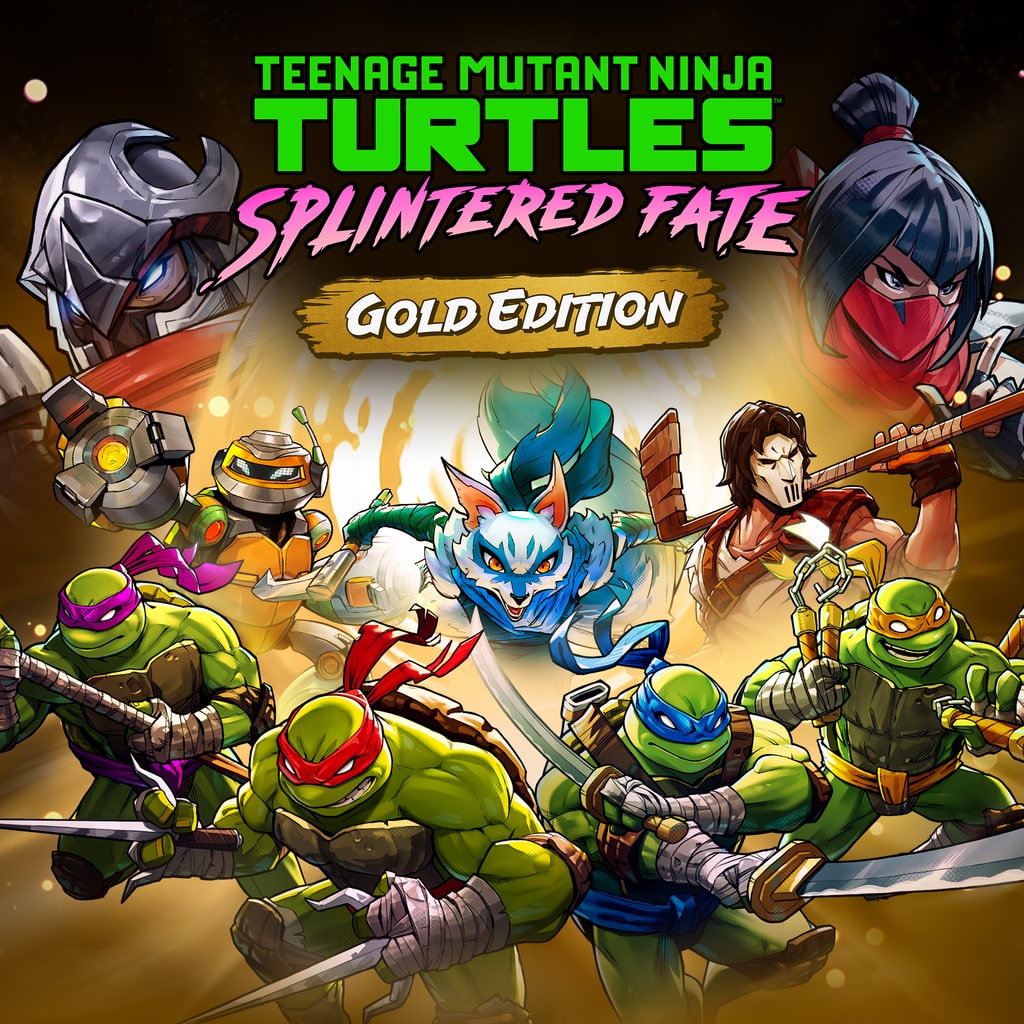
Few franchises carry the same multi-generational weight as the Teenage Mutant Ninja Turtles. From their comic book origins to animated adaptations and blockbuster movies, Leonardo, Michelangelo, Donatello, and Raphael have remained pop culture staples. In recent years, that legacy has been reinterpreted through modern gameplay formats, and Teenage Mutant Ninja Turtles: Splintered Fate from Super Evil Megacorp stands out as one of the more confident attempts to blend the franchise with contemporary roguelike design.
The newly released Gold Edition—available on all major platforms including PlayStation, Xbox, Switch, and PC—bundles the base game with all major DLC expansions and a significant balance update. It is, in effect, the definitive version of a game already known for replayability, co-operative chaos, and arcade-style combat. But does this complete edition elevate Splintered Fate into must-have territory, or merely reinforce its existing strengths?
The answer lies somewhere in between, but leaning more towards the former than the latter.
A Roguelike Built for Turtle Power
At its core, Splintered Fate is a roguelike action brawler built around the familiar structure of run-based progression. Players choose one of the four Turtles—Leonardo, Michelangelo, Donatello, or Raphael—and fight through procedurally arranged combat rooms set across stylised versions of New York City. The goal is simple: rescue Splinter from the Foot Clan and survive increasingly chaotic encounters.
Where the game excels most is in turning each Turtle’s personality into gameplay. Leonardo feels balanced and disciplined, Raphael is aggressive and close-range focused, Donatello prioritises control and utility, and Michelangelo brings unpredictable speed and mobility to every fight. These differences are not superficial—they significantly influence how each run develops.
Combat is quick, clear, and deliberately chaotic. Attacks connect with satisfying impact, enemy waves escalate smoothly, and abilities combine in ways that encourage experimenting. Even when runs fail, they tend to do so in spectacular fashion, maintaining the genre’s signature “one more try” momentum.
Co-op Chaos and Controlled Disorder
As with most modern interpretations of the franchise, co-operative play is where Splintered Fate truly comes alive. Whether online or local, teaming up with friends transforms the game from a structured roguelike into a near-constant improvisational brawl.
Enemy density increases appropriately in co-op, forcing players to coordinate abilities and positioning. Revives, crowd control, and ultimate timing become crucial. When it works, it feels like a choreographed martial arts film where everyone is slightly improvising their own choreography.
However, the chaos can occasionally tip into visual and mechanical overload. With multiple effects, enemies, and ability triggers happening simultaneously, readability sometimes suffers. This is a common issue in roguelikes with strong visual identity, but here it becomes more noticeable in late-game encounters.
Still, the energy rarely dips. Even messy fights retain a sense of momentum that keeps players engaged.
The Gold Edition: More Than Just a Bundle
The Gold Edition is more than just a content pack; it consolidates the game’s entire post-launch ecosystem. Alongside the core experience, it features three major DLC additions: Casey Jones & the Junkyard Jam, Metalhead Character DLC, and Alopex Character DLC.
Each expansion introduces substantial variety rather than simply cosmetic content. Casey Jones offers a more aggressive, momentum-based playstyle with improved mobility across rooftop sections. Metalhead shifts gameplay towards ranged-heavy mechanical destruction, providing turret-like zoning and explosive crowd control. Alopex, meanwhile, delivers a precision-focused assassin archetype with quick, lethal bursts of damage and evasive manoeuvrability.
Together, they significantly increase the roster beyond the original four Turtles, bringing the game closer to a complete character-action roguelike ensemble rather than a solely TMNT-focused experience.
The result is a game that feels structurally complete in a way the original release did not.
The Junkyard and Environmental Variety
One of the key additions in the DLC suite is the Junkyard level introduced in the Casey Jones expansion. Unlike the cleaner rooftop and sewer environments of the base game, the Junkyard is visually dense and mechanically layered.
Hazards, destructible objects, and vertical traversal elements create a more dynamic battlefield. It also introduces Punk Frog encounters, which bring faster, more erratic enemy behaviour patterns into the mix.
This environment does a good job of breaking up visual repetition, which is a common risk in roguelike structures. While procedural generation ensures variety, environmental identity often defines long-term engagement—and the Junkyard delivers that identity effectively.
The Wraith Invasion Update and Meta Evolution
Coinciding with the Gold Edition release is the free “Wraith Invasion” update, which introduces balance adjustments and a new layer of “Astral” power enhancements. This system subtly encourages late-game builds to experiment with unconventional combinations, prompting players to explore novel synergies.
Instead of overhauling core systems, it refines them. Enemy scaling becomes more consistent, underperforming abilities are given minor buffs, and high-tier runs now allow for more creative build paths without disrupting balance.
It is not a complete reinvention, but rather a healthy evolution of the game’s long-term meta.
Presentation and Tone
Visually, Splintered Fate adopts a stylised, slightly exaggerated comic-book aesthetic. Characters are bold, environments are saturated with neon and shadow, and combat effects are deliberately flashy without becoming unreadable—at least most of the time.
Audio design complements this approach effectively. Combat hits feel impactful, enemy telegraphs are clearly communicated, and voice work maintains the franchise’s playful energy without undermining tension during higher difficulty runs.
The tone strikes a comfortable balance between Saturday morning cartoon energy and modern roguelike intensity, which is exactly where a TMNT game should be.
Accessibility and Replayability
One of the game’s strengths is its accessibility across different platforms and skill levels. The learning curve is gentle enough for newcomers, but the layered build systems and difficulty modifiers add depth for experienced roguelike players.
Runs are relatively short, making experimentation straightforward and failure non-punitive. This promotes repeated play, especially in co-op where social dynamics often matter more than mechanical optimisation.
However, long-term replayability still largely depends on player interest in diverse builds. While the DLC characters are helpful, some players might find the core loop starting to feel familiar after extended gameplay.
Final Verdict
Teenage Mutant Ninja Turtles: Splintered Fate – Gold Edition is the most comprehensive version of an already solid roguelike brawler. It succeeds not by reinventing its core mechanics, but by expanding and polishing them into a more unified and content-rich package.
The inclusion of new characters, environments, and the “Wraith Invasion” update greatly enhances variety, while co-operative gameplay remains its strongest and most enjoyable feature. At its best, it captures the chaotic joy of the Turtles in a manner few modern adaptations achieve.
It is not without its flaws—visual clarity can be compromised during hectic moments, and long-term repetition might occur for solo players—but as a definitive edition, it offers exactly what it promises: a more complete, polished, and expressive version of the experience.


