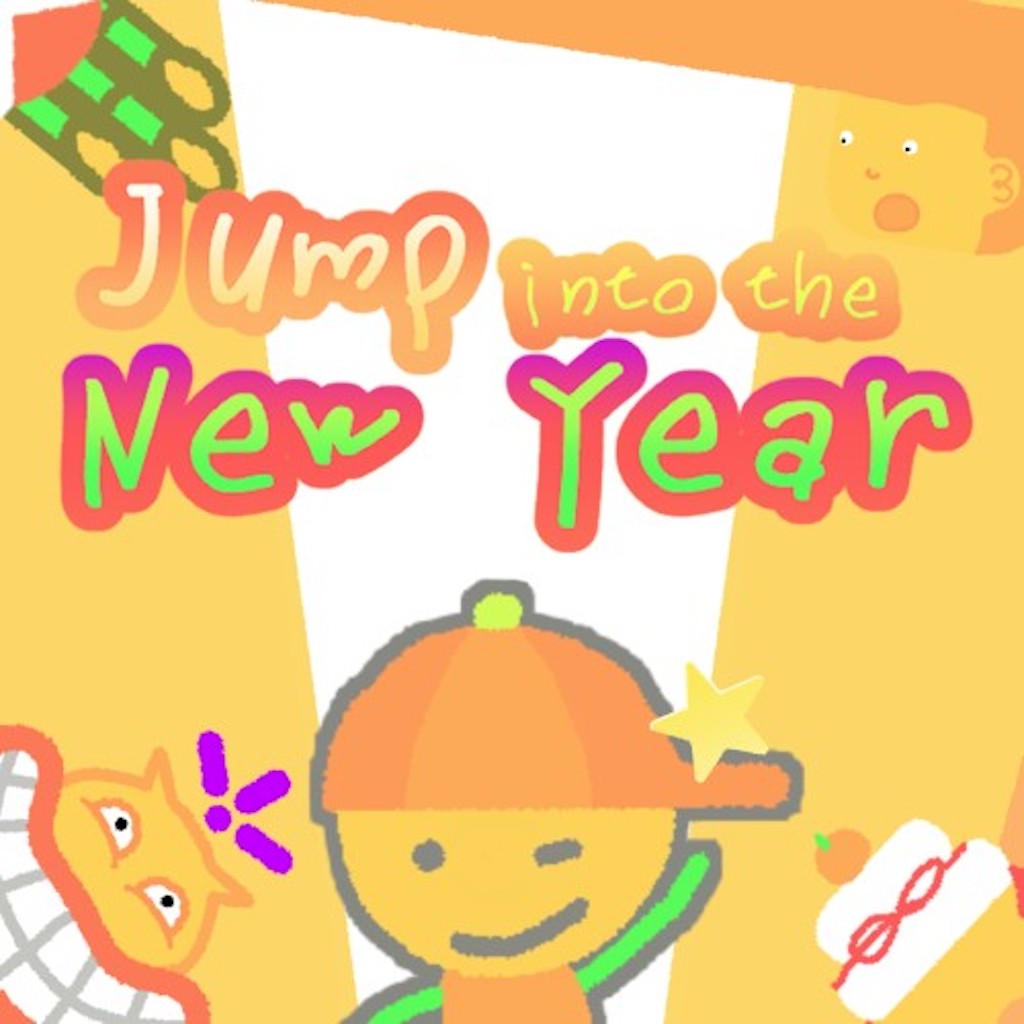
There’s a special kind of brilliance in taking a simple idea and pushing it to its very limit. Jump into the New Year is built entirely around one such idea: don’t touch the ground. It’s an almost childlike premise, the sort of rule you might invent on a playground — but in the hands of developer we have playfulness and publisher Mediascape, it becomes a frantic, surprisingly layered arcade experience that thrives on chaos, timing, and just a touch of absurdity.
Released under the Play,Doujin! label — a space known for spotlighting offbeat and experimental Japanese indie titles — Jump into the New Year wears its eccentricity proudly. It’s loud, fast, occasionally overwhelming, and always committed to its central gimmick. The result is a game that feels both instantly accessible and deceptively demanding.
Stay Airborne or Else
The core loop is refreshingly clear: keep Botti, the game’s wide-eyed hero, airborne by bouncing across objects scattered throughout each stage. Touch the ground before the countdown ends, and you’re unceremoniously whisked away to another world—failure presented as a kind of surreal punishment.
Initially, this feels almost trivial. Early stages offer plenty of objects to hop between, and the physics are forgiving enough to allow you to find your rhythm. But Jump into the New Year doesn’t stay gentle for long. As stages advance, platforms become more erratic, objects move unpredictably, and the safe routes you once relied on start to vanish.
What emerges is a game of constant micro-decisions. Do you go for the nearby object that’s safe but low-scoring, or risk a longer jump to keep your combo alive? Do you prioritise survival, or chase the perfect run? These decisions happen in fractions of a second, giving the game a kinetic energy that rarely slows.
Controlled Chaos
If there’s one word that sums up Jump into the New Year, it’s chaotic. Stages are filled with objects—everything from everyday items to surreal set pieces—and each one can become your next foothold. The visual noise can be overwhelming at first, but it’s also what makes the game so engaging.
There’s a rhythm hidden beneath the chaos. As you play, you start to recognise patterns, anticipate movement, and develop an instinct for which objects are “safe” to land on. It’s not about memorising levels in the traditional way—it’s about adapting to a constantly changing environment.
This sense of controlled chaos is where the game excels. It captures that arcade-like feeling of just managing to hold things together, where every successful run feels like a minor miracle. When you manage to stay airborne for longer—hitting that elusive “Nice~” threshold—it’s genuinely exhilarating.
A World That Refuses to Sit Still
Variety plays a significant role in keeping the experience fresh. The game’s stages cover a broad spectrum of settings, from lively towns to ancient ruins, underwater scenes, and even outer space. Each environment introduces its own quirks, whether it’s altered physics, unique hazards, or objects that behave unexpectedly.
The visual design adopts a playful, almost whimsical aesthetic. Bright colours, exaggerated animations, and a slightly surreal tone give the game a distinct personality. It’s not aiming for realism—it aims to be memorable.
However, the high density of visual elements can sometimes work against it. In more complex stages, it can be challenging to quickly distinguish between interactive objects and background details. This can lead to moments where failure feels less like a mistake and more like a misread—something that can be frustrating in a game that relies heavily on split-second decisions.
More Than Just Jumping
While the core gameplay focuses on staying airborne, Jump into the New Year adds depth through its scoring and progression systems. Points are awarded based on the objects you step on and the jumps you perform, encouraging players to experiment and take risks.
This is where the game’s replayability becomes evident. High scores unlock mini-games, while an in-game encyclopedia tracks the objects you’ve interacted with. Add in a hefty list of 100 achievements, and there’s a clear incentive to keep returning, even after you’ve completed the main stages.
It’s a clever approach. By linking progression to performance rather than simple completion, the game fosters mastery without explicitly demanding it. You can “finish” a stage fairly quickly, but truly mastering it—finding optimal routes, chaining jumps, maximising your score—is a much deeper challenge.
Boss Battles and Beyond
One of the most surprising elements is the inclusion of boss battles. These encounters pit you against the so-called “Last Boss” and its minions, adding a layer of structure to what might otherwise feel like a purely arcade experience.
These fights maintain the game’s core mechanic—staying airborne—but introduce additional pressures, such as avoiding attacks or targeting specific weak spots. They are a welcome change of pace, though not always as polished as the main stages. Sometimes, the added complexity can seem somewhat at odds with the game’s otherwise streamlined design.
The Hard Stages, on the other hand, are exactly as they sound: brutally difficult variations that push the game’s mechanics to their limits. They are not for everyone, but for players who have mastered the basics, they offer a satisfying test of skill.
Quirk Meets Challenge
Narratively, the game is light-hearted and intentionally absurd. Botti’s quest to save the world from New Year’s oversleeping—guided by a mysterious “Kamisama”—serves more as a framing device than a main objective. It provides the game with a sense of purpose without ever taking itself too seriously.
This tone extends throughout every aspect of the experience. From the exaggerated sound effects to the playful user interface, Jump into the New Year feels like a celebration of silliness. However, beneath this surface is a surprisingly demanding game that calls for precision, focus, and quick thinking.
Final Verdict
Jump into the New Year exemplifies how a simple idea can expand with the right execution. Its main mechanic is straightforward yet challenging to master, fostering a gameplay loop that is both accessible and highly engaging.
However, it’s not without its issues. The visual clutter can sometimes obstruct readability, and the chaos that adds excitement can occasionally lead to frustration. Boss battles, while welcome, don’t always blend smoothly with the core experience.
Nevertheless, the game’s energy is contagious. It’s the kind of title that’s easy to pick up for a quick play, only to find an hour has passed as you chase just one more run, one more “Nice~” moment.