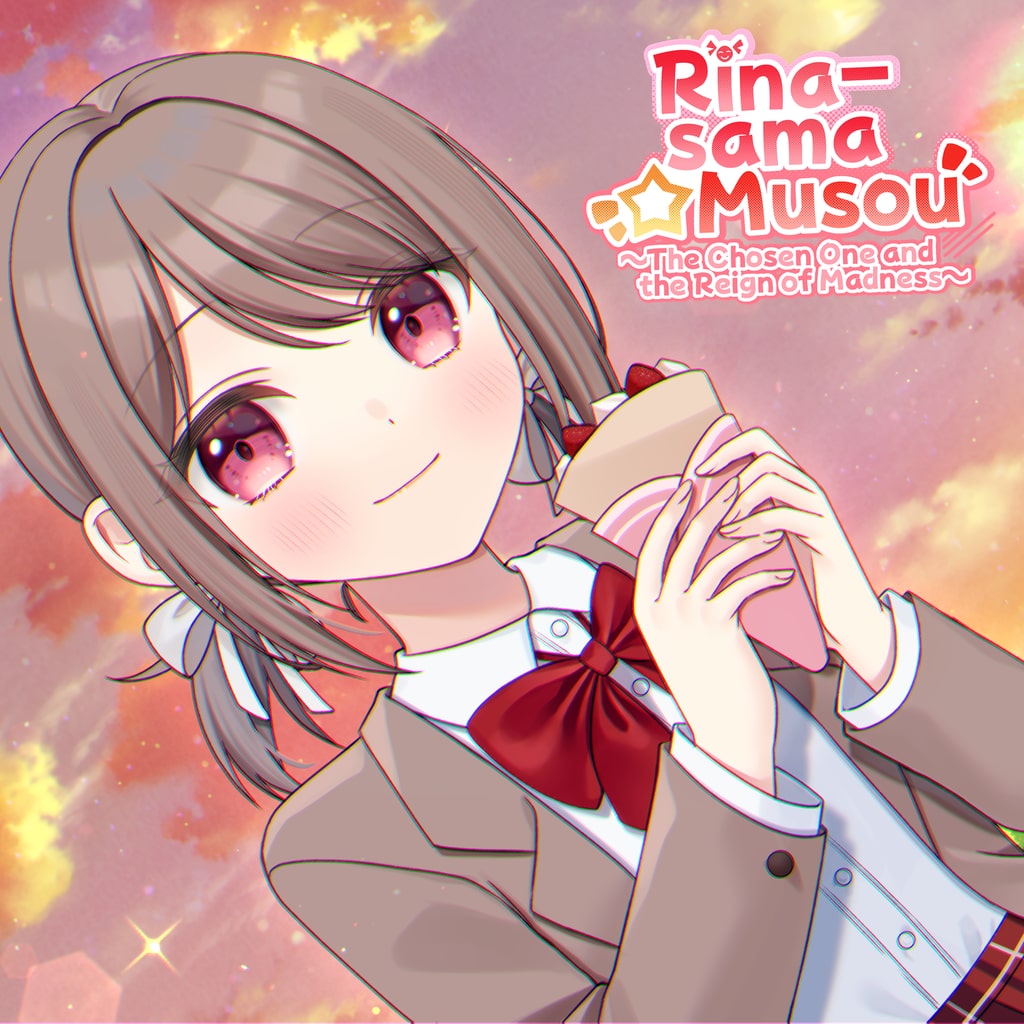
At first glance, Rina-sama☆Musou ~The Chosen One and the Reign of Madness~ looks like something entirely different from what it actually is. The word “Musou” immediately conjures images of battlefield chaos and thousands of enemies falling beneath flashy attacks. Instead, Moesoft delivers something far more intimate — and far more unsettling.
This is not a hack-and-slash power fantasy. It’s a psychological visual novel wrapped in cheerful anime aesthetics, one that slowly dismantles player expectations through surreal storytelling, unreliable perspectives, and emotional manipulation.
What begins as a lighthearted school-life comedy gradually transforms into a deeply uncomfortable mystery about identity, control, and perception. The contrast between tone and subject matter becomes the game’s defining strength — and occasionally its most disturbing weapon.
A Quiet Life That Refuses to Stay Quiet
You play as an ordinary student hoping for a peaceful school routine. That hope lasts only minutes before you encounter Rina Shinonome, an impossibly charismatic girl who forcibly recruits you into the oddly named “Happy Life Research Society.”
Rina appears perfect at first:
- Intelligent
- Energetic
- Universally admired
- Constantly smiling
But something feels… off.
The early chapters lean heavily into slice-of-life comedy. Dialogue is playful, interactions exaggerated, and character dynamics charmingly chaotic. Players familiar with visual novels may initially assume they’re entering a romantic comedy or school drama.
That assumption is deliberate — and eventually shattered.
As days pass, inconsistencies emerge. Conversations repeat with subtle changes. Characters behave as if remembering events differently. Background details shift in ways that are easy to dismiss at first.
Then the narrative begins to unravel completely.
Psychological Horror Through Atmosphere, Not Shock
Unlike traditional horror games relying on jump scares or violence, Rina-sama☆Musou builds dread slowly through psychological tension.
The horror comes from uncertainty:
- Is Rina manipulating reality?
- Is the protagonist losing sanity?
- Are supernatural forces involved — or something more personal?
Scenes that once felt comedic begin carrying unsettling undertones. Dialogue choices gain unexpected consequences, and previously harmless moments acquire disturbing new context.
The game excels at weaponizing familiarity. By establishing a safe emotional baseline early on, later narrative twists land with far greater impact.
The result is a creeping discomfort that intensifies rather than explodes — more existential unease than outright terror.
Choices That Truly Matter
Branching paths form the backbone of gameplay.
Player decisions shape relationships, reveal hidden layers of the story, and ultimately determine which of several endings you reach. Choices rarely announce their importance, reinforcing the sense that consequences unfold organically rather than mechanically.
Some routes emphasise romance or emotional connection, while others spiral into darker territory, exploring madness and obsession.
Replayability becomes essential. A single playthrough reveals only fragments of the larger narrative puzzle, encouraging players to revisit earlier choices with new understanding.
Importantly, alternate paths don’t feel like filler content — they reshape your interpretation of the entire story.
Rina Shinonome: A Brilliantly Unstable Centerpiece
Rina herself is the game’s greatest achievement.
She exists simultaneously as:
- Comic relief
- Emotional anchor
- Narrative mystery
- Potential antagonist
Her cheerful personality masks layers that unfold gradually, and Japanese voice acting elevates every interaction. Subtle vocal shifts hint at hidden emotions long before the script confirms them.
The writing keeps players uncertain whether to trust or fear her — often both at once.
Few visual novel protagonists sustain this level of narrative gravity without overwhelming the rest of the cast, yet Rina’s presence enhances every scene she occupies.
Presentation: Cute Meets Unsettling
Visually, the game adopts a vibrant anime aesthetic, featuring expressive character portraits and colourful environments.
At first, everything feels warm and inviting. Soft lighting and bright palettes reinforce the illusion of a traditional school story.
As the narrative darkens, visual techniques begin to change:
- Background distortions appear subtly
- Character expressions linger too long
- Color tones shift almost imperceptibly
These alterations rarely draw attention to themselves directly, but collectively they create unease.
The art direction understands that horror works best when beauty remains intact — just slightly wrong.
Sound Design and Voice Acting
Japanese voice acting is consistently strong, adding emotional nuance often lost in text-heavy visual novels.
Music deserves special mention. Early tracks lean into cheerful slice-of-life themes before gradually introducing distorted motifs and ambient tones as the story progresses.
The soundtrack evolves alongside the narrative, mirroring the protagonist’s psychological descent.
Moments of silence are used effectively, allowing tension to build naturally rather than forcing emotional cues.
Pacing: A Slow Burn With Purpose
The game’s pacing may divide players.
The first few hours unfold deliberately, focusing on character interactions and daily life. Players seeking immediate horror may find the opening slow.
However, this patience pays off. Emotional investment makes later twists far more impactful.
Once the story crosses its midpoint, momentum accelerates dramatically, transforming quiet scenes into emotionally charged confrontations.
The experience rewards commitment — but demands it first.
Where the Experience Stumbles
Despite strong storytelling, the game isn’t without flaws.
Navigation between scenes can feel limited, with few interactive elements beyond dialogue choices. Players expecting adventure-game mechanics may find the gameplay sparse.
Additionally, some branching routes feature extended dialogue segments, making repeat playthroughs occasionally repetitive before new content appears.
Localization is generally solid, though occasional phrasing feels slightly stiff compared with the fluidity of the original Japanese performances.
A Surreal Story That Lingers
What ultimately makes Rina-sama☆Musou memorable is how long it stays with you after completion.
Its themes — identity, perception, emotional dependency — invite reflection long after the credits roll. The title’s use of “Musou” (dream/illusion) becomes metaphorical rather than literal, representing fractured realities rather than battlefield dominance.
It’s less about defeating madness than about understanding it.
Pros & Cons
Pros
- Excellent psychological storytelling
- Strong, complex central character
- Meaningful branching paths and multiple endings
- Beautiful anime art direction
- Effective atmosphere-driven horror
- High-quality Japanese voice acting
Cons
- Slow opening hours may test patience
- Limited gameplay interaction beyond choices
- Some repeated dialogue across routes
- Not suited for players expecting action gameplay
Final Verdict
Rina-sama☆Musou ~The Chosen One and the Reign of Madness~ is a masterclass in tonal deception. Beneath its cheerful anime exterior lies a deeply unsettling psychological visual novel that rewards attentive players with layered storytelling and emotionally resonant twists.
It may disappoint those misled by its title or expecting gameplay-heavy mechanics, but for fans of narrative-driven experiences, it delivers one of the more memorable indie visual novels in recent years.
Cute, surreal, and quietly terrifying, it proves that madness doesn’t always arrive screaming — sometimes it smiles warmly and invites you to join a club.