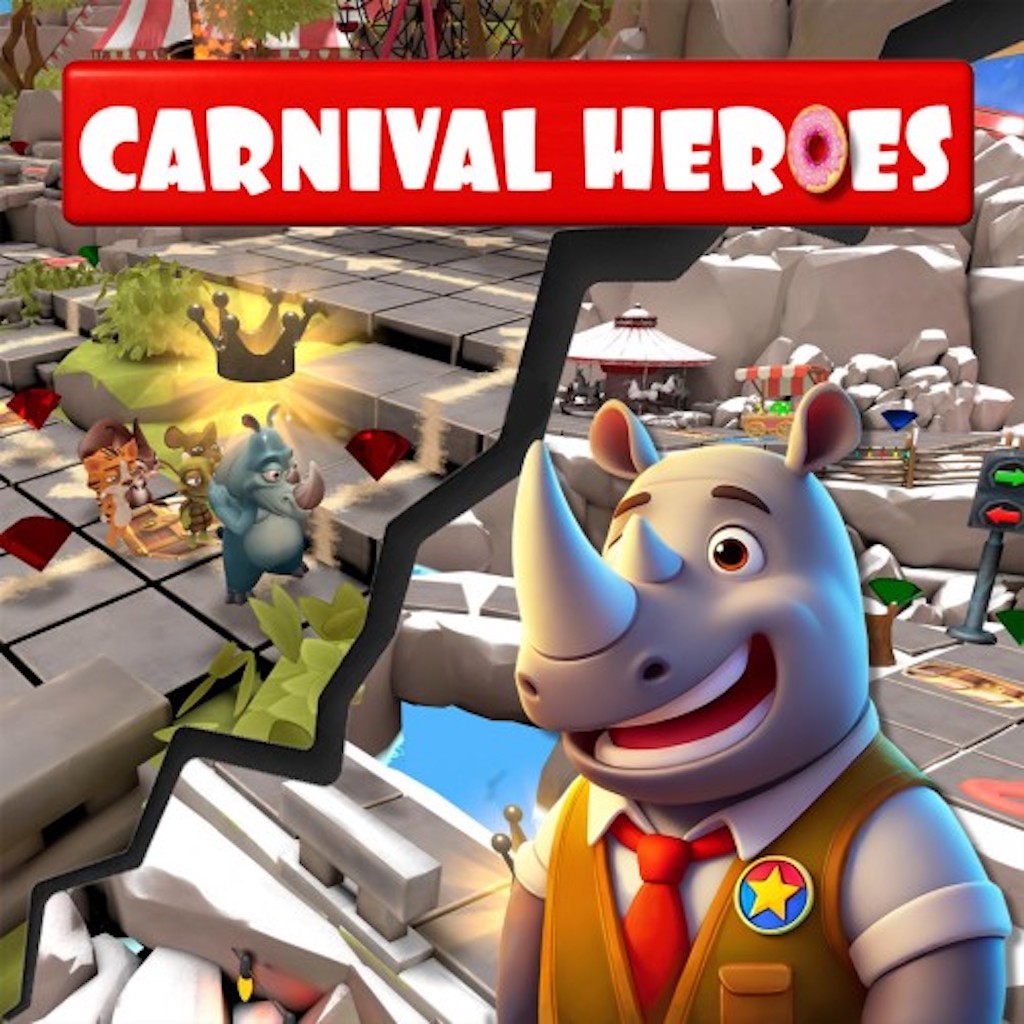
There are party games that aim for chaotic brilliance, and there are party games that aim for accessible fun on a budget. Carnival Heroes – Super Party Minigames, developed and published by LAN – GAMES LTD, firmly sits in the latter category — and that’s not necessarily a bad thing.
Originally released on PC in April 2025 before landing on PlayStation 4 and Xbox One later that year, Carnival Heroes positions itself as a cross-platform alternative to the genre giant it clearly draws inspiration from. The formula is unmistakable: digital board game progression, crown-buying economy, and a steady stream of competitive minigames designed to test reflexes, luck, and friendship durability.
At £8.39, the question isn’t whether it can dethrone the kings of the party genre. It’s whether it can deliver enough laughs, sabotage, and chaotic reversals to justify a spot in your multiplayer rotation.
Surprisingly, it often can.
The Core Loop: Roll, Race, Rival
Carnival Heroes supports 2–4 players locally, online, or in a mixed setup. The objective is simple: collect gems, purchase Crowns, and finish the game with the most Crowns.
You take turns rolling a die, navigating the board, collecting resources, and triggering events. At the end of each round — or when landing on specific spaces — players compete in one of 24 minigames. Victory earns additional gems, which are used to purchase Crowns or items.
The structure is familiar, but it’s well implemented. Matches move at a brisk pace, with rounds flowing smoothly into minigames without excessive downtime.
The real hook, however, lies in the board design.
FIXED vs FREE Mode: A Clever Distinction
Carnival Heroes offers two distinct board modes:
FIXED Mode
A traditional path-based system where players follow preset routes but choose directions at intersections.
FREE Mode
A more strategic twist where players draw their exact path before moving.
FREE Mode is where the game truly differentiates itself. Instead of simply rolling and accepting fate, you map your own route across the grid, attempting to maximize gem collection, land on advantageous tiles, or avoid dangerous ones.
This adds a layer of tactical decision-making absent from many budget party games. Planning efficient routes becomes essential, especially when Crown vendors appear far from your position.
It doesn’t revolutionize the genre, but it adds meaningful depth.
The Economy: Gems, Crowns, and Chaos
The in-game economy revolves around:
- Gems (currency)
- Crowns (victory condition)
- Items (inventory tools)
- Mates (animal allies that boost dice rolls)
Crowns start at 10 gems but increase in price over time, adding urgency to early-game aggression.
Mates are particularly interesting. Each one gives you an extra die and contributes additional small dice rolls. In FREE Mode especially, stacking mates can significantly increase mobility and strategic reach.
Board tiles include:
- Chests (random rewards)
- Stores (item purchases)
- Battle spaces (forced minigame bets)
- Hidden gifts (surprises or bombs)
- Traffic lights (free vs paid route splits)
- Cracked tiles (tax penalties if overused)
The variety keeps board play dynamic, though it occasionally feels slightly overstuffed. New players may need a few rounds to fully understand all tile mechanics.
The Minigames: Quantity Over Innovation
With 24 minigames included, Carnival Heroes offers decent variety.
They range across genres:
- Arcade shooters
- Endless runners
- Memory challenges
- Rhythm games
- Solo challenges against AI
- Reflex-based button mashers
The quality varies.
Some minigames are genuinely fun and tense, encouraging fast reactions and tight competition. Others feel simplistic — closer to mobile microgames than console-level polish.
That said, their brevity works in the game’s favor. None overstay their welcome. Even weaker minigames last only a short time before returning players to the board.
Importantly, they are easy to understand. This makes the game family-friendly and accessible for casual players.
Avatar System: Light Tactical Flavor
You choose from eight animal avatars, each with a unique special die.
You can choose to roll:
- Standard 1–6 die
- Character-specific die with unique distribution
This adds subtle strategic choice. Some special dice favor high numbers but carry risk. Others offer consistency.
It’s not deeply complex, but it encourages light experimentation and character preference.
Visually, the avatars are charming but simple. They lack strong personality beyond their dice mechanics, which feels like a missed opportunity for more thematic flair.
Cross-Platform Play: The Game’s Strongest Feature
One of Carnival Heroes’ most impressive inclusions is full cross-play between PC, PlayStation, and Xbox players.
At this price point, cross-platform functionality is rare.
Online matchmaking is straightforward and stable. Latency during minigames is generally manageable, though extremely reaction-sensitive games can occasionally feel slightly delayed depending on connection quality.
For groups of friends across platforms, this feature significantly boosts value.
Presentation and Polish
Visually, Carnival Heroes leans into bright, colorful, carnival-themed aesthetics. Boards are vibrant but somewhat generic. Animations are functional rather than flashy.
There’s a slight “indie budget” feel to the presentation — not ugly, but not especially dynamic either.
UI navigation is clear. Menu flow is smooth. Load times are short.
Audio is serviceable. Upbeat music supports the party vibe but rarely stands out.
It’s not a production powerhouse, but it doesn’t need to be.
Solo Mode & AI
If you don’t have friends available, AI opponents fill in.
Difficulty is adjustable, but even on higher settings, AI behavior can feel inconsistent. Sometimes it makes clever route decisions. Other times it wastes gems or fails to prioritize Crown acquisition.
Solo mode works as practice, but the true appeal lies in multiplayer chaos.
Where It Stumbles
While enjoyable, Carnival Heroes has limitations:
- Minigames lack standout originality.
- Visual presentation feels safe.
- No deep progression or unlockable cosmetic system.
- Avatar personalities are underdeveloped.
- Some board mechanics feel overly busy for newcomers.
It’s also not as emotionally chaotic as top-tier party games. The “friendship-ending” moments are present — particularly in Battle spaces — but they don’t escalate to legendary levels.
Still, at its price, expectations must remain grounded.
Value Proposition
At £8.39, Carnival Heroes offers:
- 24 minigames
- 2 distinct board modes
- Cross-platform multiplayer
- 1–4 player local and online support
- Adjustable AI
That’s strong value for the price.
It won’t replace premium party franchises, but it provides an affordable alternative for groups seeking casual chaos without investing in a full-price title.
Final Verdict
Carnival Heroes – Super Party Minigames doesn’t reinvent the party genre, but it delivers a surprisingly competent and accessible board-game experience at a budget-friendly price.
FREE Mode adds meaningful strategy. Cross-play boosts longevity. The minigame variety keeps sessions lively even if not groundbreaking.
It’s the kind of game that shines brightest with friends on the couch, laughing over surprise bombs, Crown thefts, and last-turn upsets.
It may not be the king of the carnival, but it certainly earns a ticket.