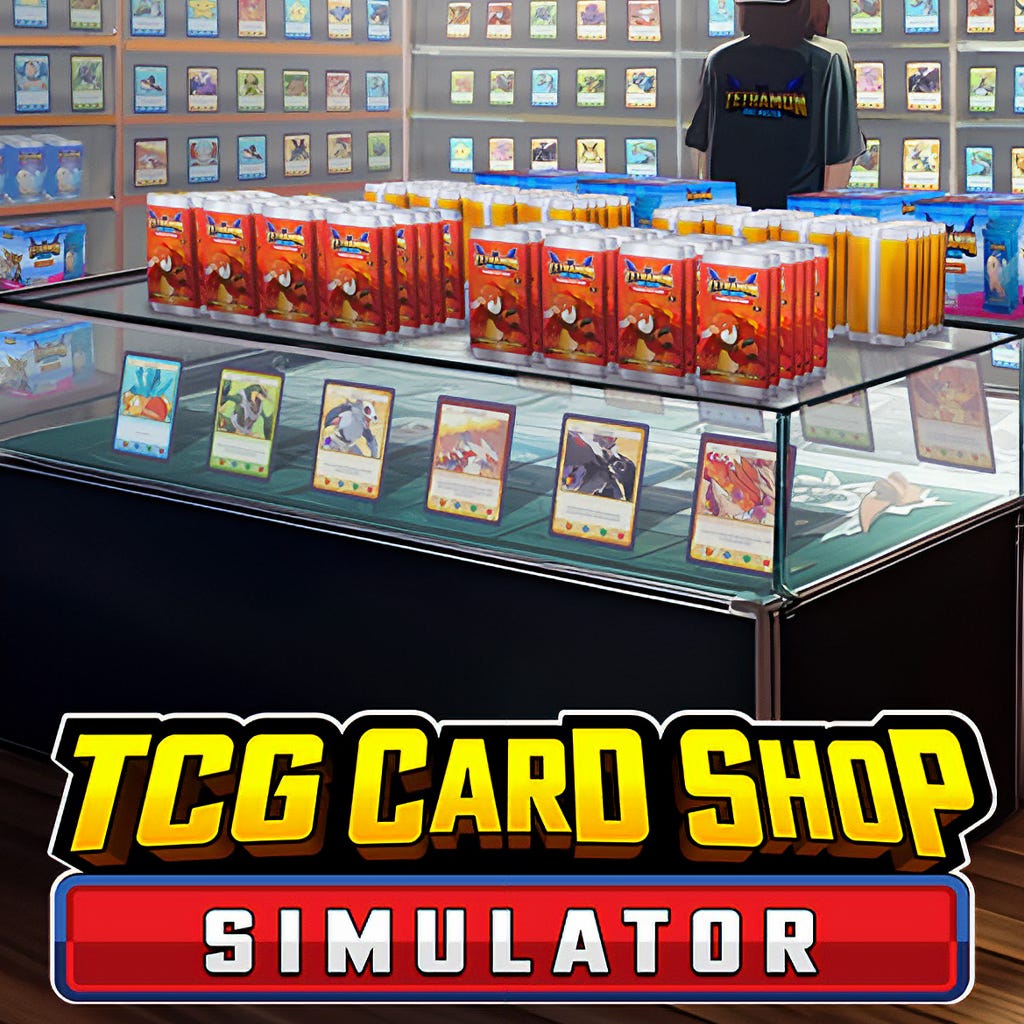
There is something wonderfully dangerous about opening a pack of trading cards. You know you probably should not be spending the money, and you know the chances of finding something genuinely valuable are slim, yet there is always that little voice in your head saying, “Go on, just one more.” TCG Card Shop Simulator understands that feeling well and builds an entire game around it. What begins as a simple shop-management simulator soon becomes an unexpectedly addictive mix of retail, collecting, expansion and the eternal temptation to rip open another booster pack.
Developed and published by solo indie developer OP-Gamers, TCG Card Shop Simulator puts you behind the counter of your very own trading card shop. What starts as a fairly humble retail operation quickly becomes an increasingly elaborate business where you order stock, set prices, arrange shelves, clean the shop, deal with customers and decide whether that shiny card you just pulled should be sold for a healthy profit or kept for your personal collection. It sounds simple, and in fairness, it is, but there is something remarkably satisfying about watching your little shop grow from a cramped room into a bustling card-collecting haven. More importantly, the game understands that running a card shop is only half the fantasy, because the other half is opening packs and hoping that fortune finally decides to smile upon you.
Welcome To The Card Shop
The early hours of TCG Card Shop Simulator are deliberately modest, making the progression all the more satisfying. You are not walking into some enormous retail empire with rows of gleaming cabinets and customers queuing around the block. Instead, you have a small shop, limited stock and a bank balance that demands rather more attention than you would probably like. Your first job is simply to get products onto the shelves, set sensible prices and make enough money to keep the business moving. Before long, however, you are thinking about where everything should go, which products are selling and whether you can afford to expand the premises.
That humble beginning gives the game somewhere meaningful to go, and there is a pleasing sense of progression as each improvement changes the feel of your business. You start by placing booster packs on shelves and gradually find yourself managing increasingly large amounts of stock. Customers arrive, browse your products, pick up their purchases and head towards the till while you rush around making sure everything is ready for the next wave of shoppers. It is hardly the most glamorous job in the world, but TCG Card Shop Simulator manages to make retail feel surprisingly rewarding.
The Art Of Making A Profit
Running a shop is about more than simply putting products on shelves and hoping people buy them. You need to think about your pricing, stock levels and what customers actually want, while keeping enough money available to fund your next expansion. Set prices too high and people may decide to spend their money elsewhere, while setting them too low can leave you working hard without generating enough profit to improve the business. That balance gives the game more depth than its cheerful presentation initially suggests.
You are constantly making small decisions about what to order and how much to charge, and those decisions gradually become more important as the shop grows. There is also something particularly enjoyable about seeing a product suddenly become popular, especially when customers start buying a particular booster pack faster than you can restock it. It creates the feeling that you are actually responding to a market rather than simply completing a list of objectives handed to you by the game. It is not the deepest business simulator you will ever encounter, but it gives you enough control to make your decisions feel worthwhile.
Just One More Pack
Then there is the part of the game that threatens to derail your carefully planned business strategy. Opening booster packs is ridiculously addictive, and the game does a remarkable job of capturing the anticipation of not knowing what you are about to find. You can choose to sell sealed products for a reliable profit, or open them yourself and hunt for valuable cards, the latter obviously being considerably more exciting and potentially much more rewarding. The problem is that it is also considerably more dangerous for your carefully maintained finances.
There is something wonderfully satisfying about tearing open a virtual pack and revealing the cards one at a time. Most of the time, you will get something fairly ordinary, but every now and then you hit something special, and that little opening animation suddenly becomes surprisingly exciting. Finding rare foil and high-value cards creates exactly the sort of little rush that makes collecting so appealing in the real world, particularly when you see a card that could make you a tidy profit. You can then decide whether to sell it, display it in your shop, or keep it for yourself, and that decision becomes one of the game’s most enjoyable little dilemmas.
A Collection Of Your Own
The collecting side of TCG Card Shop Simulator could easily have been little more than a gimmick, but it becomes an important part of the overall experience. There is genuine satisfaction in gradually building your collection and hunting down cards you have not seen before, particularly when you are chasing something rare. Opening packs becomes more than simply another way of generating money because you start wanting particular cards for yourself, and suddenly your sensible business plan starts looking rather less sensible.
This creates a constant argument between the responsible shopkeeper and the card-collecting obsessive living somewhere inside your head. You may have just pulled an extremely valuable card that could pay for your next shop expansion, but there is something deeply satisfying about keeping it instead. That tension between profit and personal obsession is one of the game’s smartest little touches because it gives the card-opening mechanics a purpose beyond simply making money. Anyone who has ever bought a pack of cards and immediately thought, “I should have bought another one,” will recognise the feeling.
Making The Shop Your Own
As money starts coming in, your shop gradually becomes more than just a place to sell booster packs. You can expand the space, add more shelving and improve your facilities, allowing the business to handle more products and more customers. The layout of the shop becomes increasingly important as you accumulate more stock, and there is a pleasing sense of ownership in arranging everything in a way that works for you. What once looked like an empty room slowly starts to feel like your shop.
You can organise your products so customers can move around more easily, create dedicated areas for different types of merchandise, and gradually turn your tiny business into something that actually resembles a thriving local game shop. The customisation is not the most sophisticated shop-building system you will ever encounter, but it does exactly what it needs to do. More importantly, every expansion feels earned because you have made the money yourself. That first major upgrade gives you a surprisingly satisfying feeling that your little business is finally getting somewhere.
Keep It Clean!
One of the more amusing aspects of TCG Card Shop Simulator is how much attention you have to pay to cleanliness. Yes, your card shop needs to be clean, because apparently rare cards and booster packs are not enough to keep customers happy. You need to keep the floors tidy and deal with unpleasant smells when they appear, all while maintaining a respectable environment for people who have come to spend their hard-earned money on cardboard.
It is hardly the glamorous side of running a gaming business, but it adds another little task to your routine and gives the shop a strange sense of life. You are not simply ordering products and watching numbers go up, because you are physically walking around the premises, sorting shelves, dealing with mess, and making sure everything is ready for the next wave of customers. There is something strangely charming about it, especially when you consider how seriously the game treats this mundane responsibility. You might be the proud owner of a valuable card collection, but someone still has to pick up the rubbish.
Game Night
As the business develops, you can also introduce gaming tables and allow customers to play card games in your shop. This is a lovely addition because it makes the store feel more like a genuine community space rather than somewhere people simply visit to buy products and leave. Players arrive, sit down and spend time in your shop, giving you another way to attract customers and generate income while adding another layer to day-to-day management. It also helps the shop feel increasingly like a place where people want to spend time.
The idea fits perfectly with the culture surrounding trading card games, because a good local card shop has traditionally been about more than simply selling packs. It is somewhere for people to meet, play, trade and share their enthusiasm for the hobby, and TCG Card Shop Simulator captures some of that atmosphere within its deliberately simple simulation framework. Keeping the place clean becomes even more important when you have players hanging around for games, which means those little maintenance jobs suddenly have a purpose. It is a small feature, but it contributes considerably to the feeling that you are building a real community around your shop.
Growing Into Something Bigger
The progression system is arguably what holds everything together, because almost everything you do feeds naturally into the next stage of development. Sell cards and make money, use that money to order more stock, sell more stock to increase your profits, and then invest those profits into expanding the shop. The loop is incredibly straightforward and remarkably effective, as there is almost always another improvement waiting for you. Before you realise it, what was supposed to be a quick half-hour can easily turn into several hours of ordering products and rearranging shelves.
There is always another upgrade waiting, another product to order, or another rare card to find, so you are rarely left wondering what to do next. The simplicity can make the experience somewhat repetitive over longer sessions, particularly if you are looking for a management simulator with much deeper economic systems. Yet that simplicity is also part of its appeal, because TCG Card Shop Simulator does not bury the fun beneath spreadsheets, complicated menus, or endless statistics. It wants you to run a shop, open cards, and enjoy yourself, and sometimes that is exactly what a simulation game should do.
A Surprisingly Relaxing Experience
Visually, TCG Card Shop Simulator takes a clean, straightforward approach that suits the experience well. The first-person perspective works particularly well, allowing you to physically interact with your shop, while products are easy to identify and shelves are simple to organise. There is little visual clutter getting in the way, so you can concentrate on what you are doing rather than trying to decipher an unnecessarily complicated interface. It is not going to win awards for graphical technology, but it does not need to.
The audio design deserves some credit too, with the chatter of customers, register sounds, background music and the satisfying noises of opening packs combining to create a surprisingly relaxing atmosphere. There is something almost therapeutic about spending an evening restocking shelves while customers wander around your increasingly impressive store. Then you open a booster pack and everything changes, because suddenly there is a possibility that you have found something worth a small fortune. That combination of relaxing shop management and occasional moments of card-collecting excitement gives the game a surprisingly enjoyable rhythm.
Final Verdict
TCG Card Shop Simulator is one of those games that looks considerably simpler than it feels once you start playing. On paper, it is a straightforward simulation about selling trading cards, but in practice it becomes a surprisingly compelling blend of retail management, shop customisation, collecting and expansion. The individual mechanics are not especially complicated, yet they fit together so naturally that the overall experience becomes far more addictive than you might expect.
The business side is accessible without feeling shallow, while the ability to open packs and hunt for rare cards gives the game its addictive heart. There is a constant tension between selling everything for profit and keeping the cards you genuinely want, and that simple choice makes the collecting mechanics far more engaging than they have any right to be. The shop also gradually becomes yours, with every new shelf, product and expansion giving you another reason to feel invested in the business. Watching customers arrive at a shop that started as an almost empty room is a surprisingly satisfying reward.
There are limitations, of course, and the basic management mechanics can become repetitive if you play for extended periods. Anyone looking for a deeply detailed business simulator may eventually want more complexity, while the straightforward visual presentation will not exactly push your hardware to its limits. Neither issue really gets in the way of what the game is trying to achieve, though, because this is clearly designed to be an accessible and relaxing simulation rather than an intimidating business management exercise. The simplicity is arguably one of its greatest strengths.
The real danger is the pack opening, because that is where your carefully considered business strategy can go completely out of the window. You start with the intention of running a profitable shop, only to find yourself staring at a booster pack thinking that surely the next one will contain something incredible. Then another pack disappears, followed by another, and suddenly you are wondering where all the money you were saving for that expensive new upgrade has gone. Before long, you realise that you are no longer simply running a card shop, because you have become the person standing behind the counter who cannot resist opening one more pack. And honestly, that is probably exactly how it should be.