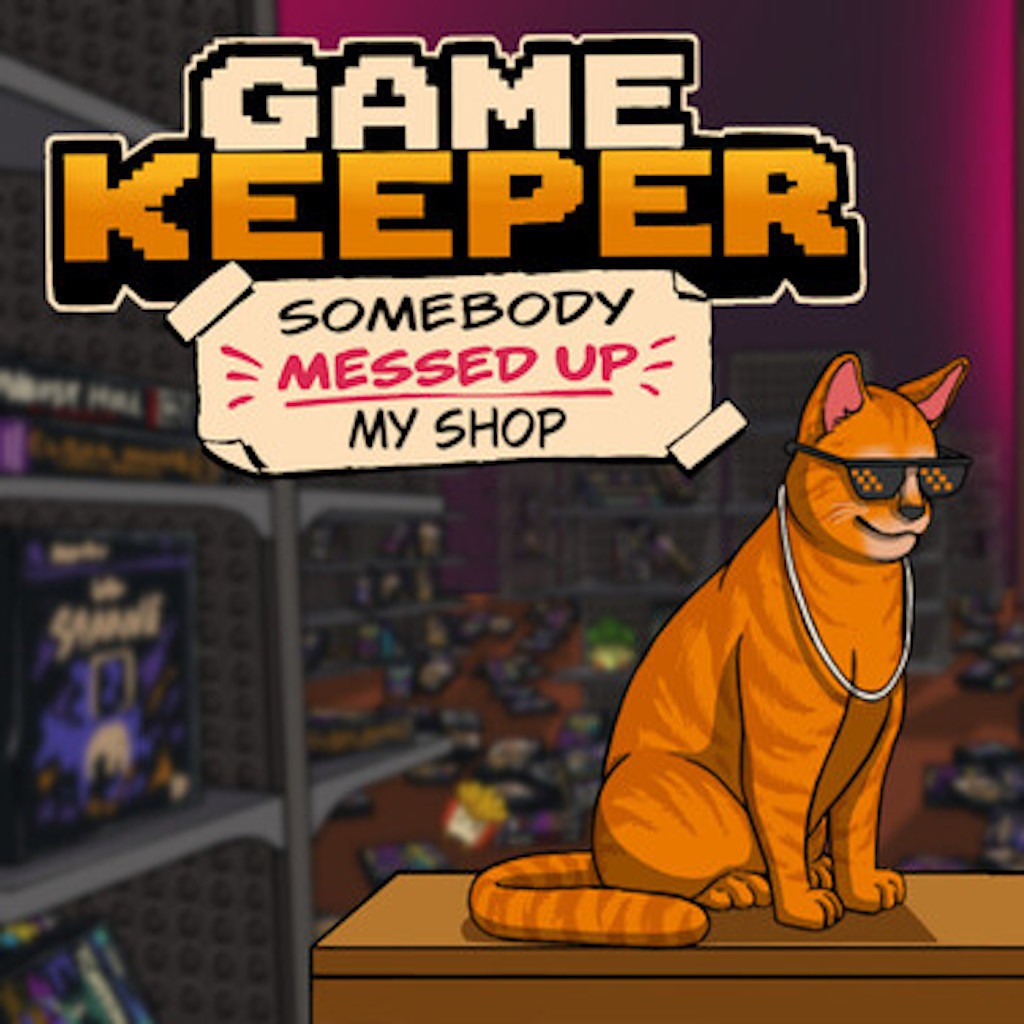
There are few things in life more satisfying than taking something completely chaotic and putting it back in order. Whether it is tidying a messy room, sorting a collection, or finally getting that unruly cupboard under control, there is something strangely therapeutic about turning disorder into something neat and organised. Game Keeper: Somebody Messed Up My Shop! takes that simple pleasure and throws an absolutely ridiculous number of video game cases into the mix, then adds a gambling-addicted cat called Jeff for good measure.
Developed and published by VeinStudios, Game Keeper: Somebody Messed Up My Shop! is a single-player organisation simulator set inside a slightly outdated video game shop that has seen considerably better days. Your unfortunate predicament begins when you wake up to discover that your colleague, Jeff, has somehow knocked thousands of game cases from their shelves. Your task is therefore rather straightforward in theory. You need to put all 4,290 cases back where they belong, filling 96 racks and organising 650 different game series in the correct order. Simple, right? Well, perhaps not when you are staring at a shop floor buried beneath a small mountain of plastic cases.
A Mess Worth Cleaning Up
The first thing that Game Keeper gets right is its grasp of the appeal of organisation. There is no complicated narrative standing between you and the mess, and there does not need to be. You walk into the shop, see the chaos, and immediately want to start fixing it. There is an almost primal satisfaction in picking up a case, finding the appropriate section, and slotting it neatly into place. Do that a few hundred times, and you begin to understand exactly what the game is trying to achieve.
The sheer scale of the job is what makes the experience particularly amusing. Four thousand two hundred and ninety cases is a ridiculous number, especially when you consider that they are spread across a sizeable shop and need to be arranged by genre and order. What initially looks like a straightforward tidying exercise gradually becomes an enormous logistical puzzle. You start by moving individual cases around, but before long you are thinking about the most efficient route through the shop and wondering whether there is a quicker way to tackle the next section.
That sense of progression is important because Game Keeper would probably become exhausting without it. Fortunately, the game understands that asking somebody to manually organise thousands upon thousands of cases requires some form of compensation.
From Shop Assistant to Organisation Machine
Progression takes the form of an extensive skill tree, and this is where the game becomes more than a simple virtual tidying simulator. As you work through the shop, you earn experience and unlock abilities that make the process faster and more efficient. Movement speed can be improved, while other upgrades let you pick up more cases or even handle entire game series at once.
There is something wonderfully satisfying about returning to an area that once felt cumbersome after unlocking a new ability. Suddenly, a job that once required several trips can be completed much more efficiently. It creates that familiar incremental game feeling, where you can look back at what initially seemed like an impossible workload and realise just how much more capable your character has become.
The progression is deliberately gradual, though, and this can make the opening hours feel a little slower than they perhaps need to be. Your movement speed starts off rather pedestrian, and when you are surrounded by thousands of cases, even a short walk can begin to feel like a commute. The upside is that the upgrades give you a genuine reason to keep playing, rather than simply existing as numbers on a menu.
Jeff Is Definitely Not Employee of the Month
Then there is Jeff. Jeff is a cat. Jeff is also apparently your colleague, despite showing no signs of being capable of meaningful work. In fact, Jeff is responsible for the entire mess in the first place. Rather than helping you clean up the disaster he created, Jeff introduces you to a gambling machine. It is difficult not to admire the sheer stupidity of this idea.
Jeff has a gambling problem, and rather than addressing it, the game effectively decides that you should participate in it too. The gambling machine can reward you with upgrades and useful boosts, adding an element of risk and reward to the otherwise peaceful organisation loop. It is an amusing little distraction that gives Jeff a personality beyond simply being the feline equivalent of a workplace disaster.
The humour surrounding Jeff also helps prevent the game from taking itself too seriously. There is a wonderfully silly quality to the entire premise. You have thousands of cases to organise, hundreds of fictional game series to complete, and a cat who appears to think gambling is an acceptable contribution to the workplace. Somehow, it all fits together.
A Love Letter to Gaming
Perhaps the biggest surprise is just how much fun there is in spotting the game’s references. The 650 game series is packed with parody names, visual nods and jokes inspired by familiar gaming franchises. Some are subtle enough to walk straight past, while others are clearly designed to make anyone with a long history of gaming stop and have a chuckle.
This adds an extra layer of enjoyment to the experience. You are not merely putting anonymous cases onto anonymous shelves. You are discovering ridiculous versions of familiar games as you work your way through the store. For anyone who has spent years surrounded by game boxes, shelves and collections, there is a nostalgic quality to the whole thing.
The references also provide a nice reason to slow down occasionally. Although the progression system encourages efficiency, there is something enjoyable about simply wandering around the shop and seeing what has been hidden among the shelves. The developers clearly have a fondness for gaming, and that affection comes through in the sheer number of references scattered throughout the experience.
The Joy of Watching Chaos Disappear
Visually, Game Keeper opts for realistic graphics and lighting rather than a heavily stylised presentation. The shop itself becomes the star of the show, with shelves, racks, cases and other details helping to create the feeling that you are genuinely working in a slightly tired but familiar video game store.
The atmosphere is greatly enhanced by the music and overall sound design. This is not a game that needs bombastic orchestral music or dramatic explosions to hold your attention. Instead, it creates a comfortable environment where you can settle into the rhythm of picking things up, walking around and putting them where they belong.
That rhythm is arguably the entire point. There is a strange meditative quality to watching the shop gradually transform from an absolute catastrophe into an organised retail environment. Every completed rack feels like a tiny victory, while completing another series gives you another reason to keep going.
Not Quite Perfectly Organised
There are a few rough edges that keep Game Keeper from being the perfectly polished organisation simulator it occasionally threatens to become. Early on, movement can feel frustratingly slow before you have invested in the appropriate upgrades, particularly when the shop is already overwhelming you with its sheer size.
There have also been reports of occasional optimisation stutters and collision issues, particularly when navigating crowded aisles. These are not problems that destroy the experience, but they can interrupt the otherwise wonderfully smooth rhythm of the gameplay. When the entire appeal is based on getting into a satisfying flow, even small technical annoyances can stand out.
Replayability is another interesting question. Once you have organised all 4,290 cases, there is obviously less reason to repeat the entire process from scratch. The achievement and challenge systems, collectibles and progression provide additional goals, but this is ultimately a game built around the satisfaction of completing one enormous organisational project rather than endlessly replaying it.
A Surprisingly Satisfying Mess
What makes Game Keeper: Somebody Messed Up My Shop! work is its understanding of its audience. It does not try to reinvent the simulator genre, nor does it need to. Instead, it takes the simple concept of putting things where they belong and expands it into an enormous, strangely compelling project.
There is something deeply satisfying about watching those empty racks gradually fill up. There is satisfaction in unlocking a new ability that saves you time. There is satisfaction in spotting a parody of a game you recognise. Most importantly, there is satisfaction in looking around the shop after a long session and realising that the enormous mess is slowly disappearing.
The addition of Jeff gives the whole thing a welcome sense of humour, while the skill tree provides enough progression to make those repetitive actions feel meaningful. The occasional technical issues and sluggish opening pace prevent it from being flawless, but once the upgrades start coming and the shop begins to take shape, Game Keeper becomes surprisingly difficult to put down.
Final Verdict
Game Keeper: Somebody Messed Up My Shop! is the sort of game that sounds ridiculous when you explain it to someone. “You organise 4,290 video game cases while a gambling-addicted cat watches you” does not exactly sound like the premise for an addictive gaming experience. Yet somehow, VeinStudios has turned that bizarre concept into something genuinely charming.
The core organisation mechanics are simple but satisfying. The skill tree gives the experience a welcome sense of momentum, and the sheer number of gaming references provides plenty of little discoveries along the way. Jeff is an inspired bit of nonsense, while the shop itself becomes a surprisingly relaxing place to spend time. It is not without technical bumps, and the slow opening can test your patience. But once you start unlocking those upgrades, the numbers begin to disappear from your workload and the shelves start filling up.
For players who enjoy cleaning games, management sims, incremental progression, or simply the satisfaction of watching a chaotic space become orderly, Game Keeper is an easy recommendation. It is cosy, silly, and considerably more addictive than its premise has any right to be.