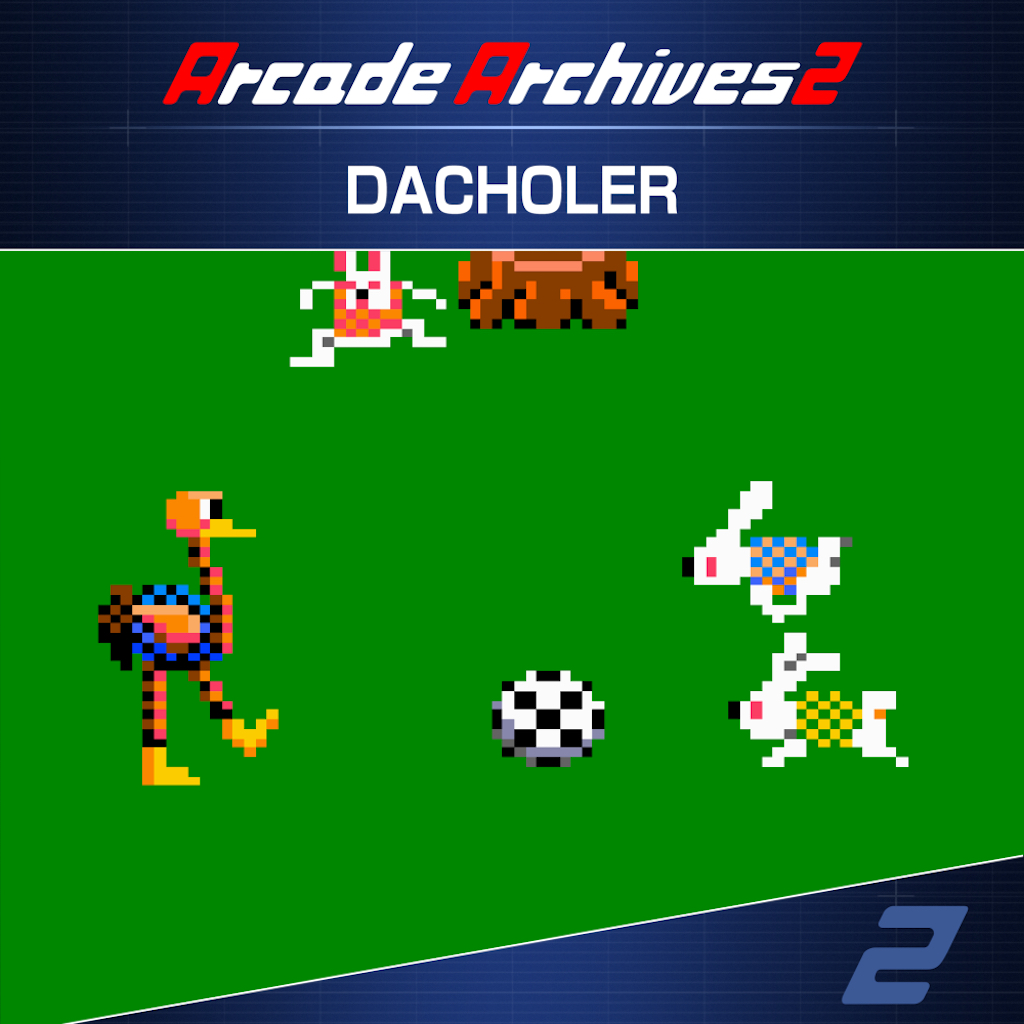
Some arcade games make perfect sense from the start. You look at the screen, understand what you are supposed to do, and know exactly how the game is going to play out. Then there are games like DACHOLER, where you are apparently an ostrich, turtles are kicked around like footballs, and a kappa can suddenly leap out of a river to ruin your carefully planned attack. This is very much one of those games, and honestly, that is precisely why it is so much fun. Originally released by Nichibutsu in 1983, DACHOLER is an obscure little arcade oddity that has survived because it has something increasingly rare in gaming: a completely bonkers idea and absolutely no interest in taking itself seriously.
Arcade Archives 2 DACHOLER brings this wonderfully strange piece of arcade history to modern hardware, preserving the original experience while adding the collection of features that has become synonymous with HAMSTER’s retro releases. At its heart, this is a simple single-screen action game centred on kicking turtles and using them as unlikely weapons against waves of enemy animals. The concept sounds ridiculous, plays exactly as ridiculous as it sounds, and somehow becomes surprisingly addictive once you understand how the momentum and positioning work. Better still, the inclusion of KICK BOY, a slightly altered version of the game, gives curious players another reason to spend time with this particularly eccentric corner of Nichibutsu’s arcade history.
Welcome To The Weirdest Arcade Fight
The basic idea behind DACHOLER is beautifully straightforward. You control your character and use powerful kicks to send turtles sliding across the screen, smashing into enemies and hopefully taking several of them down in the process. Rather than simply attacking everything directly, the turtle becomes your main weapon, and learning to make the most of its movement is where the game starts to reveal a little more depth.
There is something wonderfully satisfying about seeing a turtle glide across the screen and knock an enemy flying. The action has an almost cartoonish physicality, with each successful hit feeling more like a tiny game of arcade bowling than a traditional brawler. The best moments come when you line things up properly and send one turtle crashing through several enemies, turning what initially looked like a simple attack into a satisfying chain reaction.
Turtle Bowling
The turtle mechanic is undoubtedly the star of the show. You need to think about where the turtle will travel, where your enemies are positioned, and whether your kick will produce the result you hope for. A poorly timed kick can leave the turtle heading in the wrong direction, while a well-judged one can clear a surprisingly large section of the screen.
This makes DACHOLER more interesting than its wonderfully silly premise might suggest. You are not simply hammering an attack button and hoping for the best. There is a genuine sense of positioning involved, and once several enemies begin moving at the same time, you have to think quickly about which direction will give you the best chance of surviving. The turtle might look like a ridiculous projectile, but mastering it is the difference between an entertaining few seconds and a genuinely impressive run.
Then The Kappa Arrives
Just when you think you have worked out the rhythm of the game, DACHOLER introduces another problem in the form of the river and its rather troublesome resident. Kappas can leap out of the water and disrupt your carefully planned movements, adding another layer of danger to an already chaotic screen. They are exactly the sort of enemy that can turn a comfortable situation into a frantic scramble in seconds.
The environmental hazards are particularly effective because they stop you from becoming too comfortable. You might be concentrating on positioning a turtle for the perfect attack, only to have another threat appear where you least expect it. That is classic arcade design, where the game is constantly looking for another way to put pressure on the player. It is also part of what makes repeated attempts so enjoyable, as you gradually learn to recognise the warning signs and react more quickly.
Simple To Play, Harder To Master
Like many great arcade games from the period, DACHOLER is extremely easy to pick up. The controls are straightforward, the objective is immediately obvious, and you can grasp the basic mechanics within a couple of minutes. The difficulty comes from putting those simple ideas together while enemies move around you and environmental hazards make your life considerably more complicated.
That distinction between understanding a game and mastering it is something older arcade titles were particularly good at. You know exactly what you should be doing, yet doing it consistently is another matter entirely. One moment you are confidently lining up a turtle, and the next you are desperately trying to avoid an enemy while wondering where your carefully positioned projectile has disappeared to. It creates that familiar arcade cycle of failure, learning and one more attempt.
A Very Nichibutsu Kind Of World
Visually, DACHOLER is a lovely little time capsule from the early 1980s. The colourful sprites, unusual character designs and simple environments have an unmistakable arcade charm, and there is something refreshing about seeing a game that is not afraid to be completely strange. Modern games often spend enormous amounts of time explaining their worlds, whereas DACHOLER seems to have decided that you do not need an explanation. Here is an ostrich, here are some turtles, and there is a kappa in the river. Now get kicking.
The simple presentation also works surprisingly well for the gameplay. The action remains easy to read, which is important when turtles are flying across the screen and enemies are closing in from different directions. There is enough contrast between the characters and the background to make the important action clear, while the colourful sprites give the whole thing a cheerful personality. It looks old because it is old, but that is part of its appeal rather than something the game needs to hide.
Kick Boy Joins The Party
One of the most interesting additions here is something already part of the game’s history. Arcade Archives 2 DACHOLER includes KICK BOY, a slightly modified version that lets players compare the two releases. The differences may not completely transform the experience, but for anyone interested in arcade history, having both versions together is a genuinely nice touch.
It also gives you another reason to experiment after becoming familiar with the original. Seeing how the visuals and gameplay were adjusted offers a brief glimpse into how arcade games could evolve between releases and across regions. For casual players, it is an enjoyable extra, while for collectors and retro enthusiasts it is the sort of inclusion that makes a preservation release feel considerably more worthwhile.
Arcade Archives 2 Does Its Thing
As with the other Arcade Archives 2 releases, HAMSTER has surrounded the original game with a selection of modern conveniences. You can adjust the display settings, customise controls, and make use of save slots, rewind functionality, and rapid-fire options. These features do not change the game’s fundamental nature, but they make revisiting a title from 1983 considerably more comfortable on modern hardware.
The new Time Attack Mode is particularly interesting for a game that already has such a strong score-chasing mentality. Instead of concentrating purely on points, you can challenge yourself to clear the game as quickly as possible. Caravan Mode and High Score Mode provide their own challenges, while online rankings give those competitive players who really want to prove their turtle-kicking credentials somewhere to aim.
The Sound Of The Arcade
The audio is another area where the game’s age becomes part of its personality. The simple electronic sounds, impact effects and short musical cues have that unmistakable early arcade character, where every sound seems designed to grab your attention immediately. There is nothing remotely subtle about it, but subtlety was hardly the priority when the aim was to ensure you noticed every successful hit and every incoming threat.
Hearing those sounds alongside the colourful visuals gives the game a wonderful sense of place. It feels like something you might have stumbled across in an arcade decades ago, stared at for a few seconds, then thought, “What on earth is this?” before putting a coin in to find out. That sense of curiosity is still one of the best things about discovering obscure arcade games today.
One More Go
The real strength of DACHOLER is its ability to make something incredibly silly surprisingly compelling. You might initially laugh at the idea of kicking turtles, but once you start getting better at positioning those kicks, avoiding the kappa and building up successful attacks, the game starts to pull you in. Before long, you are no longer playing simply because the premise is funny. You are playing because you know you can get further.
That is the magic of a good arcade game. It does not need an enormous amount of content to keep you interested because the challenge comes from mastering what is already there. Every failure teaches you something, every successful chain feels rewarding, and every new high score provides a reason to try again. DACHOLER may be wonderfully odd, but beneath that oddness lies a surprisingly well-designed little action game.
A Charming Piece Of Arcade History
There is something especially enjoyable about seeing obscure games like this receive the same preservation treatment as the more famous arcade classics. DACHOLER may not have the immediate recognition of some of Nichibutsu’s better-known releases, but it embodies exactly the kind of strange, experimental thinking that made the early arcade era so fascinating. Developers were willing to try almost anything, and occasionally that produced something as gloriously peculiar as this.
HAMSTER’s treatment preserves that personality. Rather than trying to modernise the game or make it conform to contemporary expectations, Arcade Archives 2 DACHOLER simply gives it a comfortable home on modern hardware and adds the tools needed to make playing it today more convenient. That is exactly what a preservation release should do. The result is a game that feels like a genuine piece of its era rather than a modern recreation pretending to be old.
Final Verdict
Arcade Archives 2 DACHOLER is a wonderfully strange little arcade game, and sometimes being strange is more than enough. Its turtle-kicking mechanics are simple yet surprisingly satisfying, while the river and kappa hazards keep you constantly watching what is happening around you. The addition of KICK BOY makes the package even more interesting, particularly for anyone who enjoys delving into the history and variations of obscure arcade releases.
HAMSTER’s modern features also make this a comfortable way to experience a game that is more than four decades old. Save slots, rewind, display options, online rankings and the new Time Attack Mode all add value without interfering with the original personality. Most importantly, DACHOLER remains unmistakably itself, an eccentric, colourful and wonderfully silly slice of early 1980s arcade design that is difficult not to enjoy once you surrender to its peculiar charms.
It might not be the first game that springs to mind when someone mentions arcade classics, but that almost makes discovering it more rewarding. Beneath the odd premise lies a game built around timing, positioning and the endlessly satisfying sight of a turtle ploughing through a line of enemies. Sometimes gaming history is at its most interesting when it gets a little weird, and DACHOLER is certainly not short of weird.