
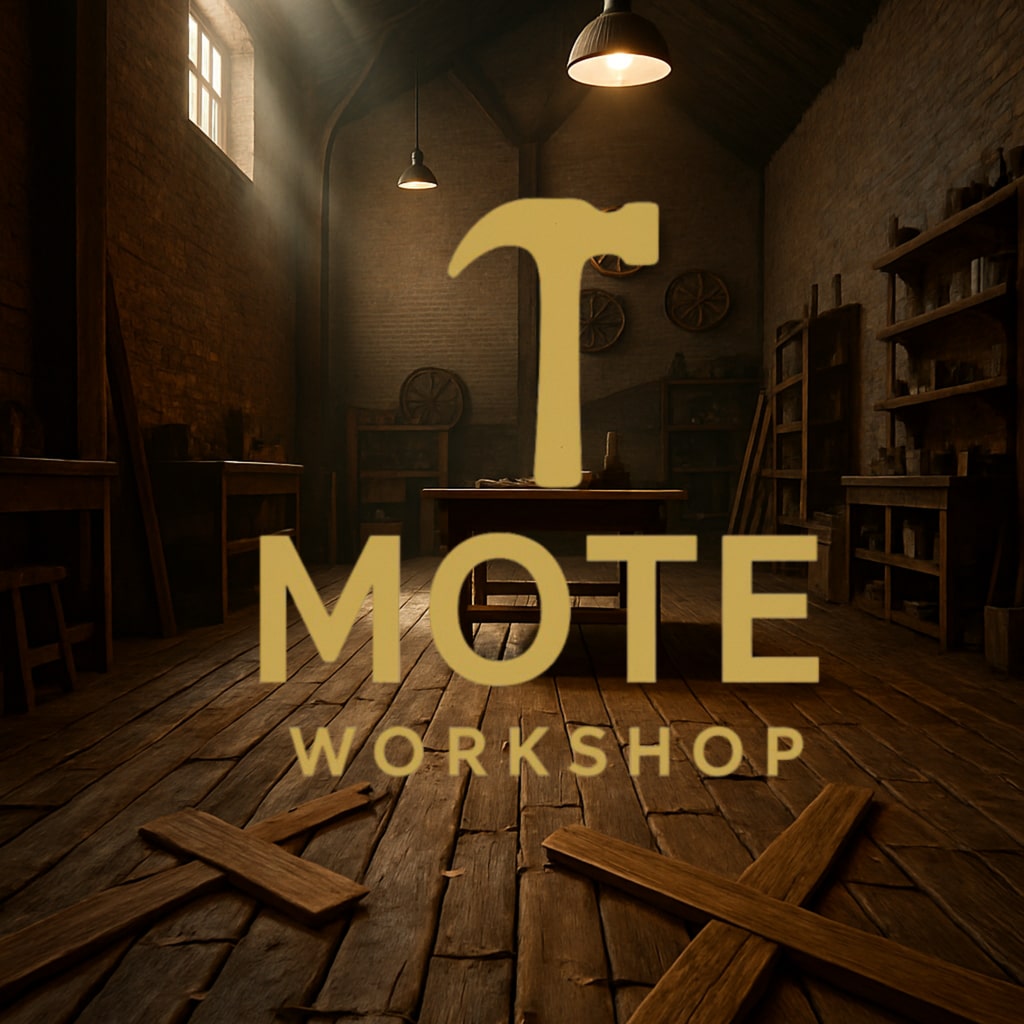
There are games about saving worlds, conquering galaxies, and slaying gods—and then there are games about standing quietly in a dusty room, running your fingers along a workbench that someone you loved once used every day. MOTE: Workshop belongs to the second category. It is not concerned with spectacle or challenge, but with atmosphere, memory, and the fragile language of ordinary objects. In an industry obsessed with scale, this short first-person narrative experience dares to be small—and in doing so becomes unexpectedly powerful.
A Story Told in Sawdust
MOTE: Workshop places you inside a forgotten woodworking shop, presumably belonging to the protagonist’s father. There are no explicit cutscenes, no voiced exposition, and very little text. Instead, the story emerges through observation: a half-finished chair, a stack of warped planks, a calendar frozen on an old year, the particular way light drifts through a grimy window.
The game trusts the player to assemble meaning from these fragments. It suggests a relationship where affection was expressed through labor rather than language—a father who spoke with chisels and clamps instead of sentences. The result is intimate and melancholy, reminiscent of walking through a relative’s house after they’re gone, discovering their personality preserved in mundane clutter.
This environmental storytelling is the heart of the experience. Every drawer you open and every tool you examine feels like turning a page in a wordless diary. The narrative never forces conclusions; it simply offers pieces and allows your own memories to fill the gaps.
The Mechanics of Stillness
Gameplay in MOTE: Workshop is deliberately minimal. You move through the space in a cinematic first-person view, interacting with objects via simple prompts. There are no puzzles in the traditional sense, no fail states, no objectives beyond curiosity. The design philosophy is closer to digital installation art than conventional game structure.
For some players this restraint will feel liberating. The absence of pressure allows attention to settle on textures—the grain of wood, the soft clink of metal, the slow swirl of dust motes in sunbeams. The controls fade into the background, leaving only presence.
Others may find the interactivity too slight, bordering on passive. The game lasts roughly an hour, and mechanically you are mostly walking and clicking. Yet this simplicity is intentional; MOTE wants you to inhabit a mood rather than solve a system.
A Place You Can Almost Smell
Visually, the workshop is rendered with loving detail. Tools show wear, paint flakes realistically, and the color palette leans toward warm ambers and tired browns. Lighting is the true star—shafts of late-afternoon sun transform the room into something sacred, turning floating dust into constellations.
Sound design elevates everything. Floorboards creak with different timbres, drawers rasp, and distant outdoor noises leak through walls. There’s a gentle musical score, but it appears sparingly, careful not to intrude on the everyday symphony of the shop.
The overall effect is tactile; you can almost smell varnish and cold metal. For a small independent project, the sensory craftsmanship is remarkable.
Themes Carved from Wood
At its core, MOTE: Workshop is about how people leave traces. The father figure is never shown, yet his presence dominates the space more convincingly than any character model could. His habits, ambitions, and frustrations are encoded in the arrangement of tools and the projects he never finished.
The game also explores the comfort of focused work. Interacting with the bench and materials evokes the meditative rhythm of making something with your hands—a contrast to the digital medium delivering the experience. It’s quietly nostalgic without romanticizing labor; there is beauty here, but also loneliness and exhaustion.
These themes will resonate differently depending on the player’s own history. Those with memories of parents or grandparents who lived through craft may find the game unexpectedly emotional.
Where It Wobbles
The very qualities that make MOTE: Workshop distinctive also limit its appeal. Its brevity and lack of traditional gameplay mean value is measured almost entirely in emotional impact. If the atmosphere doesn’t click for you, there’s little else to hold onto.
Interactivity occasionally feels arbitrary—some objects can be examined in detail while others, equally interesting, cannot. A touch more mechanical cohesion, perhaps a gentle creative activity like repairing a small item, might have deepened engagement without betraying the contemplative tone.
Performance on most platforms is smooth, though minor clipping and repeated object animations reveal the project’s modest budget. These blemishes are easy to forgive given the sincerity on display.
Who Should Visit the Workshop?
This is a game for players who appreciate titles like Gone Home, Dear Esther, or The Novelist—experiences where exploration is emotional archaeology. It’s ideal for a quiet evening with headphones rather than a weekend marathon.
Those seeking challenge, replayability, or complex systems should look elsewhere. MOTE offers a single, delicate note and asks you to listen closely.
A Small Room, a Large Echo
By the time the screen fades, you may feel as though you’ve visited a real place rather than completed a product. MOTE: Workshop demonstrates how interactive media can preserve intimacy better than film or prose alone. It reminds us that stories don’t always need heroes and villains; sometimes they only need a workbench and the ghost of a routine.
In an era of loud games, this quiet one lingers longest.
Final Verdict
A tender, beautifully observed slice of interactive storytelling. Limited in mechanics but rich in feeling, MOTE: Workshop is less a game and more a memory you can walk around inside.













[…] published by GGMUKS INC., this third entry in the MOTE series, following MOTE: The Old Office and Mote: Workshop, and arrived on PlayStation this month, bringing a distinctly different kind of horror. There are […]