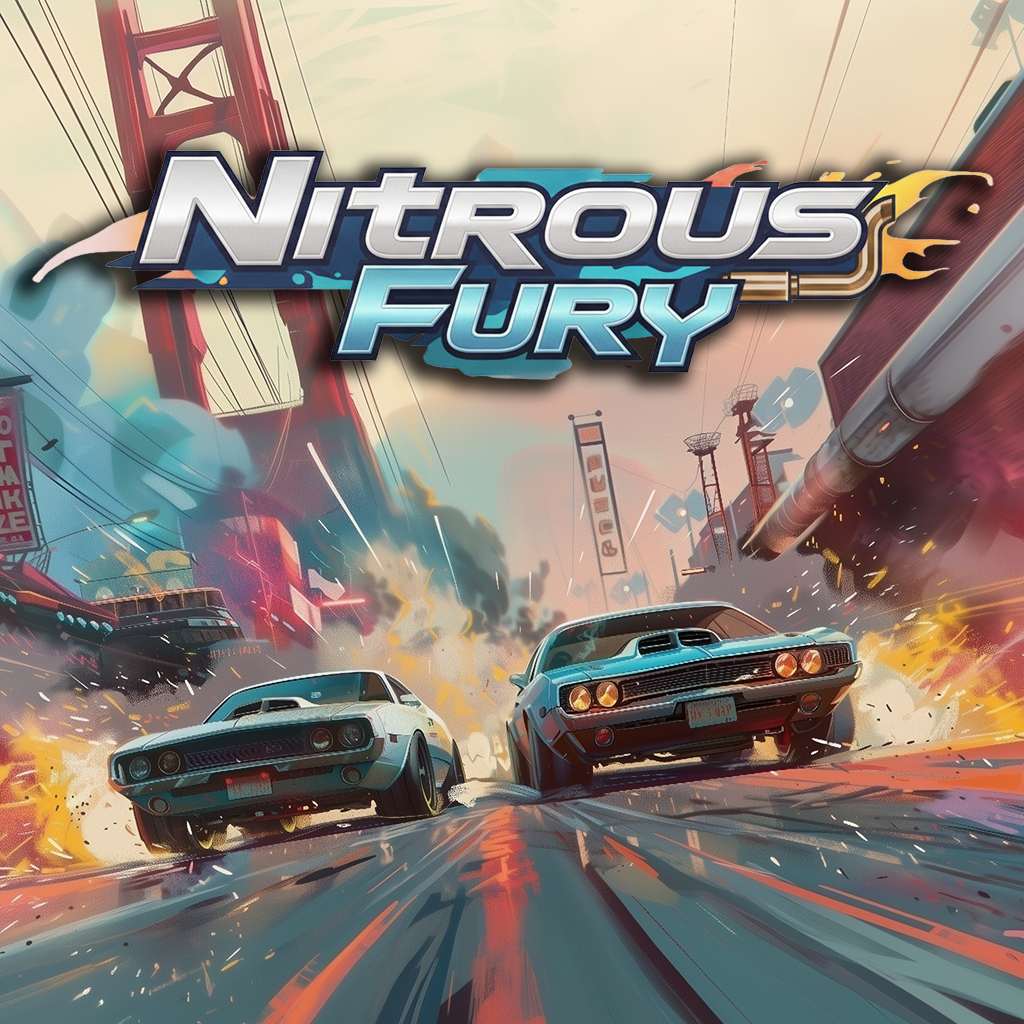
Nitrous Fury is a high-octane arcade racing game that prioritises speed, aggression, and spectacle over realism or simulation accuracy. Built around exaggerated physics, heavy use of boost mechanics, and densely packed tracks, the game aims to deliver constant adrenaline rather than strategic nuance. It positions itself firmly in the arcade racing tradition, drawing inspiration from classic boost-heavy racers while carving out its own identity through intensity and immediacy.
From the opening race, Nitrous Fury makes its intentions clear. This is not a racer that asks players to carefully manage tyre wear or perfect racing lines over long circuits. Instead, it demands fast reactions, fearless use of nitro, and a willingness to embrace chaos. The experience is loud, energetic, and unapologetically arcade-focused.
Core Racing Mechanics
At its core, Nitrous Fury revolves around boost-driven momentum. While standard acceleration and braking are present, nitro usage is the defining mechanic that shapes every race. Boost is earned through aggressive driving—near misses, drifting, overtakes—and is designed to be spent often rather than hoarded.
Vehicles handle with an intentionally exaggerated feel. Cars are responsive and quick to turn, allowing for sharp cornering and rapid course correction even at high speeds. This design keeps races accessible, ensuring that players can recover from mistakes without immediately losing contention.
Drifting plays a central role in maintaining speed and generating boost. Corners are built to encourage wide, sweeping slides rather than precise apex clipping. The result is a racing style that feels fluid and energetic, rewarding confidence and rhythm over strict precision.
Track Design and Variety
Track design in Nitrous Fury is built around constant stimulation. Courses are compact, densely packed with turns, elevation changes, and visual flair. Straightaways are often short-lived, quickly giving way to sharp corners, jumps, or hazards that keep players engaged.
Visually, tracks are themed to provide variety, but mechanically they share a similar philosophy: keep the player moving fast and reacting constantly. Environmental obstacles and tight layouts ensure that races rarely feel predictable, especially when multiple racers are clustered together.
While this approach creates excitement, it can also lead to repetition. Over time, the emphasis on intensity over distinction means that tracks can blur together, particularly during extended play sessions.
Racing AI and Challenge
AI opponents in Nitrous Fury are aggressive and competitive. They utilise boosts frequently, maintain pressure throughout races, and are rarely passive. This keeps tension high, as falling behind early does not necessarily mean defeat—but it also means victory is never guaranteed until the final stretch.
The difficulty curve is approachable but firm. Early races allow players to acclimate to handling and boost mechanics, while later events demand consistent performance and confident driving. Rubber-banding is present, ensuring close finishes, though it can occasionally feel heavy-handed.
For players seeking casual arcade thrills, the challenge level strikes a good balance. However, those looking for deep, skill-based mastery may find the AI behaviour somewhat predictable once patterns are learned.
Visual Presentation
Visually, Nitrous Fury embraces a bold, high-contrast arcade aesthetic. Cars are sleek and stylised, environments are saturated with colour, and speed effects are layered generously to reinforce the sensation of velocity. Motion blur, light trails, and impact effects all contribute to a sense of relentless forward motion.
The presentation prioritises spectacle over clarity at times. During particularly busy moments—especially when boosts, collisions, and environmental effects overlap—the screen can become visually crowded. While this enhances excitement, it can occasionally hinder readability.
Menus and interfaces are clean and functional, ensuring that navigation between races is fast and intuitive. The overall visual identity is cohesive, even if it occasionally leans too hard into excess.
Audio and Atmosphere
Audio design plays a major role in sustaining Nitrous Fury’s intensity. The soundtrack is fast, driving, and unapologetically energetic, designed to keep players in a heightened state of focus. Music adapts well to the game’s pacing, reinforcing moments of speed and competition.
Sound effects are punchy and exaggerated. Engines roar, boosts explode with force, and collisions carry weight. Audio feedback is clear and satisfying, helping players gauge speed and impact even when visuals become busy.
Over longer sessions, the audio intensity can become fatiguing, but in shorter bursts it perfectly complements the game’s arcade philosophy.
Progression and Unlocks
Progression in Nitrous Fury is straightforward and familiar. Winning races earns currency or points that unlock new vehicles, cosmetic upgrades, or additional tracks. There are no complex upgrade trees or deep customisation systems; progression exists primarily to provide motivation rather than alter gameplay dramatically.
Vehicles differ slightly in handling and speed, but the overall feel remains consistent across the roster. This ensures balance and accessibility, but limits opportunities for specialised playstyles.
The absence of deeper progression systems keeps the focus on racing itself, but may leave players craving more long-term goals.
Accessibility and Learning Curve
Nitrous Fury is easy to pick up and immediately enjoyable. Controls are intuitive, tutorials are minimal, and early races ease players into the game’s speed. The forgiving handling model allows newcomers to stay competitive without mastering every nuance.
However, the game offers limited accessibility options, and the constant visual and audio intensity may be overwhelming for some players. The reliance on fast reflexes and visual processing defines the experience, for better and worse.
Replayability and Longevity
Replayability is driven primarily by arcade fundamentals: improving lap times, unlocking content, and enjoying the thrill of close races. Short race durations make Nitrous Fury well suited for repeat play, especially in quick sessions.
That said, the lack of varied modes or deep progression systems limits long-term engagement. Once vehicles and tracks are unlocked, motivation relies largely on enjoyment of the core racing loop rather than new challenges.
Strengths and Weaknesses
Strengths
- Fast, exhilarating arcade racing
- Strong sense of speed and momentum
- Accessible controls with immediate fun
- Energetic audiovisual presentation
- Well suited to short, intense play sessions
Weaknesses
- Limited depth and long-term progression
- Tracks can feel mechanically similar
- Visual clutter during high-intensity moments
- Lacks innovation beyond established arcade racing formulas
Final Verdict
Nitrous Fury is a confident, energetic arcade racer that delivers exactly what it promises: speed, spectacle, and constant adrenaline. It does not attempt to compete with simulation racers or redefine the genre, instead focusing on delivering immediate thrills through boost-heavy mechanics and dense track design.
While its lack of depth and long-term variety may limit its staying power, the core racing experience is enjoyable, responsive, and consistently exciting. For fans of classic arcade racers who value intensity over realism, Nitrous Fury is an easy recommendation.