
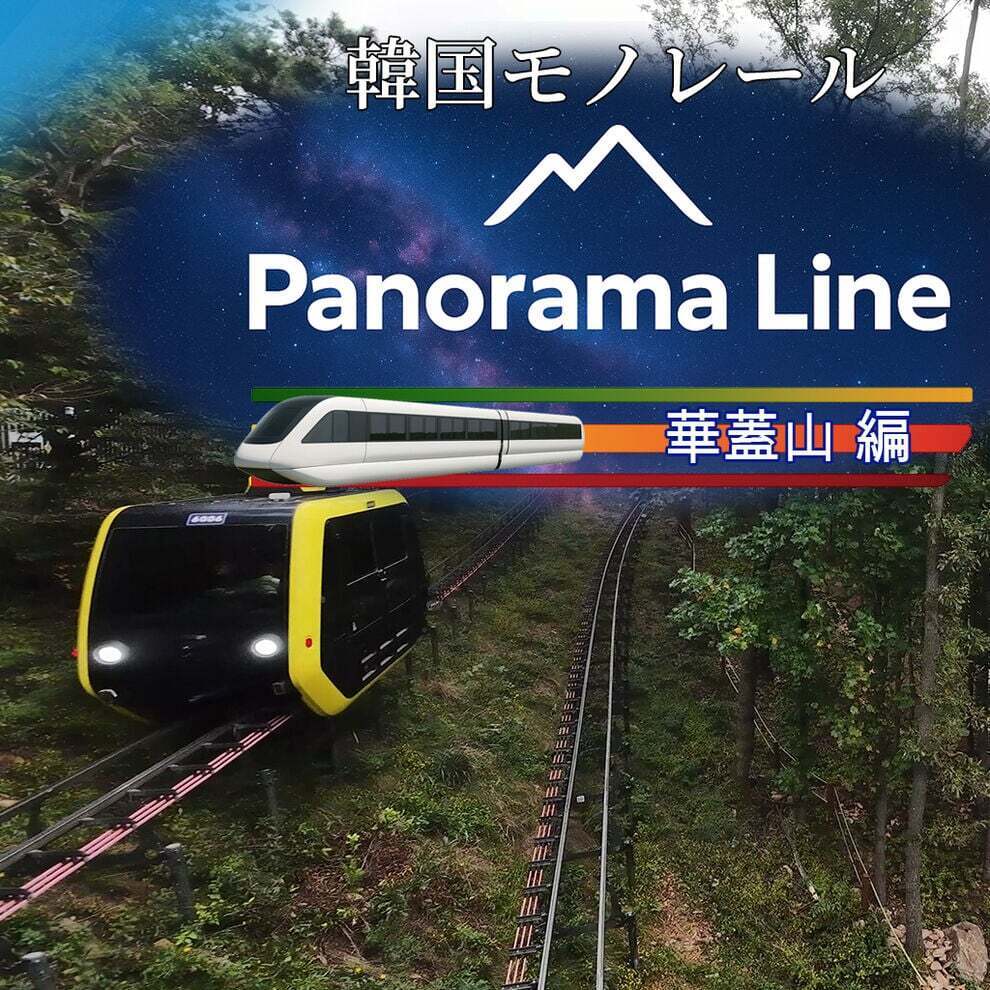
Rail simulation games often fall into two broad categories: those that prioritise technical authenticity at the cost of approachability, and those that go all-in on relaxing scenic travel but sacrifice depth. Korean Monorail Panorama Line – Hwagaesan attempts something more ambitious. It aims to be both a satisfying simulation of Korea’s uniquely engineered monorail infrastructure and a breathtaking scenic experience built around Hwagaesan’s mountainous terrain and serene cultural landmarks. Remarkably, it succeeds at almost everything it sets out to do, delivering a calm yet engaging ride that stands apart from traditional heavy-rail experiences.
Where many train-centric sims rely on speed, power, and complex locomotive systems, Panorama Line shifts the focus to precision, patience, and environmental immersion. This is a slower rhythm—one driven by gradient management, braking finesse, track curvature, and the delicate handling required for elevated monorails. It’s a refreshing change of pace that embraces a more meditative style of simulation without ever feeling shallow.
A Beautifully Realised Hwagaesan Route
The highlight of the experience is unmistakably the Hwagaesan route, a lovingly crafted stretch that captures the charm of South Korea’s mountainous midlands. The track winds through dense forest, elevated ridges, sunlit valleys, and small rural villages, offering a level of environmental variety that few monorail sims even attempt.
The developers clearly prioritised scenic authenticity. Landmarks like hillside temples, terraced agriculture, rustic footbridges, forest-lined rivers, and misty mountain horizons provide constant visual interest. Light scattering effects give sunrises and sunsets a pastel warmth, while rainstorms drape the forests in atmospheric haze. The slower pace of the monorail only enhances the view—scenery doesn’t rush past you, it unfolds.
This is one of the rare cases where simply activating the in-cab camera and cruising at regulated speed is enough to engage you for an entire session. The Hwagaesan line is not just a route—it’s a backdrop that elevates the whole simulation.
Monorail Operation That Feels Distinct and Purposeful
Unlike conventional rail experiences, monorail operation in Panorama Line has its own rhythm. The controls emphasise gentle acceleration, disciplined braking, and strict adherence to speed limits that are often much lower than heavy-rail equivalents. As a result, smooth driving becomes a core mechanic rather than a cosmetic flourish.
Braking downhill along elevated tracks requires finesse. Sharp bends demand adherence to posted limits or risk passenger discomfort violations. Station alignment is unforgiving, requiring centimetre-accurate stops. These small details collectively make the system feel believable.
The standout mechanic is the gradient-responsive handling. Hwagaesan’s mountain terrain means you’re constantly transitioning between inclines and declines, and the monorail responds dynamically to these shifts. Managing speed with precision becomes essential, especially when working toward high passenger comfort scores.
Where some train sims overwhelm players with busy dashboards and complex electrical systems, Panorama Line opts for purpose-made simplicity. This doesn’t mean “easy”—it means focused. Everything in the cab has a reason to exist, and mastering the subtleties of motion becomes its own form of challenge.
Passenger Systems and Scoring That Encourage Consistency
Passenger satisfaction forms a large part of the game’s identity. Points are awarded not just for arriving on time, but for maintaining smooth acceleration curves, safe braking assessments, tight schedule control, and stable manoeuvring around turns. It’s a system that rewards consistency and respect for the monorail’s limitations.
The game doesn’t punish mistakes harshly, but it does ensure they matter. A slightly late arrival may cut into your performance rating. Overshooting a platform requires slow repositioning and penalised precision metrics. Sharp braking sends your passenger comfort score plummeting. This is a simulation where the difference between a bronze and gold ranking can be a single sloppy turn.
It’s not a hardcore scoring system, but it adds just enough structure to keep veterans engaged while still being approachable for newcomers.
A Relaxing Rhythm That Never Feels Empty
What’s striking about Panorama Line is how peaceful it feels. This is one of the rare sims where the ambient journey matters as much as the operational mechanics. The slow traversal through lush scenery, the rhythmic hum of the monorail’s motor, the distant sounds of wildlife and wind—everything contributes to a subtly hypnotic atmosphere.
The game excels when players embrace this rhythm. It’s not trying to compete with high-octane train experiences; it’s offering something gentler. The journey is not frantic or mechanically overwhelming—it’s reflective. It’s the type of simulation you play with headphones on, letting the environmental ambience wash over you.
Yet, crucially, the game never feels boring. The route’s constant gradient shifts, varied station spacing, and environmental hazards such as low visibility conditions keep you engaged moment to moment.
Visual Fidelity and Environmental Detail
Graphically, Panorama Line is stronger than expected for a niche simulation title. Vegetation density feels natural, terrain elevation is convincing, and the lighting model gives every journey a strong sense of place. Waterfalls, suspension walkways, temple roofs peeking through treetops—these elements make the route feel alive without cluttering the screen.
Weather effects are another highlight. Rain patters against the monorail windows convincingly, fog layers over the valleys, and cloud shadows drift over the mountains in real time. As a scenic simulation, it might be one of the most beautiful monorail experiences available.
Cab models are clean and functional. They may not carry the hyper-detailed texture work of top-tier heavy rail sims, but they are authentic, readable, and satisfying to operate.
Where the Experience Falls Short
Despite its many strengths, Panorama Line has a few limitations:
- The learning curve for precision braking may frustrate beginners.
- Some background textures and distant geometry lack the polish of the immediate environment.
- AI passenger density feels static rather than dynamic.
- There are moments where station ambience feels too quiet, reducing immersion.
These issues are minor but noticeable, especially during long play sessions.
Verdict
Korean Monorail Panorama Line – Hwagaesan is a beautifully crafted, thoughtful, and quietly captivating simulation experience. It offers a unique blend of scenic immersion, focused operation mechanics, and meditative pacing that makes it stand out in a crowded genre dominated by heavy-rail giants.
This is a game for players who appreciate subtlety—those who find joy in operating a vehicle with precision, watching a landscape unfold at its own pace, and mastering the delicate behaviours of a lightweight monorail system. If that sounds like your ideal sim experience, Hwagaesan is more than worth the journey.

















[…] title marks the second entry in 14Dimension’s panoramic monorail series, following last year’s Korean Monorail Panorama Line Hwagaesan. Like its predecessor, Soisan leans heavily on authenticity—using real filmed footage of South […]