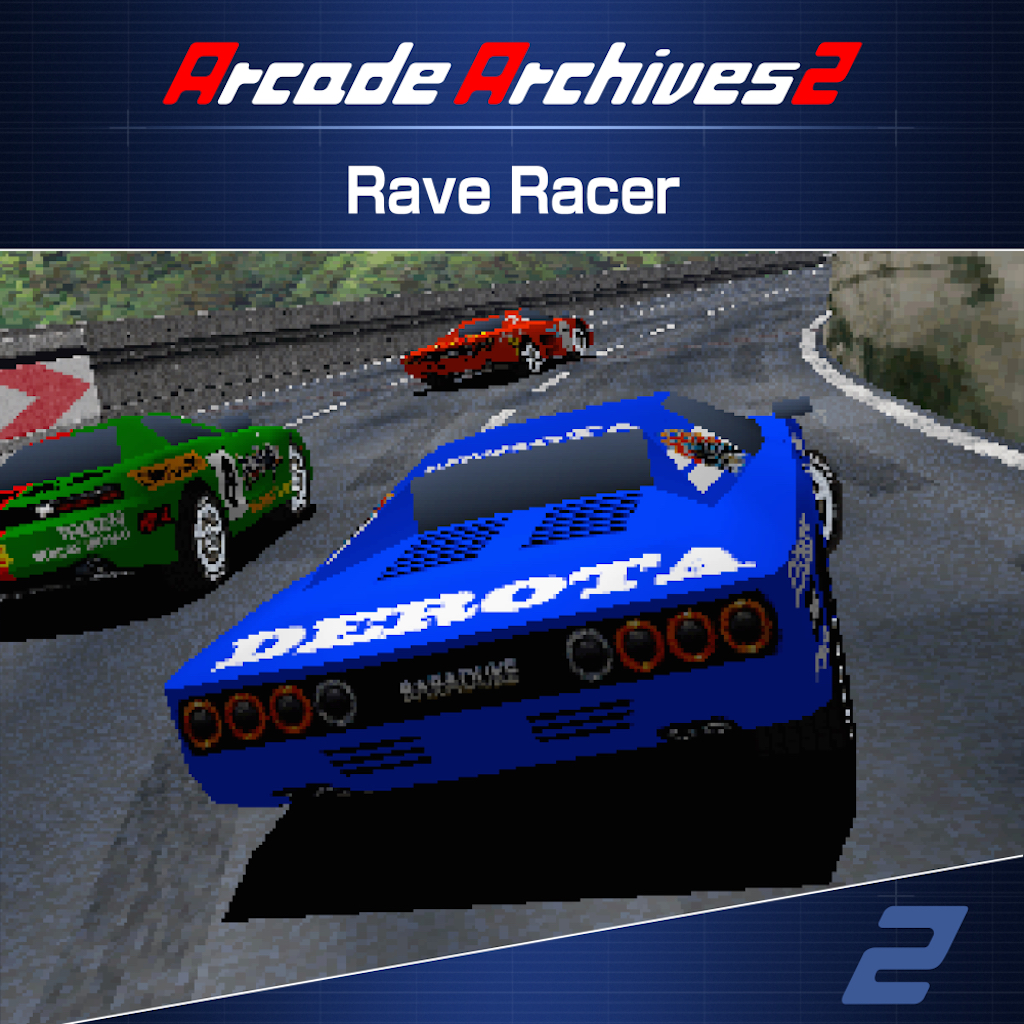
Some games become legends not because they were rare, but because they were missing. For more than three decades, Rave Racer was one of arcade gaming’s most elusive classics — a beloved 1995 sequel in Namco’s early Ridge Racer lineage that never saw a home release. While its predecessors appeared on PlayStation consoles and beyond, Rave Racer stayed confined to arcade cabinets, its long-rumoured PC port cancelled, and its legacy preserved only through memory and emulation.
That changes today.
Released on February 26, 2026, Arcade Archives 2: Rave Racer finally brings the long-lost arcade racer home, thanks to Hamster Corporation’s premium Arcade Archives 2 line. More than just a re-release, this enhanced edition offers modern performance upgrades, expanded multiplayer features, and preservation-grade authenticity — all while reminding players of how influential 90s arcade racing truly was.
And remarkably, it still feels fast.
The Racer That Time Forgot
Originally launched in arcades in 1995, Rave Racer represented a major evolution of the Ridge Racer formula. Built on Namco’s System 22 hardware, it expanded beyond the original’s technical showcase into something more confident and expressive.
Compared to its predecessors, Rave Racer introduced:
- New tracks alongside remixed classics
- Enhanced drift-focused handling
- More aggressive AI racers
- A louder, club-inspired soundtrack fitting its name
It wasn’t just a sequel — it was Namco refining arcade racing into pure kinetic spectacle.
For years, fans considered it the “missing chapter” of the Ridge Racer story. Seeing it arrive officially on modern platforms feels less like a port and more like historical restoration.
Arcade Archives 2: More Than Preservation
Hamster Corporation has built a strong reputation for faithful arcade reproductions, but the Arcade Archives 2 label signals something more ambitious.
This version includes significant enhancements:
- Native 4K resolution support
- Up to 120FPS performance
- VRR (Variable Refresh Rate) compatibility
- Enhanced input responsiveness
- Expanded multiplayer options
- New Time Attack mode
Crucially, these improvements don’t alter gameplay physics. The handling, speed, and structure remain authentic to the original arcade experience.
The result is a game that feels unmistakably 1995 — just impossibly smooth.
Drifting Before It Was Cool
Modern racing fans may associate drifting with later Ridge Racer entries or even contemporary arcade racers, but Rave Racer was among the pioneers that turned controlled sliding into a core mechanic rather than a mistake.
Driving here is deceptively simple:
- Accelerate
- Brake
- Turn
- Drift
Yet mastering corners requires finesse. Cars glide through turns with exaggerated weight transfer, rewarding early steering inputs and smooth throttle control.
Unlike simulation racers, realism isn’t the goal. Instead, the game embraces a “simulation-lite” philosophy where physics exist purely to amplify fun.
Once you understand the rhythm, races become hypnotic — chaining long drifts while electronic music pulses in the background.
Even today, the handling feels immediately satisfying.
Tracks That Still Impress
The track design remains one of Rave Racer’s strongest achievements.
Players race across:
- Urban cityscapes filled with glowing signage
- Mountain passes with sweeping curves
- Updated versions of classic Ridge Racer environments
Each course emphasizes flow over complexity. Corners are designed to encourage momentum rather than constant braking, reinforcing the arcade ethos of speed as spectacle.
Visual variety may seem modest by modern standards, but the layouts themselves remain expertly tuned. Every lap teaches something new about optimal racing lines.
And thanks to modern frame rates, the sensation of speed feels sharper than ever.
Soundtrack: Living Up to the “Rave”
Few arcade racers embraced music as boldly as Rave Racer. The soundtrack heavily features mid-90s electronic and techno influences, transforming races into audiovisual spectacles.
The Arcade Archives 2 release enhances this legacy by including remixed versions alongside the original tracks, with contributions from renowned arcade composers.
The music isn’t just background noise — it sets the pace. Beats synchronize with acceleration, turns, and overtakes, creating a rhythmic driving experience rarely matched today.
It’s loud, energetic, and unmistakably representative of its era.
Multiplayer Returns to Its Roots
One of the most exciting additions in the AA2 version is expanded multiplayer support.
The original arcade featured linked cabinets, allowing competitive racing side-by-side. This release recreates that spirit through:
- Local split-screen (up to four players)
- Online leaderboards
- Competitive score tracking
Split-screen racing especially shines. Arcade racers thrive on shared spaces, and the simplicity of Rave Racer makes it instantly accessible even for newcomers.
It’s easy to imagine friends gathering around a cabinet again — only now the cabinet is your living room.
Modes Built for Mastery
Hamster includes its standard suite of preservation modes alongside new additions:
- Original Mode – Authentic arcade progression
- Hi-Score Mode – One-credit competitive scoring
- Caravan Mode – 5-minute score challenges
- Time Attack Mode – Race for fastest completion
The new Time Attack mode is a standout inclusion, transforming the game into a precision-driven leaderboard competition.
Because races are short and skill-based, improvement feels immediate. Shaving milliseconds off corners becomes addictive quickly.
Visuals: Retro Meets Precision
Let’s be clear — this is still a 1995 game visually. Geometry is simple, textures are clean but minimal, and environmental detail reflects its era.
However, running at modern resolutions significantly alters perception.
Higher frame rates remove motion blur artifacts, while sharp scaling makes the bold colour palette stand out. The aesthetic sits somewhere between nostalgic retro and minimalist modern design.
CRT filters and display options further enable players to customise authenticity versus clarity.
It’s preservation done respectfully rather than artificially modernised.
Where It Shows Its Age
Despite its strengths, Rave Racer carries limitations inherent to arcade design.
Limited Content Length
Races are short, and progression is minimal compared to modern racers.
Lack of Career Mode
There’s no long-term progression system — mastery comes purely from skill.
AI Predictability
Opponent behavior can feel scripted once patterns are learned.
Presentation Simplicity
Menus and structure remain extremely barebones.
Yet these are less flaws than reminders of arcade philosophy: replayability through skill, not unlock trees.
A Time Capsule That Still Moves Forward
What makes Arcade Archives 2: Rave Racer special isn’t just nostalgia — it’s how well the gameplay still holds up.
Many arcade racers seem primitive today. Rave Racer doesn’t.
Its drifting mechanics remain rewarding. Its pacing stays sharp. Its audiovisual energy still impresses. And thanks to modern improvements, it arguably plays better now than it did in arcades.
For long-time fans, this is a long-awaited reunion. For newcomers, it’s a rare opportunity to experience a missing piece of racing history.
Pros & Cons
Pros
- ✔ First-ever home release of a legendary arcade racer
- ✔ Excellent 4K/120FPS performance enhancements
- ✔ Timeless drift-focused gameplay
- ✔ Strong soundtrack with remixed tracks
- ✔ Authentic arcade preservation options
- ✔ Fun local multiplayer support
Cons
- ✘ Limited long-term progression
- ✘ Short arcade-style content structure
- ✘ AI lacks variety over time
- ✘ Barebones presentation by modern standards
Final Verdict
Arcade Archives 2: Rave Racer is more than just a retro rerelease — it’s the revival of a lost classic. Hamster Corporation has delivered a faithful yet polished version that honours arcade authenticity while adopting modern performance standards.
It may lack the depth expected from modern racers, but that was never its aim. Instead, it provides pure arcade thrill: fast races, smooth drifting, and music-driven momentum boiled down to its most essential elements.
After 31 years, Rave Racer finally crosses the finish line at home — and shows that some games never lose their speed.