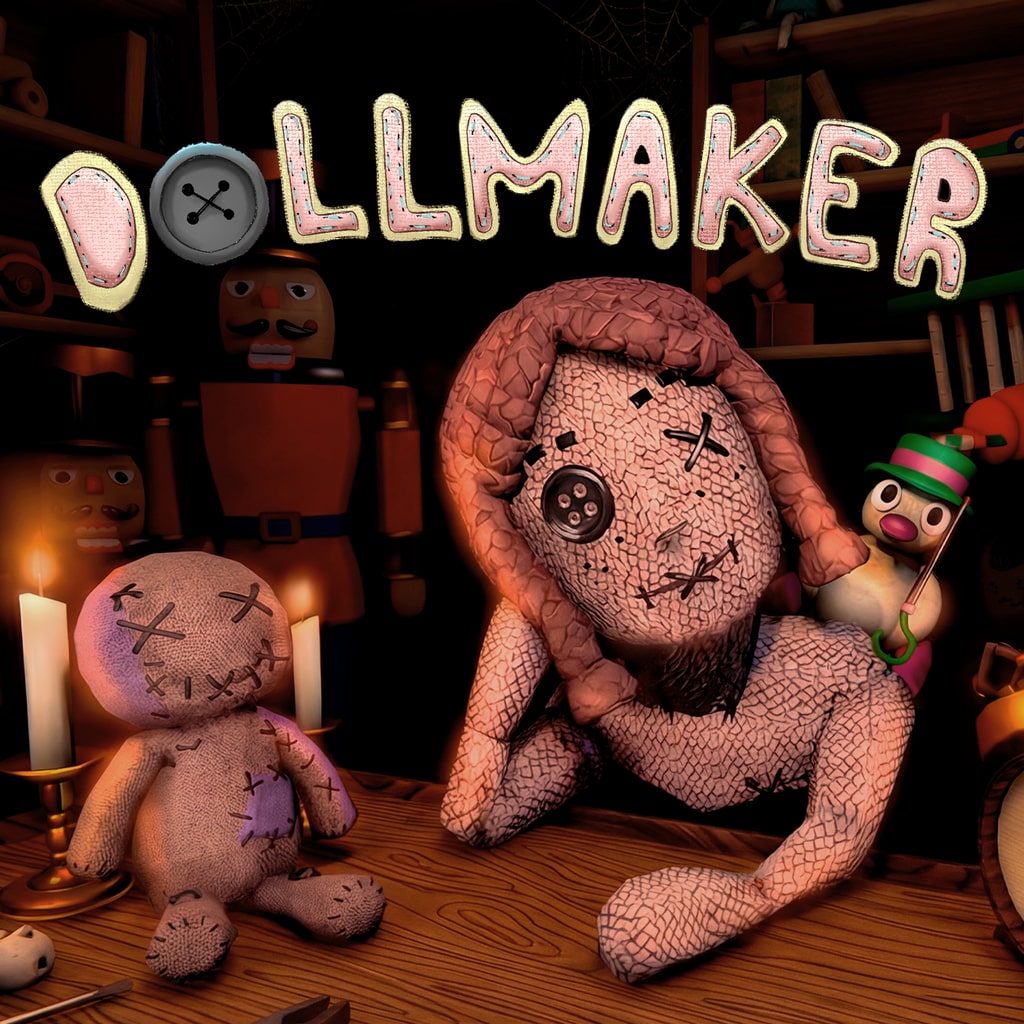
I recall a unsettling childhood moment when my sister’s doll, with its unblinking eyes, appeared to observe us across a dark room. It transformed from a mere toy into a subtle guardian, so much so that my brother eventually poked their eyes out with a pen and broke their limbs off. DOLLMAKER by MrWhiteNoiz taps directly into that primal unease. Released last month by Upscale Studio, it strips away the comfort of the playroom and replaces it with a desperate, timed race for survival. It’s a game that understands a fundamental truth of our earliest fears: there is something deeply haunting about an object meant to look human that is just slightly wrong.
Sitting across from the stitched-together Dollmaker herself, I realised the hardest thing to build under pressure was not the doll on the table, but the courage to keep my hands steady while those button eyes watched every mistake.
At its core, DOLLMAKER is deceptively simple. You are shown a photograph of a completed doll. After a brief viewing period, the image disappears, and you must recreate it from memory using a drawer full of doll parts scattered across the table before the timer runs out. Eyes, hats, stitched clothing, ribbons, cracked porcelain heads, tiny shoes, unsettling accessories — every piece matters.
Get one detail wrong, and the atmosphere shifts immediately. The room darkens. The Dollmaker twitches. The soundtrack groans with distorted strings and creaking wood. It is not a game interested in cheap jump scares. Instead, it weaponises pressure, uncertainty, and the horrible feeling of being watched while your brain struggles to remember whether the doll wore a red ribbon or a burgundy one.
Gameplay
The brilliance of DOLLMAKER lies in how it turns a straightforward memory challenge into psychological warfare. Early rounds lull you into a false sense of security. The dolls are relatively simple, the time limits forgiving, and the room almost calm in its eerie silence. But as the game progresses, the complexity escalates rapidly. More parts are introduced. Accessories begin to overlap visually. Tiny details become essential. Then the anomalies appear.
One eye may look correct at first glance, but the pupil is subtly misshapen. A dress might have an extra stitch hidden near the hem. A hat could contain a nearly invisible crack. The game delights in forcing you to second-guess yourself, and that paranoia becomes its greatest weapon.
There were moments when I found myself staring at two nearly identical doll heads for far too long while the timer ticked down mercilessly in the background. The panic it creates feels strangely physical. Your thoughts become scrambled. Simple observations suddenly feel impossible.
The controls intentionally contribute to that discomfort. Movement is slightly stiff, interactions carry a tiny delay, and grabbing objects never feels perfectly smooth. Under normal circumstances, that might sound like criticism. Here, it feels deliberate. The awkwardness mirrors the panic of fumbling with tiny objects under immense stress.
That said, the intentionally cumbersome handling occasionally crosses the line from tense to frustrating. A few late-game failures felt less like my fault and more like the interface refusing to cooperate during critical moments. Thankfully, the game’s short runtime prevents this irritation from becoming overwhelming.
The structure also deserves praise for knowing when to stop. At roughly two to three hours, DOLLMAKER delivers its ideas efficiently. Horror games built around a singular mechanic often stretch themselves too thin, but this one ends before repetition dulls the tension.
Graphics & Atmosphere
Visually, DOLLMAKER is exceptional in ways that sneak up on you. This is not a loud horror game drenched in gore or constant darkness. Instead, it builds dread through texture and detail. The workshop feels ancient and rotten. Dust hangs in the air like fog. Wood creaks softly beneath shifting floorboards. Every doll part looks worn by decades of neglect.
On the PlayStation 5, the environmental detail becomes deeply unsettling. You can see frayed stitching on fabric sleeves, chipped paint on porcelain cheeks, and tiny fingerprints embedded in old varnish. The dolls genuinely look handled, loved, and abandoned over countless years.
The lighting design is phenomenal. Shadows stretch unnaturally across the room as candles flicker beside the Dollmaker’s table. Sometimes the darkness itself seems to shift while you are distracted assembling a doll. Whether that movement is real or imagined becomes part of the psychological torment.
The Dollmaker herself is one of the strongest horror designs I have seen in recent memory. She barely moves for most of the game, yet every subtle twitch feels threatening. Her missing eye somehow makes her gaze more intense, not less. There is an uncanny sadness to her appearance that hints at tragedy beneath the horror.
The game constantly balances beauty and discomfort in fascinating ways. The dolls are grotesque, yet strangely delicate. The room is terrifying, yet oddly melancholic. It creates an atmosphere that lingers long after the console is switched off.
Sound Design & Music
If the visuals establish dread, the sound design seals it. Every tiny sound matters. Wooden drawers scrape loudly against the silence. Porcelain clicks together with unnerving sharpness. Fabric rustles softly as the clock continues to tick somewhere behind you like a heartbeat counting down to disaster.
The soundtrack rarely dominates scenes directly. Instead, it creeps beneath them with low drones, warped lullabies, and distant mechanical noises that sound almost human. Several moments become terrifying purely because the music suddenly disappears altogether.
Voice work is used sparingly, which makes it far more effective when it appears. The Dollmaker’s occasional whispers feel intimate in the worst possible way, as though she is speaking directly into your ear from inches away. Horror games often rely too heavily on noise to manufacture fear. DOLLMAKER understands the value of restraint.
Story & Themes
While gameplay remains the focus, there is a surprisingly emotional undercurrent running through the experience. The central idea of “recovering a missing part of yourself” slowly gains meaning as fragments of the protagonist’s past emerge through environmental details and subtle narrative hints. The game never overexplains itself, which is the right choice. Much of its emotional power comes from ambiguity.
The dolls themselves begin to feel symbolic rather than decorative. They represent fractured identities, lost memories, and the pressure to reconstruct something broken under impossible circumstances.
There is also a fascinating layer of perfectionism beneath the horror. Every mistake is punished. Every flaw feels catastrophic. The constant need to replicate images flawlessly creates a suffocating anxiety that mirrors real-world fears of failure and inadequacy. For such a short game, it leaves an unexpectedly heavy emotional residue.
Final Verdict
DOLLMAKER is not trying to be the loudest horror game of the year. It does not bombard players with endless jump scares or drown in gore. Instead, it chooses something far more difficult: sustained psychological discomfort.
By taking a simple memory puzzle and wrapping it in oppressive atmosphere, tactile tension, and deeply unsettling imagery, MrWhiteNoiz has created a horror experience that feels uniquely intimate. It gets under your skin quietly, patiently, and effectively.
The intentionally awkward controls and occasional late-game frustration keep it from reaching true greatness, but the game’s haunting aesthetic, sharp pacing, and suffocating atmosphere make it incredibly memorable nonetheless. Long after the credits rolled, I still found myself thinking about that dim workshop, those scattered doll parts, and the terrible pressure of trying to create something perfect while being watched by eyes that never blink.