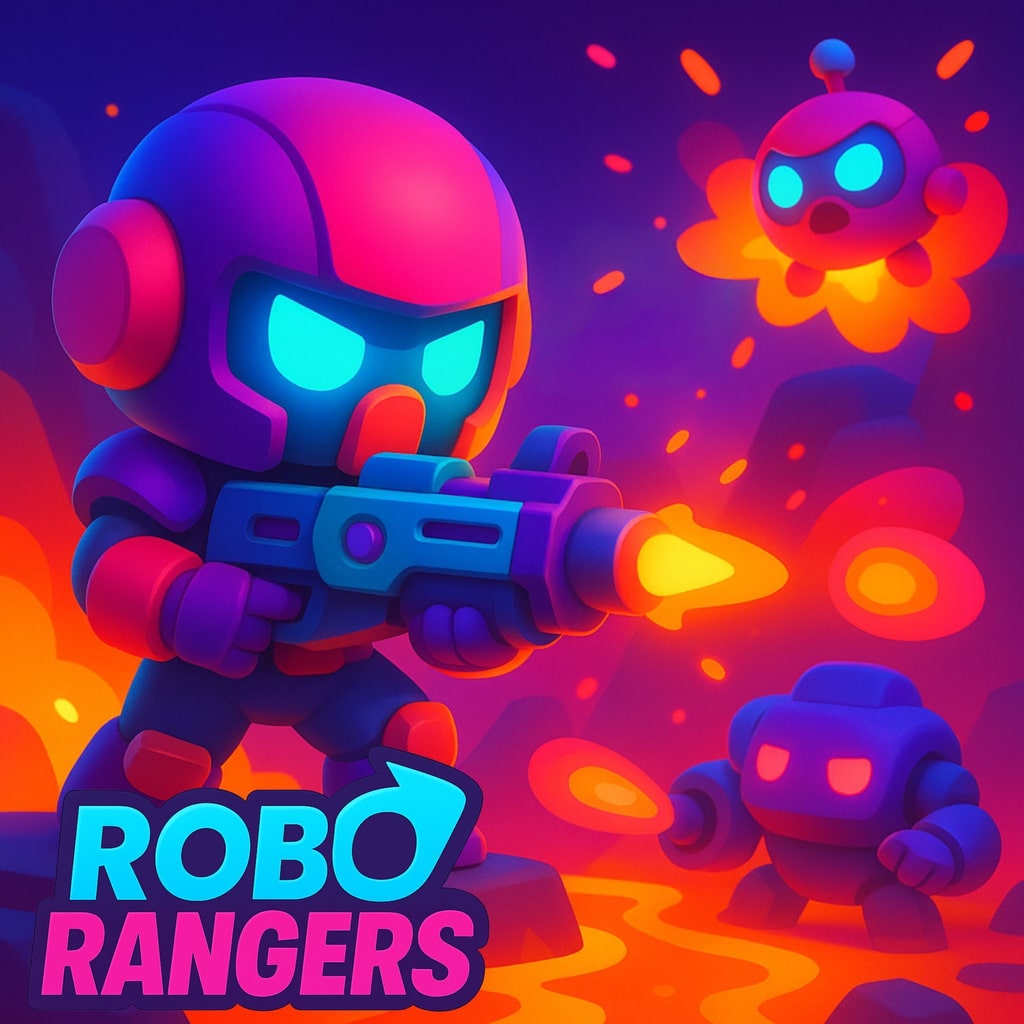
Budget arcade shooters arrive on digital storefronts with the regularity of vending-machine snacks—cheap, colorful, and usually gone in minutes. Robo Rangers, the latest from Gametry, plants its metallic boots firmly in that territory. A top-down twin-stick blaster starring an “elite combat robot,” it promises vibrant biomes, endless waves, and crystal-powered upgrades. The reality is a game that occasionally sparks to life like a well-oiled machine, but just as often feels assembled from spare parts found behind the genre’s garage.
Plug In, Pull Trigger
The setup couldn’t be simpler. You pilot a squat battle bot across compact arenas, mowing down waves of enemy droids, bugs, and vaguely alien shapes. Movement is smooth, shooting is mapped to the right stick, and the loop of dodge–fire–collect is immediately familiar to anyone who’s touched Geometry Wars or Nex Machina.
Credit where it’s due: the core controls feel tight. Your ranger slides across the battlefield with satisfying weight, and most weapons deliver crunchy feedback. Shotguns thump, lasers sizzle, and rockets bloom in pleasing showers of sparks. For short bursts, Robo Rangers captures that hypnotic arcade rhythm where brain and thumbs merge into a single humming circuit.
Biomes Built from Bright Plastic
The game advertises “vibrant, handcrafted biomes,” and visually that’s not entirely a lie. Levels shift between neon cities, desert outposts, icy platforms, and digital voids. Colors pop, hazards glow, and the frame rate holds steady on PS5.
Yet the environments feel more like themed backdrops than living spaces. Obstacles repeat, layouts blur together, and after an hour you’ll recognize the same crates and barriers recycled like stage props on a touring play. It’s cheerful but thin—a carnival set where you can see the plywood if you look too closely.
Enemy variety follows a similar pattern. Dozens of models exist, but behaviors rarely change beyond speed and hit points. Most foes simply march toward you like enthusiastic shoppers on Black Friday. Bosses arrive with bigger health bars and louder music, though only a handful introduce genuinely new mechanics.
Crystals, Numbers, Repeat
Progression revolves around collecting crystals dropped by defeated enemies. These feed into a straightforward upgrade tree: more damage, faster reloads, extra health, new special abilities. The system works, providing just enough carrot to push “one more run.”
The problem is lack of personality. Upgrades feel statistical rather than transformational. A 10% damage boost doesn’t alter how you play; it just makes the same actions finish sooner. Compare this to genre leaders that grant wild synergies or game-breaking toys—Robo Rangers keeps its imagination on a short leash.
Special abilities fare better. Deployable turrets, time-slowing fields, and screen-clearing bombs add flashes of tactical flavor. Timing a shield at the last second can feel heroic, and certain late-game powers briefly hint at the chaos the whole package could have embraced.
Arcade Heart, Budget Bones
Where Robo Rangers stumbles hardest is in presentation and longevity. Menus are bare, music loops are serviceable but forgettable, and there’s little narrative glue beyond mission text that reads like instruction manuals written by an intern.
The game is also short—campaign mode can be rolled in a few hours, after which you’re left with score-chasing and difficulty modifiers. For a budget price that’s not criminal, yet the design lacks the depth needed to support endless replay the way classic arcade shooters do.
There’s a lingering sense of asset-store familiarity: animations reused, effects slightly generic, UI fonts that appear in a dozen other indies. None of this ruins the experience, but it prevents Robo Rangers from carving its own identity.
Moments of Genuine Spark
Still, dismissing the game entirely would be unfair. In its best moments—surrounded by dozens of enemies, health flashing red, soundtrack finally hitting a decent groove—Robo Rangers becomes a pure reflex playground. I found myself leaning forward, swearing at the screen, genuinely invested in beating the next wave.
Local co-op, where available, elevates the fun considerably. Two robots weaving between bullets brings chaotic energy the solo mode often lacks. Suddenly those simple arenas feel like gladiator pits, and even repetitive enemies become entertaining dance partners.
Who Is This For?
If you’re hunting for a deep, genre-defining twin-stick experience, this isn’t it. But for players wanting a light, accessible shooter to burn an evening—especially at a budget price—Robo Rangers scratches the itch. It’s the gaming equivalent of a greasy slice of pizza: not gourmet, but sometimes exactly what you crave.
Pros
- Responsive, enjoyable twin-stick controls
- Bright, colorful presentation
- Easy pick-up-and-play structure
- Solid co-op potential
- Satisfying moment-to-moment shooting
Cons
- Repetitive level design and enemies
- Upgrades lack creativity
- Thin audio and presentation
- Short campaign with limited replay hooks
- Feels overly familiar
Final Verdict
Robo Rangers is a competent machine built from well-known parts, humming along without ever achieving true liftoff. The shooting feels good, the colors are cheerful, and in short sessions it can be genuinely entertaining. Yet the experience lacks the personality and invention needed to stand out in a crowded arcade field. Repetition creeps in early, upgrades rarely excite, and the whole package feels more assembled than authored. It’s fun in the way a rented laser tag match is fun—loud, bright, disposable—but unlikely to linger in memory once the credits roll. For the asking price, it’s acceptable; for the genre, it’s merely adequate.