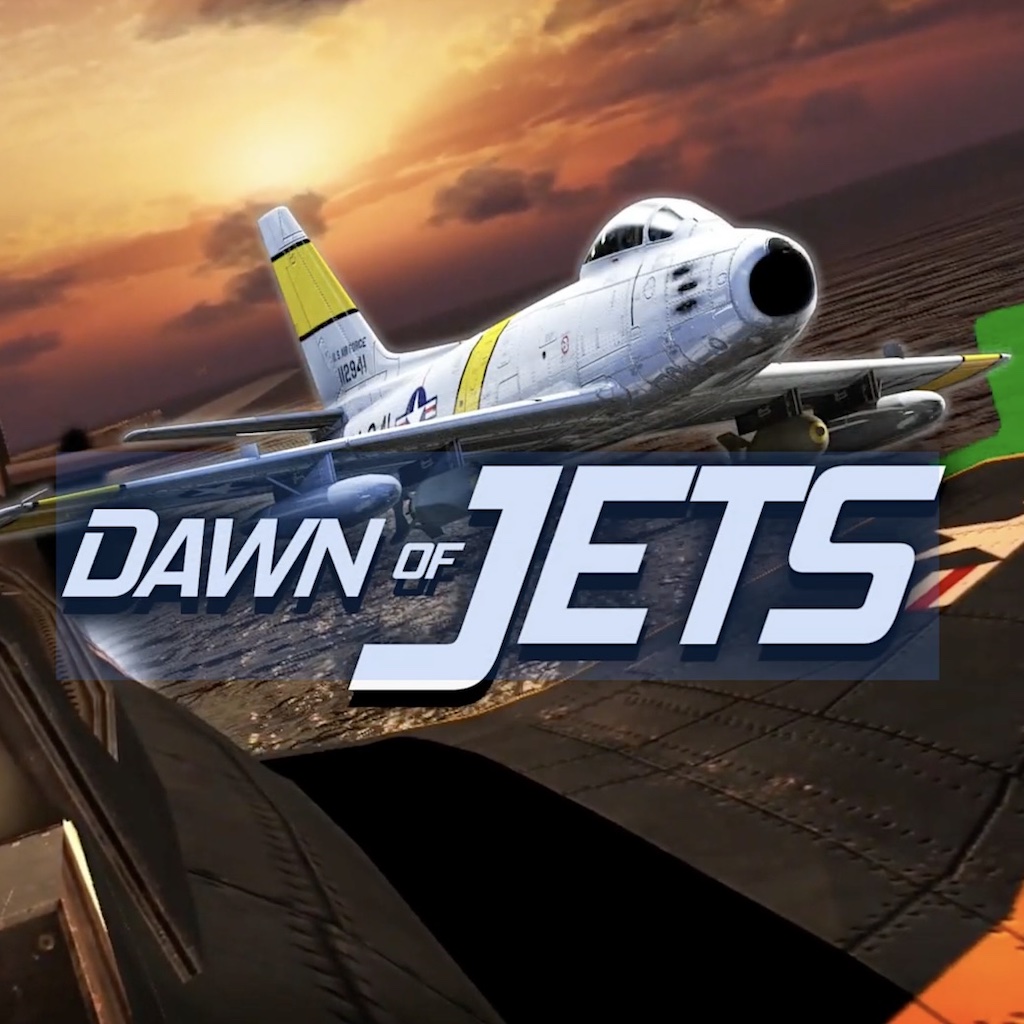
Dawn of Jets is a VR-focused aerial combat game that sets its sights squarely on delivering fast, accessible jet action rather than deep simulation. Designed specifically for the Meta Quest ecosystem, it aims to capture the exhilaration of dogfighting at supersonic speeds while remaining approachable for players who may have little experience with traditional flight simulators. The result is a game that prioritises moment-to-moment excitement, intuitive controls, and arcade-style spectacle, often at the expense of long-term depth — but rarely at the expense of fun.
From the first take-off, Dawn of Jets makes its intentions clear. This is not a meticulous recreation of real-world aviation physics, nor does it burden players with complex cockpit procedures. Instead, it embraces VR’s strengths: presence, scale, and immediacy. You are placed directly in the cockpit, surrounded by sky and clouds, and tasked with surviving intense aerial engagements that test reflexes and spatial awareness.
Setting and Presentation: A Clean Canvas for Combat
Narratively, Dawn of Jets keeps things minimal. There is no elaborate storyline, political backdrop, or character-driven campaign. The setting exists primarily to support combat scenarios, with missions framed around defending airspace, intercepting enemy squadrons, and surviving escalating waves of hostile aircraft.
This stripped-back approach works in the game’s favour. By avoiding heavy narrative framing, Dawn of Jets keeps the focus on action and pacing. Missions load quickly, objectives are clearly communicated, and downtime between engagements is kept to a minimum. For VR players, where comfort and flow are critical, this efficiency is welcome.
Visually, the game opts for clarity over realism. Jets are cleanly modelled, enemy silhouettes are easy to read at a distance, and environmental effects — clouds, sky gradients, explosions — are designed to enhance immersion without overwhelming performance. While it may not rival high-end PC flight sims in detail, the visual presentation is well suited to standalone VR hardware and maintains stable performance during intense dogfights.
Core Gameplay: Arcade Flight Done Right
At the heart of Dawn of Jets is an arcade-style flight model that strikes a careful balance between freedom and control. Aircraft respond quickly to input, allowing players to perform sharp turns, rapid climbs, and evasive manoeuvres without wrestling with realistic aerodynamics. This design choice lowers the barrier to entry while still providing enough nuance to reward skillful flying.
Controls are intuitive and clearly mapped. Whether using traditional controller inputs or motion-assisted aiming, the game ensures that basic flight and combat actions are easy to grasp within minutes. Throttle control, weapon firing, and targeting are streamlined, keeping the player’s attention on situational awareness rather than mechanical complexity.
Combat encounters are fast and aggressive. Enemy jets flank, dive, and retreat dynamically, forcing players to constantly adjust positioning. Lock-on missiles, machine guns, and evasive countermeasures form the core combat loop, creating a rhythm of pursuit, attack, and escape that feels particularly effective in VR.
Dogfighting in VR: Presence Makes the Difference
What truly elevates Dawn of Jets above similar arcade flight games is its use of VR presence. Sitting in the cockpit, looking over your shoulder to track an enemy jet, or craning your neck upward as a missile streaks past adds a layer of immersion that flat-screen games struggle to replicate.
Spatial awareness becomes a genuine skill. Success depends not just on aiming accuracy, but on reading the sky, anticipating enemy movement, and using vertical space effectively. The sense of speed — clouds rushing past, the horizon tilting during tight turns — is convincing enough to create real tension during close engagements.
Importantly, the game manages to deliver this intensity without excessive motion sickness. Comfort options and sensible camera behaviour help maintain accessibility, even during aggressive manoeuvres. While sensitive players may still need adjustment periods, Dawn of Jets is generally considerate of VR comfort standards.
Mission Design and Progression
Missions in Dawn of Jets are structured around clear objectives: eliminate enemy squadrons, survive timed encounters, escort allies, or defend strategic points. These objectives provide variety without overcomplicating the experience.
Progression is tied to mission completion and performance, unlocking new aircraft, weapons, and upgrades over time. This system provides a steady sense of advancement, encouraging players to refine their skills and revisit earlier missions with improved loadouts.
That said, progression depth is relatively modest. While new jets and weapons add variety, they don’t dramatically alter the core gameplay loop. The emphasis remains on execution rather than build experimentation. For some players, this simplicity will be refreshing; for others, it may limit long-term engagement.
Audio Design: Speed and Impact
Sound design plays a crucial role in selling the fantasy of high-speed jet combat, and Dawn of Jets largely succeeds here. Engine roars convey power and acceleration, weapon fire feels punchy, and explosions provide satisfying feedback when targets are destroyed.
Audio cues are also used effectively for gameplay feedback. Missile lock warnings, incoming fire alerts, and objective prompts help players stay oriented during chaotic engagements. Music is understated, designed to enhance tension without distracting from spatial audio cues that are vital in VR.
Replayability and Longevity
Replay value in Dawn of Jets comes primarily from skill mastery rather than content breadth. Missions are replayable, and higher difficulty settings provide increased challenge for experienced pilots. Leaderboards or performance-based scoring systems further encourage optimisation and repeat attempts.
However, players seeking expansive campaigns, deep customisation systems, or narrative-driven progression may find the experience somewhat limited. Dawn of Jets is best enjoyed in focused sessions — jumping in for a burst of adrenaline-fuelled dogfighting rather than committing to lengthy playthroughs.
Strengths and Limitations
Strengths:
- Strong sense of speed and presence in VR
- Accessible arcade-style flight controls
- Intense, satisfying dogfighting mechanics
- Clear visuals and stable performance on Quest hardware
- Well-considered comfort options
Limitations:
- Limited narrative and world-building
- Modest progression depth
- Mission variety, while solid, can feel repetitive over long sessions
- Less appealing to hardcore flight sim enthusiasts
Final Verdict
Dawn of Jets delivers exactly what it promises: fast, accessible, and immersive aerial combat built specifically for virtual reality. It doesn’t aim to compete with deep flight simulators or narrative-driven campaigns, and that focus allows it to excel as a pick-up-and-play VR action title.
For Meta Quest owners looking to experience the thrill of jet dogfighting without the complexity of traditional sims, Dawn of Jets offers a compelling and enjoyable ride. Its limitations are rooted in scope rather than execution, and within its chosen design space, it performs confidently.