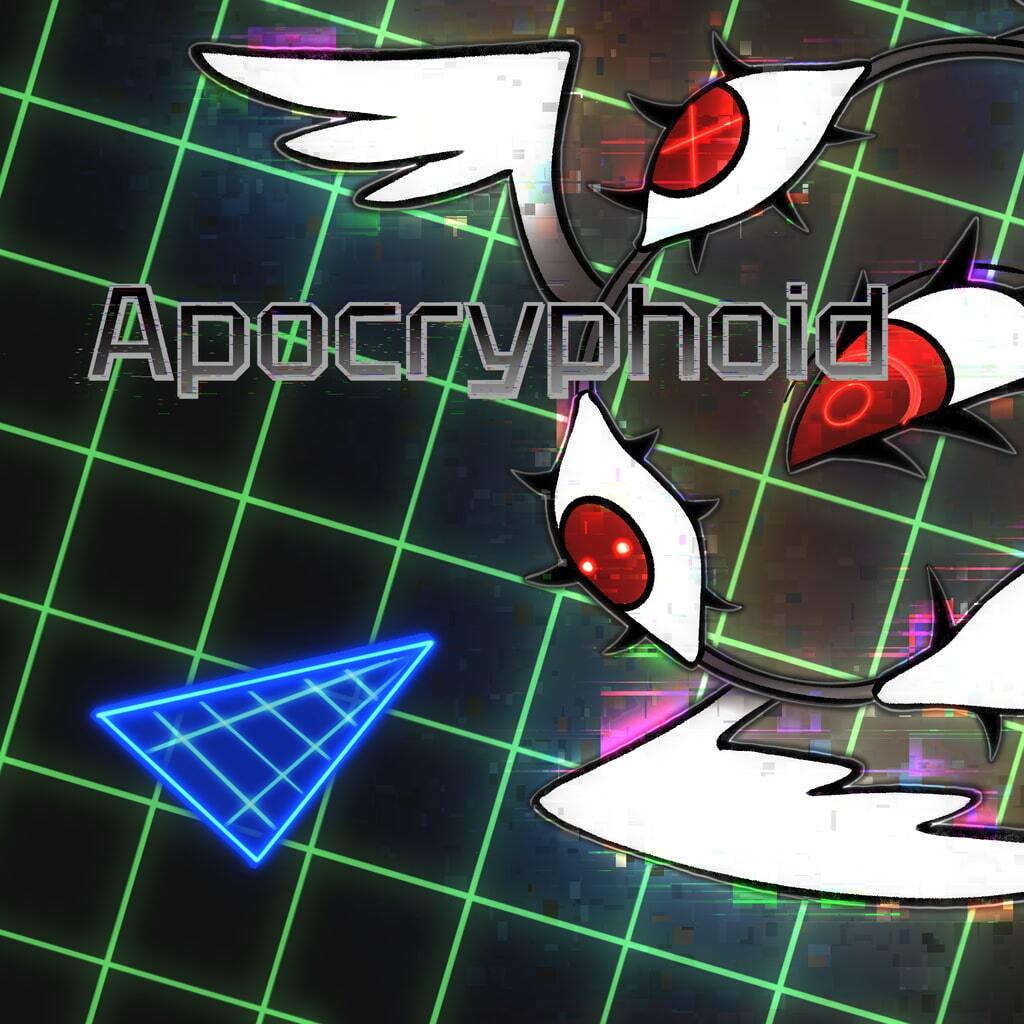
Bullet hell shooters often feel like conversations with chaos—arguments conducted at high velocity where survival depends on reading patterns faster than your own heartbeat. Apocryphoid, the latest from indie outfit Xeneder Team, frames that conversation in a strikingly strange setting: the afterlife rendered as corrupted cyberspace, where you exist not as flesh but as a digital spirit battling something called the Angel Virus. It’s a premise that sounds like a lost late-90s anime OVA, and fittingly, the game embraces that same mixture of melodrama, abstraction, and raw arcade intensity.
What emerges is a focused boss-rush shooter that trims away excess fat to reveal a lean, challenging core. No sprawling levels, no filler encounters—just you, ten towering adversaries, and an ever-thickening curtain of neon death.
A Purgatory of Circuits and Halos
The narrative is delivered with minimalist strokes: after death, consciousness awakens inside a fractured network where angelic programs have turned hostile. The concept functions more as atmosphere than story, but it’s effective. Menus flicker like corrupted terminals, bosses resemble cathedral statues melted through a GPU, and the soundtrack hums with ominous synth-choir hybrids.
Xeneder Team clearly understands that in a bullet hell, mood must be communicated instantly. The visual language—glitch effects, stained-glass lasers, and shimmering halos—gives each encounter a spiritual unease. You’re not simply dodging projectiles; you’re slipping between verses of a hostile digital scripture.
Ten Trials by Fire
Structurally, Apocryphoid is unapologetically old school. The campaign consists of ten primary bosses followed by an unlockable secret encounter that promises a “better ending.” Each fight is a self-contained gauntlet with multiple phases, evolving attack patterns, and escalating aggression.
The design philosophy favors clarity over spectacle. Projectiles are bright and readable, hitboxes feel honest, and patterns telegraph their intent without becoming predictable. Early bosses teach fundamentals—streaming, micro-dodging, baiting—while later ones remix those lessons into fiendish mosaics. By the seventh or eighth fight, screens bloom with intersecting geometry that feels impossible until, suddenly, it isn’t.
Controls are crisp, offering the expected precision movement and focus mode. There’s a satisfying weight to your craft, a sense that survival is always just within reach if your hands can keep pace with your nerves.
Upgrades with Purpose
Unlike purist shmups that rely solely on player skill, Apocryphoid layers in a modest upgrade system. Defeating bosses grants currency used to enhance firepower, movement, or defensive options. These improvements never feel like crutches; rather, they allow personalization.
Do you favor raw damage to shorten phases, or mobility to thread tighter patterns? A few upgrades introduce risk-reward mechanics, such as boosts that amplify damage while increasing your hitbox. Experimenting with builds adds replay value and softens the difficulty curve without undermining the genre’s demanding spirit.
Still, the game remains primarily about execution. No amount of upgrades will carry you through the late game without learning the choreography. Xeneder Team walks that line gracefully.
The Language of Bullets
Where Apocryphoid truly earns its wings is in boss design. Each enemy embodies a distinct theme: one floods the arena with rotating rosaries of light; another summons mirror images that echo your movements; a later monstrosity writes glyphs across the screen that detonate like digital scripture.
Patterns feel authored rather than random, conveying personality through geometry. You begin to recognize “sentences” in the bullet language—intro clauses, deceptive commas, violent exclamation points. Mastery becomes an act of translation.
The secret boss deserves special mention. Unlocking it requires meeting performance conditions across earlier fights, and the encounter repays that effort with a multi-movement duel that pushes every system to its limit. It’s the kind of challenge that inspires shaky hands and triumphant laughter.
Presentation: Rough, Reverent, Effective
As a small-team project, the game shows occasional rough edges. Backgrounds can appear sparse, and some visual effects blur together during peak chaos. A few audio loops repeat more obviously than ideal, and story elements remain tantalizingly vague.
Yet these shortcomings are outweighed by confident art direction. The fusion of religious iconography with cyberpunk decay creates a memorable identity, and performance remains smooth even when the screen resembles a shattered kaleidoscope.
Quality-of-life features help too: practice modes, phase select after clears, and adjustable difficulty modifiers respect the player’s time. Leaderboards encourage score chasing, giving arcade purists something to chew on long after credits roll.
Difficulty, Faith, and Flow
Make no mistake—this is a hard game. Newcomers to bullet hells may find the opening hours punishing, and the lack of traditional stages means there’s little downtime to breathe. The experience is closer to a sequence of final exams than a semester of classes.
But for those attuned to the genre’s rhythms, Apocryphoid delivers that elusive state of flow where terror melts into elegance. Minutes disappear as you learn to trace safe routes through impossible storms, and victory feels less like winning than like harmonizing with the machine.
Final Judgment
Apocryphoid doesn’t reinvent the bullet hell, but it refines it with conviction and style. By focusing on boss design, clear mechanics, and a haunting digital-spiritual aesthetic, Xeneder Team crafts an experience that respects the genre’s traditions while carving its own identity.
It’s short, sharp, and intensely replayable—a cathedral built from code and gunfire where devotion is measured in dodges per second.