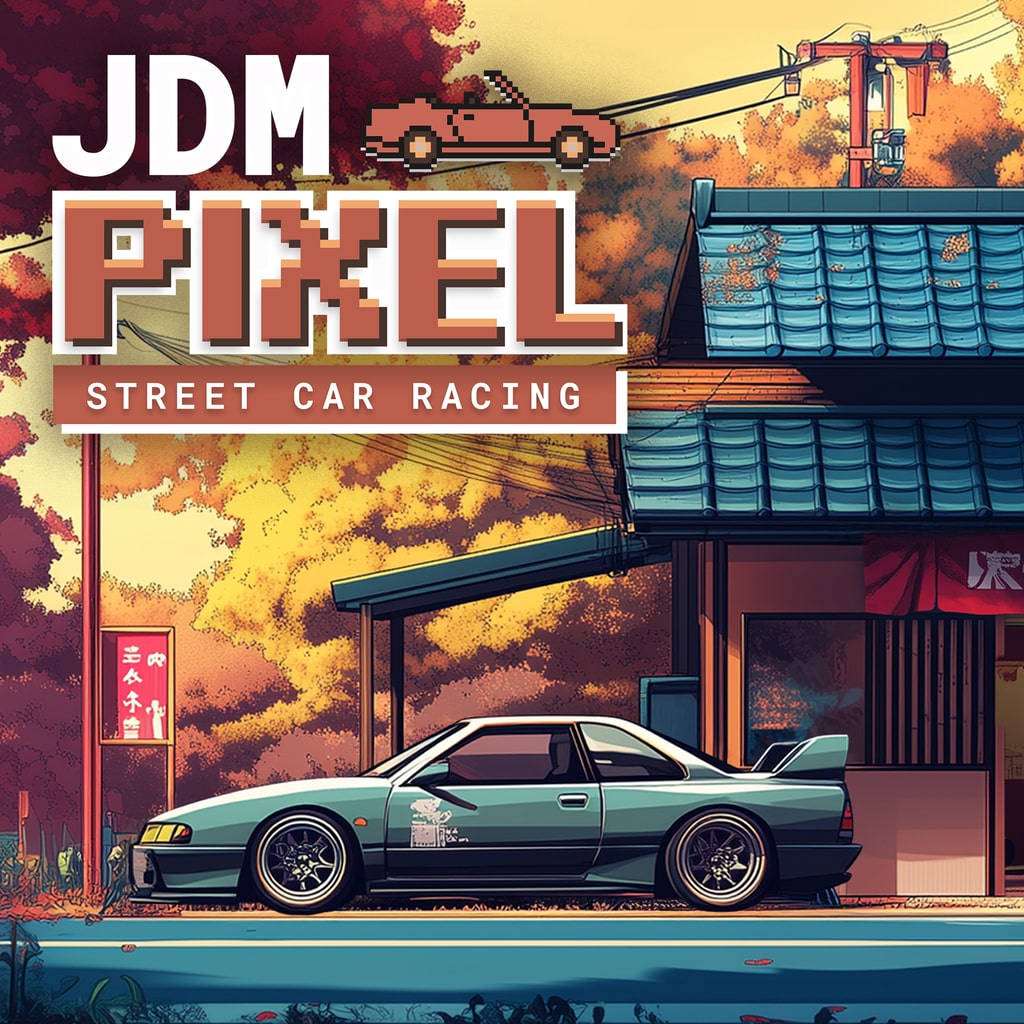
There is something inherently appealing about pixel art when it is applied with purpose, particularly in genres traditionally dominated by visual excess. Racing games, in particular, often chase realism to the detriment of clarity and immediacy. JDM Pixel Street Car Racing takes the opposite approach, embracing a deliberately retro pixel aesthetic while grounding itself firmly in Japanese street-racing culture. The result is a focused arcade racer that prioritises drifting, tuning, and style over realism, delivering a compact but enjoyable experience with a clear identity.
At its heart, JDM Pixel Street Car Racing is a single-player arcade racing game built around urban street circuits and a love of JDM tuner culture. You begin with a modest car and work your way through increasingly demanding races, earning currency to upgrade performance parts and visual elements. The structure is familiar, but the execution benefits from the game’s tight scope and clear design priorities.
Pixel Art with Purpose
Visually, the game immediately stands out. The pixel art style is not merely decorative; it actively enhances readability. Cars are clearly defined, tracks are easy to parse at speed, and environmental details never overwhelm the action. Neon-lit cityscapes, industrial zones, and night-time streets provide enough variety to keep the visuals engaging without overcomplicating the presentation.
While the environments lack the depth and spectacle of modern 3D racers, they compensate with charm and consistency. This is a game that understands its limitations and works within them, delivering a cohesive aesthetic that complements its arcade-driven gameplay.
Driving and Drifting Mechanics
Drifting is the backbone of JDM Pixel Street Car Racing, and much of the game’s enjoyment comes from learning how to control your car through tight corners and long sweeping bends. The handling model is intentionally arcade-focused, offering forgiving steering and predictable slides that encourage experimentation rather than punishing mistakes.
When it works, drifting feels rewarding. Linking corners smoothly, maintaining momentum, and shaving seconds off your times becomes genuinely satisfying. However, the handling does show its limitations as difficulty ramps up. Later events demand more precision than the control model sometimes comfortably supports, leading to occasional frustration where success feels slightly inconsistent rather than fully skill-driven.
Even so, the overall feel remains enjoyable, especially for players who prefer accessible mechanics over simulation-level complexity.
Customisation and Progression
Customisation is one of the game’s strongest elements. Players can upgrade engines, suspension, and other performance components, while also tweaking cosmetic details to personalise their cars. This system adds a sense of ownership and progression that goes beyond simply winning races.
The tuning process is straightforward but meaningful. Performance upgrades have a noticeable impact on how cars behave, encouraging players to experiment and adapt their builds to different race types. For a game of this scale, the depth on offer is impressive and reinforces the street-racing fantasy effectively.
Race Variety and Structure
Races are divided into standard street events and drift-focused challenges, each testing different aspects of your driving skill. Track layouts vary enough to avoid immediate repetition, but the overall structure remains fairly simple throughout.
There is no elaborate narrative or branching career mode here. Instead, progression is linear and functional, moving you steadily from one event to the next. While this keeps the experience focused, it also limits long-term engagement. Once the core loop is understood, the game relies heavily on player enjoyment of drifting and tuning to maintain interest.
Audio and Atmosphere
Audio design is serviceable rather than standout. Engine sounds and tyre squeals do their job, reinforcing the sense of speed without drawing attention to themselves. The soundtrack supports the retro street-racing vibe adequately, though it is unlikely to leave a lasting impression.
The overall atmosphere succeeds largely because of cohesion. Visuals, audio, and gameplay align well enough to sell the fantasy, even if none of the individual elements push technical boundaries.
Verdict
JDM Pixel Street Car Racing is a focused, stylish arcade racer that understands its niche. Its pixel art presentation is clean and effective, its drift-centric gameplay is engaging, and its customisation systems provide a satisfying sense of progression. While the handling can feel inconsistent at higher difficulty levels and the career structure lacks long-term depth, the game delivers a solid experience within its intended scope.
For players who appreciate retro aesthetics, accessible racing mechanics, and JDM-inspired tuning culture, JDM Pixel Street Car Racing offers an enjoyable, if modest, street-racing experience.